Sunday, May 10, 2009

Twitter - winning the war against eloquence


Having had a lot of time off from blogging, I'm even more out of date than usual. Some months ago, after listening to a radio segment about Twitter, I wrote the following, and since then Twitter seems to have taken over the world. Of course, it seems to be essentially a networking vehicle, and I'm the world's worst networker, and a completely isolated, pathetic soul. Anyway, here's my piece, for my own amusement.

Being a dweller in the most pathetic Beckettian solitude, I'd never heard of Twitter before this morning, when I listened to a Radio National program called Future Tense - more moderne than moderne.
According to the program's hype, Twitter is rapidly replacing Facebook etc as the latest thing in networking - not exactly my forte.
A very brightly speaking young gent was interviewed, and he enthused about the level playing field that Twitter is - largely because all communications are limited to 140 characters. The advantage of this, according to our interviewee, is that eloquent people - this is the term he used - don't have an unfair advantage. You begin to get a sense of why it's called Twitter. He also pointed out that [presumably articulate] people don't get a chance to hijack the space and 'debate politics' or some such subject.
So, lpf or lcd? What do they actually talk about on such sites? I'm sure that, at a pinch, you can say something substantial with 140 characters, but why do I get the impression that the push is against substantiality? That Twitter is a dumbing down of Facebook which is a dumbing down of Blogging which is a....
I know it's nowhere near as linear as this, and that imposing restraints can sometimes lead to greater creativity, but really the move is not towards greater creativity but towards more bums on seats. A democratisation which has its downside. I can well imagine that the next great networking service might be Twitch, in which those who can't read or write will also be included [it could even be used to bridge the language barrier by simply eliminating language, or creating a new universal one, in which each touch of the keyboard represents a gesture or emotion. We can all Twitch, and someone will be Twitching all the way to the bank. Good luck to them.

Labels:

Tuesday, December 30, 2008

various weighty matters

zebras and their hooves

I hadn't visited the bonobo handshake blog for a while, and was happy to find it still going strong, and moved as always by those fascinating beasties. I'd heard that the fierce fighting in the Congo was wreaking havoc, as if bonobos didn't have enough to contend with, but at least the principal bonobo habitat, in the central region, is away from most of the fighting. Still there are scads of hungry desperate soldiers hunting throughout the whole country. 

Wish I had the money for a t-shirt or two.

Pronunciamento: when the army, in those countries where the army stands pretty big in its boots, illegally proclaims a lack of confidence in the prevailing government, setting the stage for a military coup. In expansionist Japan in the thirties there was a pronunciamento mood against the more cautious governments of the day, but more in the junior ranks of the army than among the top brass. 

Yesterday we visited the airport in an attempt to farewell my favourite six year old, who was taking her broken arm with her back to Mount Gambier. I was armed with a video camera, and carried too a little talking zebra she got from MacDonalds [not the farm] and left at my house, after painting its white hooves black [because that was the colour they should be, according to Her Certitude]. I have a funny relationship with airports. Because I've never flown in my adult life, never having the money for a ticket, they're like places where the other half live, though the other half looks more and more like myself. 
We kept telling ourselves we had plenty of time, which meant that we were running terribly late. We stopped at a post office for some reason, and then when we got there, we got into a confusion as always, finding ourselves precious minutes away from where we wanted to be. Then tried to find the Rex airlines departure area. We found the arrival area, and nobody to direct us, so we walked thousands more steps  until we found the departure area, which seemed to be immediately above the arrival area. By this time we were realizing it was going to be too late, and she was very apologetic, and I was cursing the awfulness of airports that I didn't belong to.
I love that girl so much. I'll ring her today.

From tomorrow plastic bags will be banned in South Australia. I'm not sure if the general public is ready for it, I have plenty of carry bags here but I keep forgetting to keep them in my car. I'll put them in right now. 

My weight, precisely measured at the right time of day, is 81.1 kgs. Today I'm restarting with CSIRO, volume 2. I did 5 kms on the exercise bike before 7.30, followed by a brief walk. If only I could keep it up, but do I ever? The boy is away for a few days over new year, and that's much relief. 


Labels: ,

Monday, December 29, 2008

on christmas, shopping, books, poverty and being alone


I get less Chrissie presents each year, as the number of people who like me, or even acknowledge that they know me, continues to dwindle. So I only managed one book, but it does look like being v interesting. It's called The Kiwi's Egg, by David Quammen, and it's all about Darwin and natural selection. Now that we're almost into the big Darwin celebration [2009 is the 200th anniversary of his birth and the 150th anniversary of the publication of The origin of species] I feel a spate of evolution blogging coming on.

There's a fine Darwin quote on the back cover of my new book. I cannot persuade myself that a beneficent and omnipotent God would have designedly created parasitic wasps with the express intention of their feeding within the living bodies of Caterpillars. Such a typically polite, and fastidious, demurral. Wonder why he chose to capitalize caterpillars along with god.

It might be a while before I get started on that book, I'm reading a half-dozen of em at present, including two on the natural selection theme, the Wallace bio and The blind watchmaker. 

When Vestiges of Natural Creation, a speculative, anonymous work which claimed an evolutionary link between monkeys and humans, was published in 1845 it caused a sensation and made this kind of speculation quite the popular thing. Price Alfred read it aloud to Victoria, and two other interested readers were Charles Darwin and Alfred Russell Wallace. Darwin, whose ideas on the mechanism of evolution would have been quite advanced by this time, called it 'that strange, unphilosophical, but capitally written book', and wrote to a friend that the author's 'geology strikes me as bad, and his zoology far worse' [the book failed completely to provide an explanation for the evolutionary process it promoted]. Wallace was only 22 at this time, and without any field experience as yet, and his response was not surprisingly, more enthusiastic:
I do not consider it a hasty generalization, but rather as an ingenious speculation strongly supported by some striking facts and analogies but which remains to be proved by more facts & the additional light which future researches may throw up on the subject - It at all events furnishes a subject for every observer of nature to turn his attention to; every fact he observes must make either for or against it, and it thus furnishes both an incitement to the collection of facts & an object to which to apply them when collected -
I would observe that many eminent writers give great support to their theory of the progressive development of species in animals & plants.

It would seem that the time for developing a detailed and fruitful theory of the evolutionary process was just about ripe. 

Ikea effect: You picture your home as an experimental laboratory, full of new-fangled desks, utensil racks, ergonomic and elegant chairs, trim bookshelves. You will entertain like never before. You feel part of a just-so material world, appreciative and ready to be appreciated. You go home full of the future, having bought a $2 lint remover. 

Labels: ,

Friday, December 26, 2008

a basic matter


While watching the pleasant movie Ever After, featuring a younger Drew Barrymore as a Cinderella figure in cahoots with Leonardo da Vinci, we heard a joke about cleaning some queen-like figure's throne, which led us to speculate about toilets in the time of da Vinci, and also about how the Romans did it. 

 The Romans improved greatly on the Greeks re sewerage. Some of their sewers are still being used. They had public toilets which housed many people at once, as shown. The picture is from Ostia, Rome's harbour city. They seem not to have been partitioned off, and I don't know if they segregated men and women. It isn't clear whether the Romans squatted or sat at these toilets, but they were probably raised from the ground more for sanitary reasons than for ease of sitting. The sewerage, washed away into rivers by aqueducts, wasn’t treated of course, Romans had no such technology nor would they have seen the reason for it, not knowing anything about bacteria. No toilet paper, instead citizens used a communal sponge, washed after each use.

 One authority has claimed or calculated that Rome had some 144 public lavs in the later empire. They were generally connected to public baths, and would have been utilized by most of the population, except for the poor who couldn’t afford the public baths. The poor relieved themselves in chamber pots, which were emptied into vats under the stairs, which in turn were emptied into cesspools located around the city. Lead pipes connected to the aqueducts provided running water for wealthy homes.

 The excavations at Pompeii have provided invaluable info on Roman plumbing. They found that most houses were fitted with taps, and waste was piped away into sewers and trenches. I’d be very interested to see a picture of a Roman tap, or a surviving example to compare to modern types. Lead piping was used in the Roman area and the Western Mediterranean, and ceramic piping [developed by the Greeks] in the east.

The public lavs, which seemed to be popular hangouts, used buckets or containers, calleddolia curta. These were collected by fullers, who used the urine to clean laundry [because of the ammonia]. Clothes washing wasn’t a regular thing though. They seemed to be more tolerant of smelly clothing than smelly bodies.

 The Oxford Handbook of Engineering and Technology in the Classical World looks like a great place to start [and finish] as regards this sort of thing, but what about the da Vinci era?  

Leonardo da Vinci lived from 1452 to 1519. We know that the collapse of the Roman Empire led to a degeneration of sanitation in subsequent centuries. For example flush toilets were, amazingly enough, first used in the Indus Valley civilization as long ago as the third millenium BCE, and the Romans also used them, but the technology was lost for centuries. The flush toilet was rediscovered or redesigned by John Harrington in the 1590s for the use of Elizabeth I [she didn't like it, it made too much noise]. It didn't take off in England but was adapted by the French, for limited use. From the eighteenth century, a number of modifications and design features led to the development of a recognisably modern toilet. The plumber Thomas Crapper is often associated with the flush toilet, but he was more of a promoter and manufacturer, flourishing in the late nineteenth century. Our crap doesn't come from the name, instead it's a delightful case of nominative determinism. So to get back to da Vinci, the thrones of those times wouldn't have flushed, and presumably the contents of these thrones would've been dealt with by the servants [in the case of the rich]. The nightsoil man doesn't seem to have been a feature of towns until the eighteenth century. 

So there you go. A very patchy history.

Labels:

Monday, December 08, 2008

wee escapades and intimations of mortality


I'm somewhat exiled from my second family these days, so I heard with horror yesterday that my fave girl, six-year-old Courtney, has been in the wars again, having broken her arm during a family party. I was at Sarah's for a co-op bbq, and she told me that the day before, the intrepid girleen had been jumping off a wardrobe into a portacot, showing off to some younger kids, when the greenstick fracture occurred. Her screams were impressive, apparently, and they no doubt scuppered the party. 
About eighteen months ago, Courtney was playing with a friend in a field near Mount Gambier. There had been a campfire, and the ashes were still smouldering. Courtney tripped and fell, landing with her forearms in the hot cinders. 
Courtney now has her arm in a cast, which she's enthusiastically getting everyone to sign. I will see her in a day or two, I hope. Unless something thoroughly unforeseen happens, she'll make a full recovery. When she was burned before, people weren't quite so sanguine about it, burns being much more iffy injuries. There was talk of skin grafts, permanent disfigurement. She was flown from Mount Gambier to Adelaide, I think with the Flying Doctor Service, charming the socks off the medical staff along the way. She received excellent treatment, and again made a full recovery, not a trace, or barely a trace, remaining. 
Naturally there has been much talk of the resilience of children, and there's plenty of truth in that, but Courtney is also a child of good fortune being an Australian, twenty-first century girl. 
The other day, I read an intriguing article in Cosmos magazine. Its theme was that human evolution may have come to a halt, because we have reached the stage of a 'grand averaging'. As part of the argument, geneticist Steve Jones points out that 
In Shakespeare's time, two out of three babies were dead before they were 21. In Darwin's day, just half of them were dead. Today, that's down to just one percent. That's a great achievement in the developed world, but for evolution it means that there are no differences in mortality to the age of reproduction, and therefore no material for natural selection.
This is just a hint of Jones's elaborate and really quite compelling argument, and I hope to reflect further on this stuff in a later piece, but for now I want to focus on the accident-prone and fortunate Courtney. 
In those earlier times of high child mortality, it was not unusual for women's pregnancies to reach into double figures, to try to ensure the survival of the one, two or three children that women choose to limit themselves to today, with the expectation that all will be bouncy happy and healthy. And that situation would've pertained not only in Shakespeare's time, but for centuries and millenia before that, leaving aside the odd enlightened ancient civilisation. In fact, Courtney's campfire accident prompts me to imagine the earliest days of homo sapiens, when campfires were de rigueur, and the risk of getting burnt in the family or tribal fire might well have been the most serious and frequent one faced by toddlers. How would an accident like Courtney's be treated then? Maybe they kept a few tried and tested balms in the cave. Maybe they licked their wounds a lot. Maybe, after a few hours of moaning and groaning, they'd get sick of the child and cuff her out of the way. Certainly there would be largely unconscious calculations as to how much time and effort they'd spend on the hurt child, what with all the other mouths to feed and survival tasks to undertake. Quite possibly, if the wounds began to fester, they'd dispose of her over a cliff or with a heavy rock. More likely, they'd simply abandon her when it came time to move hunting grounds. 
Broken limbs, the result of climbing accidents or tribal or familial infighting, would have been commonplace of course. Courtney's greenstick fracture might've been treated with a splint of sorts, and she would've survived, misshapen but not horribly so, especially considering that few of her fellows would've escaped intact from various tumbles and spearings and bludgeonings. That was life, but not as we know it. Today we expect miracles, and get them every day. If not, there'll be hell to pay. 
So I look forward to signing that cast and hearing her tell of her latest little escapade.


Labels: ,

Wednesday, December 03, 2008

The Life


Sex has always been a major theme of my writing, though I've generally hived it off to other spaces, such as here and here. Yet I'm not comfortable with erotic writing. Much of it is boring to read, and as a purely theoretical libertine, I've not had much experience to write about. I'd be a bit worried, imagining anyone ever read my stuff, about ending up in the bad sex writing columns. The real point is, though, that I'm interested in real sex, from a scientific/anthropological/psychological perspective, rather than fantasy, though I fantasise often enough. From this perspective, In My Skin, Kate Holden's honest and very informative memoir of her experience as a prostitute in Melbourne, is a real find. 
Holden's story is one of slipping into heroin addiction with alarming ease, and then gradually moving into the seedy world of sex in parked cars to pay for her habit, before moving up into safer and generally healthier brothel environments. I haven't finished the book, but presumably she has traded on her writing skills to finally kick the heroin habit and to generally 'go legit'. I don't know that I'm looking forward to the last part of the book, which inevitably will be about the pain of withdrawal from a drug she uses, at the point I'm at in the book, twice a day, sending more than a small fortune, by my standards, through her veins. And a very hard-earned fortune too.
Needless to say, the drugs side of this story interests me much less than the prostitution side, yet they're tightly related, and though I can't quite identify with being in that space myself, I've certainly known and lived with drug addicts [and struggled to tolerate them], and Holden's account is very matter-of-fact on the guilt, the desperation, the euphoria and the tedium of that lifestyle. Maybe it's all been said before, but in fact every situation is different, and Holden always come across as honest and likeable, and somehow a survivor. Her account is tight, completely unromantic and without self-pity, and very absorbing. 
In the past I've tried to write about being a prostitute, the ultimate in cheek really for a male who's had little experience of sex of any kind, let alone as a woman paid to have her body invaded by strangers young and old, drunk and sober, beautiful and ugly, fat and skinny, smart and stupid, kind and brutal, bold and timid, smelly and sweet. La putain, c'était moi, and I imagined myself a very attractive woman, witty and realistic, out to make a solid living to set herself up, and finding herself in various awkward, amusing and scary positions. I hadn't really thought it through more than that, but I've always been strong on charcter and weak on plot. What always weighed heavily on me with this project was that this was essentially a male fantasy, of the woman who gets into prostitution by choice rather than necessity. At the same time I didn't want my character to get into the life as the stereotypical junky - stereotypical because so sadly common. I could have made such a character sympathetic, but I didn't think I could make her interesting enough to myself to keep me at it. I wanted her, of course, to be a version of myself, a dilettante who was at a loss as to how to make a living. So she decides to trade on her looks, going in with eyes wide open, knowing there's going to be many awful moments and awful people, and resolved to be professional on all occasions and to savour the occasional sweet-faced boy or seasoned lady's man. 
I abandoned the project after a few attempts, though not without contemplating a job in the industry. I discussed with someone I knew the possibility of working as a driver for her - taking girls to assignations. I didn't have a very reliable car at the time, so I didn't pursue it...
Anyway, Holden's book will feed into my Confessions of a theoretical libertine somehow, I'm sure. I'd love to meet her... What stories she could tell, what laughs we could have...
    

Labels:

Thursday, November 20, 2008

drifting and gospel dating

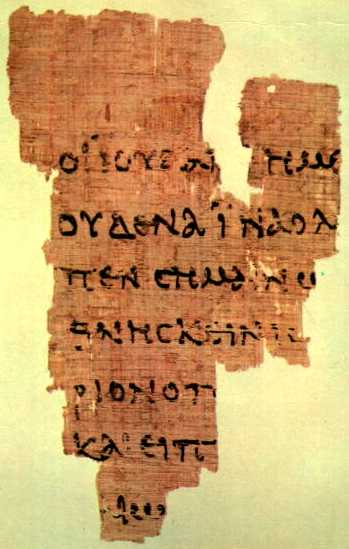
P52

Currently suffering a touch of emotional and intellectual drift and sadness, which often happens.

Via Pharyngula, I've been listening to a talk by the atheist biblical scholar Hector Avalos. In it he showed a papyrus fragment of New Testament MS, the earliest dated fragment, called P52, which he mentions as dating from around 125CE. The purpose of showing this evidence was to underline the fact that we have nothing whatsoever from the time of Jesus to prove his actual existence. It interested me, though, in terms of addressing again the dates of the gospels. This fragment is from John, which I seem to recall is generally agreed to be the last-written gospel. In fact, according to this site, the fragment's dates are estimated as between 125 and 150CE. It has not been carbon dated, according to Avalos, it has only been dated through paleography [hand-writing]. However, though there are no other extant manuscripts dating before the third century, the gospels are dated according to the events recorded within them [eg the destruction of Jerusalem in 70CE, apparently prophesied in Mark, possibly because it had already happened], and according to their political treatment of the Romans and the Jews [there were obviously great tensions between them both before and after Jerusalem's destruction], as well as the use of Latinisms and other possible markers. Scholars are generally agreed that the writing of Mark, the earliest gospel, falls between 65 and 75CE. 

Avalos is keen to cast doubt on the very existence of Jesus, which is very easy to do. He says in his talk that the name Jesus isn't mentioned in fragment P52 - though he doesn't deny that it's a genuine fragment of John. The above-mentioned site gives a translation [the MS is in Greek] which, through reconstruction of the missing words, mentions Jesus and Pilate a number of times [both sides of the papyrus are written on]. It was discovered in Egypt, which suggests, well, nothing much more than the gospel had spread to Egypt by that time.

Another, smaller and older fragment, 7Q5, from the Qumran caves, is purported to be from Mark, but the evidence is very doubtful.  

I happen to have been reading a bit on anti-semitism lately - first, only sketchily, in Rebecca West's book, in which she merely points out William Joyce's anti-semitism, but more powerfully in Niall Ferguson's The War of the World, which looks at all the cultural, economic, imperial and other forces swirling around in the first half of the twentieth century. Amongst all that is European [and American] anti-semitism and its role in WW2. And I'm also reading Rome and Jerusalem: the clash of civilisations, by Martin Goodman, which focuses primarily on the destruction of Jerusalem by the Romans, its causes and consequences. The book has a brief epilogue entitled 'the origins of anti-semitism', which I read this morning [though I've only read a fraction of the book itself]. 

So there's always material to write about, to keep depression at bay. 


Labels: ,

Wednesday, November 19, 2008

impudicitia

Fiona Patten, Sex party convenor

The birth of the Australian Sex Party is something to celebrate, though I'm not expecting it to sweep the scene. I think though that we've reached the stage, even if it's only due to an increase in diversity, that we can seriously, if not too seriously, use the sex word in the title of a political party. Its stated aim, or one of them, is to counter what it sees as the growing influence of religious groups as lobbyists, and of Family First as an essentially Christian conservative party. The influx of Moslem immigrant groups, and other religious immigrants, might also be a concern regarding the maintenance of a truly secular polity. I'm hoping that secularism and the promotion of a sexually healthy and more open society can find common ground to work within.
I note that sex education, for example, is on the ASP agenda, and having noted the appalling response to a more inclusive attitude to homosexuality from the arch-conservative religious school of one of my previous foster-kids [who just happened to be a confused young homosexual], I feel strongly about defending a secularised, inclusive sex education system.

There are many focus issues, even if they're not so high on the agenda now that the economic crisis is carrying all before it. Sex education, abortion, gay marriage, the puritanical [and killing] conditions attached to overseas aid, censorship, the funding of religious schools and institutions, issues around prostitution and pornography, sex discrimination, sexual health issues, drug laws and other civil liberties issues, to name just a few broad areas. The whole idea of this party - the only sex party I'd ever have the chance of being invited to, I suspect [as an overweight, middle-aged single male] - is quite rejuvenating, and I'd quite like to get involved as more than just a member. I've bookmarked the site and I'll pay a membership fee and I'll email them re volunteering. I have writing skills to offer, at least. Of course I might have to tread carefully as a foster carer who receives, in that role, considerable support from a religious charity, though they've never mentioned religion to me and I doubt that all their workers are True Believers. Still, combining foster care with libertine causes might make for a tough juggle. 

I've already spoken of this stuff to my current foster kid [who's seventeen and about to fly the coop] and we discussed a couple of the issues, namely gay marriage and abortion. On abortion, he thinks it shouldn't be freely available, but only under certain conditions, such as not having the funds to care for a child, or being too young, or too old... and he also thinks the father of the child should have a say. Like most teens, he puts his finger well on the general dilemmas but hasn't thought through the details, the implications for each particular case ... but then he finished with the view that each individual case should be taken on its merits, which is fine but it doesn't take us too far. The whole discussion made me aware how little I know about what happens when a woman presents for an abortion. Presumably she has counselling choices but may not take those options. Presumably the father doesn't rate a mention? There are quite a few ethical issues kicking around just there. 

The lad also argues that gays shouldn't be allowed to be married, because marriage is a Christian ceremony and the Bible's dead against homosexuality. He's dead against the Bible himself, but he somehow seems to feel that if you're gay you wouldn't want to be married, or a Christian, because of Biblical injunctions against homosexuality. I pointed out of course that there were many homosexual Christians and that marriage isn't just a Christian tradition, and of course he said he knew all that... and he modified his view to allow at least civil gay marriages, which are presumably outlawed still by the current Federal government. Again I felt that I should bone up on the issues. Earlier this year, Federal Labor worked on reforming all they could reform re discriminatory legislation around gender and sexual orientation, but they stopped short of giving gay marriage the go-ahead. Why? What was their rationale? How instrumental was the Christian Rudd in this decision? And as to the reforms, have they now passed through both houses and become law? 

There are plenty of other issues to investigate and monitor. There is apparently a strong will within this Federal government to overturn the Harradine-inspired policy which ties overseas aid funding to an anti-abortion message, but it hasn't happened yet. And then there's this proposed internet filter...

This article on the Harradine policy is an online version of one I read yesterday in a doctor's surgery. Possibly a bit sensationalist, but not bad for a fashion rag, I thought. 

Hopefully I  can make a real connection with this party, but I'll have to change my shy ways. Apparently they're launching the new party at Melbourne's Sexpo, and I've never been able to dig up the courage to go to one of them....

Labels: ,

Monday, November 17, 2008

recessional


Historian Niall Ferguson describes it as Kipling's finest poem, and of course its still-puncturing refrain still lives on. The god message doesn't move me, but something does, in this remembering, collapsing time 


God of our fathers, known of old--
Lord of our far-flung battle line--
Beneath whose awful hand we hold
Dominion over palm and pine--
Lord God of Hosts, be with us yet,
Lest we forget--lest we forget!

The tumult and the shouting dies--
The Captains and the Kings depart--
Still stands Thine ancient sacrifice,
An humble and a contrite heart.
Lord God of Hosts, be with us yet,
Lest we forget--lest we forget!

Far-called our navies melt away--
On dune and headland sinks the fire--
Lo, all our pomp of yesterday
Is one with Nineveh and Tyre!
Judge of the Nations, spare us yet,
Lest we forget--lest we forget!

If, drunk with sight of power, we loose
Wild tongues that have not Thee in awe--
Such boastings as the Gentiles use,
Or lesser breeds without the Law--
Lord God of Hosts, be with us yet,
Lest we forget--lest we forget!

For heathen heart that puts her trust
In reeking tube and iron shard--
All valiant dust that builds on dust,
And guarding calls not Thee to guard.
For frantic boast and foolish word,
Thy Mercy on Thy People, Lord!
Amen.

Labels:

Monday, November 10, 2008

and you get more


ain't drugs

These words affront me every time.
Drugs are not recreational 
Drugs are drugs

And cars are cars and brains are brains and 
stupidity is stupidity and imagination is precisely and
pins are not ever needles and love
cannot possibly be pain, and sex is, 
and a smile is nothing but a smile, please be
clear

a word is only a word but always a word
and that is the word that it is

a dictionary is another word for a liar
and that is a lie 
by definition

We live in narrow times that are always coming to an end
- at least to this little ego


on hubristic claims to custodianship

we must save the planet, I hear
parroted by kids and such
and the Anzacs died to save us
except they didn't
they just beastly died
and our planet isn't dying
but so many of our prey are
and so it goes, and will go
until maybe we all go
to nothing
and the planet will spin on
throbbing and thickening
with life, but not as we know it

Labels:

Sunday, November 09, 2008

three wee poems


the bush

This morning I woke up to rare spring rain.
the thyme had been thinning greying
in the desert front
midst of cobwebs and drooping straps
carelessly dealt with.

With rain it shines and enlivens.
No watering can can compare.
It's all it should be
all of a sudden.

By afternoon dull thiness is back, almost,
for hope's colour just remains
and a tiny trace of body, or mind.


life long learning

Treason, strange word nowadays
in a world of sharing
your secret's with me
your face my book

William Joyce was hanged.
He hated Jews.
That wasn't nice.
his poor parents died before him
which was a good thing

and if he were alive today
ever in his prime
to witness his death and aftermath
and ever after
wouldn't he feel the fool

Time wounds all heels 
and heals all wounds


thank you 

Your music somehow does it

the mood
for spare stark words

I feel precise and languid
warmly human and sans nonsense

a kind of love
disembodied unfortunately
but that has its place
a place that saves


Labels:

Thursday, October 30, 2008

Rebecca West and William Joyce


Rebecca West is a name I've occasionally conjured with. I've been reading her for the first time recently, and before that I knew her by reputation as a sometime lover of H G Wells and a prolific writer/journalist, a fairly formidable figure in English letters in the first half of the twentieth century. When, a few years ago, I was reading up on Serbia and the Balkans, I came across her hefty tome, Black Lamb and Grey Falcon, in a second-hand bookshop, but finally decided against buying it. Now, having almost finished her fascinating book-length essay on William Joyce [aka Lord Haw-Haw] in a collection entitled The Meaning of Treason, I can't wait to write about her and to read more. 
As Wikipedia tells us, West had a very long as well as productive life, dying in 1983 at the age of ninety, and always participating energetically in the issues of the day. Her writing on Joyce shows her to be a shrewd psychologist and a political pragmatist, wryly realistic and nobody's fool. It's a fascinating account of the polical tensions before and after WW2, with communists switching to fascism then switching back to communism, with anti-democratic political ideals holding far greater sway in the west than they do today, and with so many people caught up in the vagaries of family ideology, competing nationalisms and generally divided sympathies. 
William Joyce, for example, was born in the USA to Irish Unionist parents - which, since they were also Catholic, immediately rendered them anomalous. He returned to Ireland with his family as a young boy, where he received a good Jesuit education, proving himself industrious and disciplined. He moved to England as a teenager, and made various attempts to join the military. From an early age he seems to have been drawn to conflict and controversy. He was a rabid anti-semite and when he became prominent in the British fascist movement he emphasised that element in his oratory, polarising opinion on the BUF [British Union of Fascists] and possibly creating tensions with its leader, Mosley. 
Bigotry is an intriguing phenomenon. We know that it's all around us - anti-semitism, racism, homophobia - and we associate it with ignorance, and we find people who espouse  such thinking boring as well as dangerous, but its very familiarity masks its essential mystery - why do people engage in wholesale hatreds based on such flimsy pretexts? How did this way of thinking become so popular as to convulse the whole of Europe for a decade? Why did it attract so many reasonably well-educated types as well as the usual misfits and crazies?

West is ultimately no more able to provide answers to these questions than I could. In any case, anti-semitism was much more fashionable then than it is now, at least in Western Europe. Well, no, not just there, think of the USA, think of the highly respectable Henry Ford and Charles Lindbergh, and the backdrop that made their views respectable. Think too of the emphasis on race and eugenics in those pre-war days.   

Joyce’s hatred of communists was also something of a fashion, but it should also be noted that then as now, the people most consumed with the activities and the danger to society of the extreme left were those of the extreme right, and vice versa. It’s a kind of co-dependence in which each side must necessarily over-value the negative impact of the other. When Joyce was a young man he was slashed by an assailant at a conservative party meeting he was convening. It left him badly scarred. He always claimed the culprit to be a communist Jew. Of course if that were true it might be cause for resentment, but it’s much more likely to have been a convenient fabrication.

West makes much of the issue of class in Joyce’s ambitious make-up. He wasn’t a gentleman – West uses the term with only partial irony – in spite of his educated airs, and Mosley would never have considered him his equal. This seemed to make him more determined than ever to make his mark, and we get a strong sense of someone who feels himself worthy of better things than others are willing to concede to him. He wanted to become a British officer but was somehow blocked in that ambition. As a fascist organizer he was probably more successful than Mosley but was given little credit by him. When he finally left for Germany just as war was about to break out, the Nazis treated him with suspicion and disdain, to such a degree that he almost turned tail for England and incarceration for the duration. When, with great reluctance, he was given his head over more ‘gentlemanly’ broadcasters [the name Lord Haw Haw was transferred to him from earlier, more plummy announcers], he proved to be their most reliable propagandist.

Of course it was a very circumscribed success. Fascism, by its very nature, was always bound for failure, and its spectacular failure and spectacular destructiveness in the thirties and forties has discredited anything like it for a long time to come. Joyce’s broadcasts in any case probably did more good than harm to the British cause. He became a figure of fun but also a rallying point. People tuned into him both for amusement and to try to get a handle on how the enemy saw them, and how they were coping with the war.

West's reportage of the case, her description of the trial process and Joyce's response to it, is wholly absorbing. Her general remarks about treason are more open to question, though. However, my response comes from a time when Western Europe has known decades of peace and stability, and has even formed a union of sorts, with a common currency. Globalism has also played its part in rendering the concept of treason quaint, to some. It's worth having a closer look at West's reasoning in the light of the twenty-first century, and i'll do that next time. 


Labels: , ,

Friday, October 10, 2008

la petite mort


Here's a site to delight if ever there was one. A pity I can't actually watch these videos at present, my internet is on go-slow.

Labels:

Tuesday, September 23, 2008

just quickly


I’ve looked up Poe’s law, provenance unknown – the idea being that no parody of a primitivist/fundamentalist/creationist is ever as good a parody as the real thing, and there’s nothing you can think of writing that is so asinine that nobody will believe it for a moment, in fact it’s likely that many will believe it, for a long time, e.g. Dianetics.  


Heard today of the suicide of David Foster Wallace, a terrible shame. Suffered from depression all his life apparently. I read his essay collection A supposedly fun thing I’ll never do again and raved about it some years ago, then I read The broom of the system and wasn’t so sure, wasn’t so entertained and provoked. I don’t read fiction so much these days I’m afraid. Don’t know if I’ll tackle Infinite Jest. Would probably prefer to take on some more of his essays. What I loved was the freshness and intensity, the energy his work gave me. That sort of thing has a visceral effect. Some have mentioned Rabelais, and believe it or not I thought Shakespeare, who was the dabbest of hands at opening out and freshening up a cliché… it’s so shocking that such a talent can end up in such a space, yet it’s also not uncommon.


On the theme of depression, I know it well, though it has never quite managed to drag me to such deeps. On today’s radio, a visually impaired visual artist spoke of his half dozen simple tasks a day to ward it off, and of his sex life void. At least he has an excuse of sorts, though I’ve found an excuse too, in attachment theory – I have a fearful attachment style, masked by a dismissive attachment style, or vice versa.


On Wallace, incidentally, read this honest if unspectacular obit – and then read the truly dipshitted comments. What roisterous larry-kins these Americans be.

Labels:

Sunday, September 14, 2008

Plugging in


google - written in the clouds

So much to keep track of outide of our teensy-weensy circle of life. Google is raising concerns and excitement with its cloudy new super-browser, Chrome. The Beta version of this open source browser was launched a few days ago, that’s September 2 I think. I don’t know much about what a Beta version is, or if a Beta version or a non-Beta version is more suitable for me, but I’m interested in the whole idea. I’ll explore it more fully later. That’s to say, I’ll wade just a tiny bit deeper into the shallows.

The Large Hadron Collider is also naturally making news, and highlighting the ignorance of many of us re physics and its significance in our lives. Not that all of those warning of the dangers of the LHC are ignorant. There’s apparently a genuine concern among some theorists that the LHC could generate tiny black holes which will eventually expand and gobble up the earth – or something like that. Michio Kaku provides us with plenty of reassurance here.

The role of the US in the extermination of some half a million soi-disant communists in Indonesia in the mid sixties has come under the spotlight with the recent release of damning documents. There’s a useful background to the horror here. Meanwhile, Spring’s freshening things up, and I’m hoping for a bit of rejuvenation meself.

Labels: ,

Sunday, September 07, 2008

Selective Maughamisms


A couple of strange ones from the Maugham short story ‘the Human Element’:

He wore a dinner jacket and a boiled shirt – I think of boiled lollies, which had stripes through them, but no. Here’s a pretty comprehensive description. Shirts that needed to be kept white before washing machines were often boiled in starch, which made them very stiff and no doubt none too comfy. Anyway, sounds as if this one isn’t too strange, and I was surprised that Sarah, my usual consultant on such matter, hadn’t heard of them.

A couple of footmen in the fustanellas of their country – the country being Greece or the Greek island of Rhodes. A fustanella, or foustanelle, is described as a white kilt worn by Greek and Albanian men. Wikipedia has a much more complex description of it history and usage here.

Labels:

Monday, September 01, 2008

slopes


About seven weeks ago I sprained my ankle very badly. This happened a few days after I crashed my car on the way to Victor Harbour [it was the other guy’s fault], so it was a bit of a bad run.

I was walking across the parklands on my way to court, and I was running late. The court case was about my having driven my now totally wrecked car without registration and without ownership being properly transferred. It was a fairly recently purchased vehicle, and I really was quite vague about the paperwork.

I’d just crossed a railway line and was walking along beside a low wire fence looking for a break so that I could get through it without having to climb over, but there was no break in sight. The place was littered with railway bits and pieces, and I came across a small concrete platform abutting the fence. It had a gentle slope to the top, and I thought I might walk up it and jump down over the fence to the other side.

The top line of the wire was just above the floor of the platform so I had to jump up a little to make sure I cleared it. Because I was a little nervous of getting my foot caught in the wire, I jumped up quite high. I had no thought that this jump would cause me any damage, so I was completely taken by surprise by the excruciating pain when I landed on the graveled area on the other side of the fence. The pain and surprise sent me sprawling, my glasses flying off… I sat up and thought hopefully that the pain would subside in a few moments. A month later it was still painful to the touch, and I was still limping.

I made a valiant effort to get up and hobble on my way, but I soon realized that, though clearly nothing was broken, the damage was greater than first hoped. I had to abandon all ideas of getting to the court, and, to cut a long story short, managed to arrange a rescue.

For a week I could barely walk at all, and was very impatient to be healed, noting each daily improvement, trying to calculate how long it would be before things were entirely back to normal. I needed to get to shops, to replenish my supplies and so forth.

I could definitely feel daily improvements, but the foot would throb intensely at the end of each day, because every step I took on it during the day was more painful than the previous step. A night’s rest and I would imagine the foot had recovered – until I put my weight on it. I borrowed my foster-kid’s old crutches, which he kindly adjusted to my size [he towers over me]. It was his only act of kindness, mind you. To get him to help me out with cleaning and cooking during my period of greatest incapacity was impossible. Later, I borrowed Sarah’s walking-stick [a birthday gift from a waggish friend of her son], which was helpful in taking the pressure off my foot, though I refused to use it outside.

About two weeks after the accident [I was of course carless at this time] I made the effort to go shopping, which entailed a walk to the bus stop, and then back with the shopping. However, after a long and tiring struggle to the bus stop, I realized this wasn’t going to work. I was totally exhausted and in considerable discomfort, and the idea of walking back the same way, heavy laden, after traipsing about the shops, rather horrified me.

But it was probably this trip [I’d tried one or two testing ventures outside] that brought me the valuable insight about slopes. I’d already assumed it was a slope that caused my injury. I hadn’t really landed awkwardly, but clearly my left foot had touched the ground before my right, and bore the brunt of my weight when I landed, causing the ankle to squish. The ground had been uneven – possibly even a stone or rock had obtruded. I didn’t examine the ground afterward, but it obviously makes sense.

I’d gone to a local café a day or two before, and noticed that I wasn’t in so much pain walking back as I was walking there. I didn’t work out why until two days afterwards, when walking across a driveway. I felt the pain in my ankle increase, and it suddenly occurred to me that it was because of the slope. My left foot, the damaged one, was on the high side of the sloping driveway, and was bearing more of the weight, suddenly, than my right foot. When we walk, of course, we remain upright, perpendicular to the surface of the earth, regardless of local variations in slope. So when we’re walking on a slope [I mean across one not up or down one], the weight will be more on the foot on the upper side of the slope, and the ratio of that differential load will depend on the angle of the slope.

So when you have an injured ankle, take note of slopes. It’s a bit like bike-riding – anyone who rides a bike regularly will be aware that few roads are completely flat for any great portion of their length. Cyclists know all about slopes. For the injured walker, what you will soon realize is that most footpaths slope down towards the road. Best to walk on that side of the road where the high side favours your strong foot.

Another interesting point is that we walk unconsciously always as if we’re walking on the flat, decelerating quickly our forward-leading foot just before it hits the ground. It’s a bit like the sweet spot when we engage the clutch changing gears. When we’re on a slope, though, we don’t quite adjust that deceleration – that’s to say, we might still be in the process of deceleration when our foot hits the ground. We might even be in the early stage of deceleration, and so we jar our foot slightly. This is barely noticeable when your feet are in mint condition, but when you have a badly sprained ankle you really feel it.

So, God, You gave me a sprained ankle for a reason. How devious and inscrutable is Your wisdom?

Labels: ,

Saturday, August 30, 2008

The Vessel of Wrath


Lanchester's Miss Jones

For all his limitations Somerset Maugham is still a pleasurable read, and a writer we can gain from. I’ve just read ‘The Vessel of Wrath’ from volume 2 of his collected short stories. It was written in 1931 [and in fact filmed in 1938 by Erich Pommer with an impressive cast including Charles Laughton as Ginger Ted, Robert Newton as the Dutch Contrôleur and Elsa Lanchester as Miss Jones, though for some unfathomable reason it was released in the USA as The Beachcomber] and set on the Dutch controlled island of Baru, principal island of the Alas Islands. Nowadays, these islands, just to the west of the Solomons, are part of Papua New Guinea.

There’s a certain datedness in Maugham’s surface style which is revealing as it preserves attitudes and considerations well. Early on in the story, for example, he writes ‘The population of the [Alas island] group is estimated at about 8000, of whom 200 are Chinese and 400 Mohammedans. The rest are heathen.’ It’s an odd and arbitrary division in which Chinese is apparently counted as a religion, but it’s pragmatic enough. The point being that the vast majority of the populace will provide raw material for the missionary work that is a part of the story.

It’s a story of four white people, set against an amorphous background of restless natives, and Maugham tells his story with an eye for detail and a mordant humour that masks a certain remoteness and lack of empathy. The fat controleur and Ginger Ted the scapegrace are in a sense pitted against the humourless Joneses [brother and sister rather than husband and wife] who are missionaries with a bit of doctoring on the side [or vice versa, I’m not sure]. Miss Jones [her first name isn’t provided] is middle-aged and unattractive but strong-willed and competent, much like her brother, yet the more laid-back controleur and even the drunken Ginger Ted have their practical capabilities, and the author clearly finds this pair the more congenial.

Miss Jones might be described as the stereotypical ‘old maid’, disapproving of but obsessed with sex. Having just watched D W Griffiths 1916 film Intolerance, which features middle-aged matronly do-gooders wreaking destruction on those they regard as depraved, I recognise the zeitgeist out of which these ‘types’ are constructed, but Maugham does at least make us feel sympathy as well as a callous amusement at poor Miss Jones’ self-concocted excitation at the prospect of being raped [she finds herself, in a key scene in the story, forced to spend a night on a desert island with Ginger Ted, who has a reputation for sexual depravity]. We might also feel a grudging admiration for the woman’s final sexual victory, when in the end she wins over the former scapegrace, persuading him to at least give lip service to the missionary position.

In the end, it’s a story about sex. Miss Jones imagines being raped by Ted, and when he doesn’t do so but covers her up instead, she’s able to combine the qualities of a gentleman with those of a sexual conqueror, thereby purefying her lustful thoughts, while still retaining them. Not that it’s likely that Ted will remain totally tamed, or that the missionary position will retain much flavour for too long.

The author’s own view is of course not explicit, he speaks through his characters, variously. Some remarks on god and providence, however, struck me as well calculated. Miss Jones and Ted had become stranded on their island [in an ingenious touch Miss Jones insists on consummating their marriage on this same island] when they were off together fighting a cholera outbreak on outlying islands, in which 600 islanders lost their lives. Miss Jones believes, of course, that the Lord’s will has brought them together:

‘Do you think so?’

Í know it. Don’t you see? Except for the cholera Edward would never have found himself. Except for the cholera we should never have learnt to know one another. I have never seen the hand of God more plainly manifest.’

The Controleur could not but think that it was rather a clumsy device to bring those two together that necessitated the death of six hundred innocent persons, but not being well versed in the ways of omnipotence he made no remark.

These kinds of grotesque arguments are still made by even the most supposedly sophisticated of believers, as Dawkins [God Delusion, chap 2, p64] well illustrates.

Labels: ,

Sunday, August 24, 2008

Stengah-shifter


something like this, with buttons?

I’ve come across this term in Maugham’s story The vessel of wrath, set in the East Indies. It was an item of clothing with bright brass buttons. It appears to be something like a shirt, but with no lapels. There’s very little on the net about it.

I’m reading a collection of Maugham stories that I’ve read before. It took me a while to realize this. Something in his style – droning and forgettable. A certain shallow knowingness, to paraphrase Coetzee, though informative about the colonial world and the general feel of the times – eg anti-semitism and class attitudes in Britain between the wars, in Alien Corn.

Labels:

Thursday, August 14, 2008

Something joyously irrelevant


Troian and others decided to head for Vladivostok, so as to reach Italy by sea, and in an epic Anabasis they crossed Siberia

Claudio Magris

Not knowing the word Anabasis – Magris is a slow read, rich with allusion – I’ve just looked it up, opening myself into the wonders of Xenophon and the Ten Thousand. The Greek term anabasis actually refers to an inland journey from the sea, whereas Xenophon’s Anabasis described a journey the other way round, though towards a semi-internal sea, the Black Sea. Presumably that's why Magris has capitalized it, referring specifically to Xenephon's work. Basically, the Ten Thousand were Greek mercenaries fighting for Cyrus the Younger, who was trying to overthrow his brother, Artaxerxes II. They defeated Artaxerxes at the Battle of Cunaxa, but Cyrus was killed, so it was all for nothing, and the mercenaries were trapped deep in enemy territory. They decided to head northward to the Black Sea, abounding in Greek settlements. It was a huge trek, an odyssey of sorts, and they were hounded, harassed and killed by the Persians along the way. Arriving at the Black Sea hardly brought an end to their troubles, but the cry on sighting the sea – Thalatta, Thalatta [aka Thalassa, Thalassa], has rung through the ages. More gilding to the life.

Labels:

pavlov's cat