Monday, May 11, 2009

the end of the journey: chez nous


I've continued reading Journey of the Magi, and sure enough it has only irritated me the more. In this passage he gets more blatant, and ridiculous.

Freedom without divine laws results in, to paraphrase Shakespeare, humanity preying on itself like monsters of the deep; and progress has brought us to the brink of doing to the world what God promised he would never do to it again himself.
First, to exonerate Shakespeare. The beauty, and to some the frustration, of the reflections expressed in Shakespeare's plays is that none of them can be pinned on the bard himself. The words belong to Albany, in King Lear, who mordantly asserts that, without the 'visible spirits' sent down from the heavens to tame us 'humanity must perforce prey on itself, like monsters of the deep' - and yes, he uses the plural, just as Gloucester does when he famously says, 'as flies to wanton boys are we to the gods, they kill us for their sport' - which gives an idea of what he thinks of divine law, a view not dissimilar to that of Mark Twain. King Lear is a pagan play, so what is asserted here about 'divine law' is hard to ascertain, suffice to say that humanity needs taming - something we can perhaps all agree on.
As to progress, that long-suffering whipping-boy, if we define it, uncapitalized, as positive change, or improvement, it reflects a thoroughly human and indispensable striving. The notion that we're on the eve of destruction, going to hell in a handcart etc, is as old as civilization itself, and hardly needs any effort expended on it here.
It might be pointed out, though, that divine laws, whatever they are, are inimical to the notion of progress, because of course they're eternal, as divine stuff tends to be. How can anything which is eternal change? This is, of course, a big problem, bigger than is recognised, for all proponents of 'divine law'. If you think biblical injunctions, or sharia laws, really are divine, then you're stuck with them for ever and ever. Hardly any wonder then that so many experts on divine law, imams and rabbis and so forth, have sprung up over the centuries to 're-interpret' the laws for changing times. Not that they've done a particularly impressive job - sharia law, in particular, continues to be a gross insult to anyone who has any respect for human rights [that construction of miserable, despised human beings].
Of course, there are no divine laws. Roberts should have written 'freedom without laws leads to humanity preying on itself', as, basically, Hobbes asserted. But that would've been way too prosaic, I suppose.

I feel almost guilty about getting stuck into Roberts like this, searching for 'gotcha' moments, or passages. I remember Glenn Gould, the pianist, saying that he gave up concert performances because he felt that the audience was only there to hear him fail, to wait for that 'gotcha' moment when the whole performance might collapse on a bum note. Roberts' book, which he sees as an entertainment, is contradictory, muddled, funny, angry and occasionally inspired. He has apparently written acclaimed reportage on both gulf wars, and he has some of the footloose, rambling quality of a Hunter S Thompson. Also, I read on his website that he has gone blind in both eyes, a fate I don't even want to begin to imagine. Yet I also feel something like a duty to challenge sentences such as the one quoted above. To not let people get away with hazy-lazy religious talk, to show up the emptiness at its heart. Human laws are imperfect, but they're all we have, and if we accept they're always going to be only human, we'll accept the challenge of constantly modifying them. Unlike the mysteriously misplaced ones given to Moses, they're not written in stone.

Labels: , ,

Monday, November 10, 2008

the treason problem


Klaus Fuchs - a bit naive, a bit arrogant

Rebecca West's collection of essays, The Meaning of Treason, is both reportage and meditation. The edition I've been reading was published in 1952 and it deals with the treason of Nazi collaborators such as William Joyce [Lord Haw-Haw] and John Amery, the more or less incompetent founder of the British Free Corps, an organisation mired in haplessness. The later essays, however, treat of scientists who sold secrets to Soviet Russia, including Allen Nun May and the controversial physicist Klaus Fuchs. It's worth noting that these trials were conducted in, and contributed to, an atmosphere of anti-communist paranoia that came to a head with McCarthyism in the USA. 
In spite of the title, I'm not sure that West has come to terms with the concept of treason. Then again, I'm not sure if it's possible to come to terms with it or wholly capture it - it's a slippery and ever-contested concept. West's book is naturally of its time, a time buffeted by the most damaging war, perhaps, in human history. Considering this, West's judgment and those of her contemporaries seem measured and humane enough. Compare the response to September 11 [not an act of treason but yet somehow seen as a betrayal "of our freedoms''], when the tragic and senseless murder of 3000 people was seen as sufficient reason for invading two nations, at the cost of hundreds of thousands of lives, imprisoning countless numbers of their inhabitants, suspending habeas corpus, dispensing with the Geneva conventions, encouraging the use of torture, creating secret prisons and so much more besides. At times like this, when a nation sinks so low, the line between treason and whistle-blowing becomes hard to draw. 
Rebecca West was faced with no such problems when she wrote her book. The defeat of fascism had laid bare all its murderous and nihilistic horror. Communism under Stalin had revealed itself as equally bereft of value. Still, treason isn't really about different systems of governance, it's about your country versus everyone else's. It's about the meaning of ''my country''. It's about patriotism, the flip side of treason.  
In her epilogue to the essay collection, West returned to the central concept, perhaps feeling she needed to sharpen the focus. She began by anticipating Peter Singer's notion of the expanding circle; the self, the immediate family, the larger community of interests... and then country. 
Born and bred in England, he will find it easier to understand the English than the rest of men, not for any mystical reason, but because their language is his, because he is fully acquainted with their customs, and because he is the product of their common history. So also each continent enjoys a vague unity of self-comprehension, and is divided from the others by a sharp disunity...
We can all sense what is being gotten at here, and it raises interesting questions, because it suggests that treason [and patriotism], isn't necessarily about nationhood, but perhaps more about [the betrayal or upholding of] a shared heritage, which may or may not be tied to a nation state. One can imagine being accused of treason against Athens in ancient times, for example, or even of being a traitor to the Aboriginal cause, but to claim someone as a traitor to the European Union seems way too fraught, the ''unity of self-comprehension'' being altogether too vague and too riven with competing allegiances to carry conviction. 
West goes on to say - but I'm oversimplifying, I know - that this simple pleasure in shared heritage has been 'lately' muddied by rationalism, by which
the ardours of patriotism were to be abandoned, and replaced by a cool resolution to place one's country on a level with all others in one's affections and to hand it over without concern to the dominion of any other power which could offer it greater material benefits
I would suggest though, that at all times there have been characters, and more than we might like to admit, who have switched national allegiences as frequently, and often for much the same reasons, as pro footballers have switched clubs. Think of Alcibiades, who worked just as hard for Sparta against Athens as he ever did for his birth state, and then again for the Persians against the Peloponnesians, or Josephus, the controversial adviser to Rome on all things Jewish. In troubled times, the self, the centre of that circle of affections, often becomes paramount. 

To us now, Nazi or Stalinist sympathisers seem beyond the pale for reasons having little to do with treason, unless we use the term in the sense of betraying the whole species. Still, we are able to make concessions – for the Brits of German background caught between two sides, for the hapless, uneducated POWs who joined the British Free Corps in exchange for kinder treatment from their captors, and even, though to a lesser degree, for those leftists who genuinely believed that communism would provide us all with something somehow better.

In an odd passage [she can certainly be obscure at times] West seems to mock and dismiss the internationalism which many would nowadays claim as a basis for shaking off or transcending the quasi-primitive charms of nationalism: 

So the evil moment of fascism came and was clear: not surpassed in evil since the days of the barbarian invasions. The devil of nationalism had been driven out of man, but he had not become the headquarters of the dove. Instead there had entered into him the seven devils of internationalism, and he was torn by their frenzies.

This is more sensationalist than illuminating, but West seemed to believe that this internationalist spirit was a product of a rationalism more dangerous even than the misguided nationalisms that had so recently damaged Europe, and the sphere of Japanese adventurism. It was defeated, she claimed, by the simple reassertion of ordinary folks' claims to their own heritage in the aftermath of the war. I think the term ideology should replace rationalism here, and her remarks are clearly better suited to socialist/communist 'blank slate' ideology, internationalist in spirit, than to fascism, with its focus on nationalist/cultural bloodlines. West's critique is both eloquent and at times hopelessly muddy. In the end it's about cherishing your own - not too much, for ... All men should have a drop or two of treason in their veins, if the nations are not to go soft like so many pears. Of course she’s right that we have to appreciate the small values, the small virtues, those that Nietszche sneered at in Zarathustra. That we shouldn’t aim so high that we lose sight of our foiblesome neighbours and their strivings. The question is, whether people should be punished for giving their all to an idea or a set of ideas rather than to their neighbours, as a matter of principle. It will depend, of course, on the idea, and on the neighbours. The problem with communism was never its international appeal, it was an appeal to a vague utopian concept of equality and social engineering. To sell your neighbours into danger for something so vague and dubious was both naive and arrogant. Was it treason? Probably, yes, but perhaps not quite as commonly understood. The meaning of treason remains unresolved, indeed never more so in an age of increasing global co-operation. In fact, with treason not having much of a profile in the courts these days, the question, both of treason and of patriotism has clearly become increasingly vexed. May it continue to be so - it might just be a sign of maturity. 
 

Labels: ,

Thursday, October 30, 2008

Rebecca West and William Joyce


Rebecca West is a name I've occasionally conjured with. I've been reading her for the first time recently, and before that I knew her by reputation as a sometime lover of H G Wells and a prolific writer/journalist, a fairly formidable figure in English letters in the first half of the twentieth century. When, a few years ago, I was reading up on Serbia and the Balkans, I came across her hefty tome, Black Lamb and Grey Falcon, in a second-hand bookshop, but finally decided against buying it. Now, having almost finished her fascinating book-length essay on William Joyce [aka Lord Haw-Haw] in a collection entitled The Meaning of Treason, I can't wait to write about her and to read more. 
As Wikipedia tells us, West had a very long as well as productive life, dying in 1983 at the age of ninety, and always participating energetically in the issues of the day. Her writing on Joyce shows her to be a shrewd psychologist and a political pragmatist, wryly realistic and nobody's fool. It's a fascinating account of the polical tensions before and after WW2, with communists switching to fascism then switching back to communism, with anti-democratic political ideals holding far greater sway in the west than they do today, and with so many people caught up in the vagaries of family ideology, competing nationalisms and generally divided sympathies. 
William Joyce, for example, was born in the USA to Irish Unionist parents - which, since they were also Catholic, immediately rendered them anomalous. He returned to Ireland with his family as a young boy, where he received a good Jesuit education, proving himself industrious and disciplined. He moved to England as a teenager, and made various attempts to join the military. From an early age he seems to have been drawn to conflict and controversy. He was a rabid anti-semite and when he became prominent in the British fascist movement he emphasised that element in his oratory, polarising opinion on the BUF [British Union of Fascists] and possibly creating tensions with its leader, Mosley. 
Bigotry is an intriguing phenomenon. We know that it's all around us - anti-semitism, racism, homophobia - and we associate it with ignorance, and we find people who espouse  such thinking boring as well as dangerous, but its very familiarity masks its essential mystery - why do people engage in wholesale hatreds based on such flimsy pretexts? How did this way of thinking become so popular as to convulse the whole of Europe for a decade? Why did it attract so many reasonably well-educated types as well as the usual misfits and crazies?

West is ultimately no more able to provide answers to these questions than I could. In any case, anti-semitism was much more fashionable then than it is now, at least in Western Europe. Well, no, not just there, think of the USA, think of the highly respectable Henry Ford and Charles Lindbergh, and the backdrop that made their views respectable. Think too of the emphasis on race and eugenics in those pre-war days.   

Joyce’s hatred of communists was also something of a fashion, but it should also be noted that then as now, the people most consumed with the activities and the danger to society of the extreme left were those of the extreme right, and vice versa. It’s a kind of co-dependence in which each side must necessarily over-value the negative impact of the other. When Joyce was a young man he was slashed by an assailant at a conservative party meeting he was convening. It left him badly scarred. He always claimed the culprit to be a communist Jew. Of course if that were true it might be cause for resentment, but it’s much more likely to have been a convenient fabrication.

West makes much of the issue of class in Joyce’s ambitious make-up. He wasn’t a gentleman – West uses the term with only partial irony – in spite of his educated airs, and Mosley would never have considered him his equal. This seemed to make him more determined than ever to make his mark, and we get a strong sense of someone who feels himself worthy of better things than others are willing to concede to him. He wanted to become a British officer but was somehow blocked in that ambition. As a fascist organizer he was probably more successful than Mosley but was given little credit by him. When he finally left for Germany just as war was about to break out, the Nazis treated him with suspicion and disdain, to such a degree that he almost turned tail for England and incarceration for the duration. When, with great reluctance, he was given his head over more ‘gentlemanly’ broadcasters [the name Lord Haw Haw was transferred to him from earlier, more plummy announcers], he proved to be their most reliable propagandist.

Of course it was a very circumscribed success. Fascism, by its very nature, was always bound for failure, and its spectacular failure and spectacular destructiveness in the thirties and forties has discredited anything like it for a long time to come. Joyce’s broadcasts in any case probably did more good than harm to the British cause. He became a figure of fun but also a rallying point. People tuned into him both for amusement and to try to get a handle on how the enemy saw them, and how they were coping with the war.

West's reportage of the case, her description of the trial process and Joyce's response to it, is wholly absorbing. Her general remarks about treason are more open to question, though. However, my response comes from a time when Western Europe has known decades of peace and stability, and has even formed a union of sorts, with a common currency. Globalism has also played its part in rendering the concept of treason quaint, to some. It's worth having a closer look at West's reasoning in the light of the twenty-first century, and i'll do that next time. 


Labels: , ,

Friday, August 08, 2008

the marquis and me - 6


All of this sounds like hearty progressivist stuff, thoroughly acceptable to a modern secularist, but Sade, at this point, doesn’t elaborate on these ethics. We get an inkling further on, when one of Sade’s favourite terms, capitalized Nature, is invoked. Naturally, in terms of Nature, or nature for that matter, Sade is no David Attenborough, and he even asserts that it’s ‘far less essential to inquire into the workings of nature than to enjoy her and obey her laws’. Basically, this means if it feels good do it, for it must be natural.

In the section on Manners, Sade is more explicit, asserting that ‘there are very few criminal actions in a society whose foundations are liberty and equality’. First, with the abolition of all deities, religious crimes – far more numerous and more ‘offensive’ in the seventeenth century – become obsolete. Sade can’t help another dig or two here at believers, and he anticipates Dawkins et al, recommending that the religious be mocked rather than criticized, as a surer way of depriving them of the oxygen that gives them life and power. However, in the same paragraph he recommends proscribing all religion, and we know that trick never works. Consistency isn’t of great concern to Sade, I think [he would say it’s against Nature]. He’s passionately anti-religion, and he’ll grab any weapon at hand to fight it, regardless of effectiveness.

Unimpressed with the ‘love thy neighbor as thyself’ principle, Sade argues for pragmatism. We can love others as brethren or friends depending on how we find them. Interestingly, what he’s pleading here is a case for diversity:

…let us do without blaming, and above all without punishing, those who, of chillier temper or more acrimonious humour, do not notice in these yet very touching social ties all the sweetness and gentleness others discover therein; for, it will be agreed, to seek to impose universal laws would be a palpable absurdity….

He advocates a flexible legal system [the principle of precedent would hardly be congenial to him] in which those incapable of bending to the law’ would be treated very differently from the more malleable. The problems here are evident. Our crime and punishment system moves in the opposite direction – the habitual, irredeemable offender will be treated ever more harshly, on the solid enough ground that the public must be protected. Sade, implicitly here and more flagrantly elsewhere, disdains the concept of victimhood.

Sade is opposed to capital punishment [he’d been witness to a glut of guillotining during the reign of terror], on the distinctive ground that, though we’re justified in murdering each other out of ‘natural’ passion, the sort he assumed to pertain in the animal kingdom, the law, having no relation to nature, has no ‘passionate’ justification for execution. Basically his argument against capital punishment is an extension of his argument against anything interposing itself between humans and their ‘natural inclinations’.

Reducing all crimes to four types calumny, theft, impurity and murder – Sade proceeds to defend each one, directing legislators and authorities to encourage and reward them.

Labels:

Saturday, August 02, 2008

The marquis and me - 5

definitely my favourite picture of Sade

Sade is certainly correct to claim that monarchies and despotisms have always been supported by the church, especially the Catholic Church, itself a model for despotisms and their traditional claims to ‘divine right’. The restoration of extraordinarily repressive monarchies in Europe after the fall of Napoleon was aided and abetted by that church – but I’m veering off topic, for the point of Sade’s attack upon the church is to undermine all moral authority, so that everything can be permitted, according to his view of nature’s dictates. It’s the kind of argument that embarrasses many brights, and that’s jumped on gleefully by believers as proof of the corrupting force of non-belief. I’ve even read critiques, from philosophers of a spiritual bent, that Sade represents the corrupting or nihilistic effects of pure rationalism. I can only suppose they’re misled by Sade’s frequent use of the term logic in his commentaries, which are in fact no more logical than the average.

Yet Sade’s warnings about the church are just as relevant today:

Well understand that your system of liberty and equality too rudely affronts the ministers of Christ’s altars for there ever to be one of them who will either adopt it in good faith or give over seeking to topple it, if he is able to recover any dominion over consciences. What priest, comparing the condition to which he has been reduced with the one he formerly enjoyed, will not do his utmost to win back the confidence and authority he has lost? And how may feeble and pusillanimous creatures will not speedily become again the thralls of this cunning shavepate?

Accepted that Sade’s comments are a bit extreme and absolutist, his understanding of the church’s need to re-establish and maintain a power that was ever arbitrary is pretty well spot on. The modern commentator Pascal Boyer, in Religion Explained, points out the need for religious orthodoxy, because of its arbitrariness, its lack of empirical grounding, to maintain itself through rigorous and ruthless policing of boundaries. See my own commentary on Boyer here and here. The problem, of course, lies in the establishment of established churches, or orthodoxies. They become established because the credulity of the general populace allows them to.

I want to move on, though, to Sade’s more general views on society, manners and the state. Of course he sees connections here – there is never more than a single step from superstition to royalism, he writes. However, like many thinkers witnessing times of revolution - year zero times we might call them, and how many zeros there have been – he was overly optimistic about the refashioning of human society. The blank slate disease, as Steven Pinker might call it:

Frenchmen, only strike the initial blows; your state education will then see to the rest. Get promptly to the task of training the youth, it must be among your most important concerns; above all, build their education upon a sound ethical basis, the ethical basis that was so neglected in your religious education.

Labels:

Monday, July 21, 2008

the marquis and me - 3


This time with an exquisitely beautiful young woman many years my junior. The initial impact was perfect, just as I’d wanted it. She was deeply impressed, so she assured me. IMHO, it was one of my best productions, and I’d used it to cross a threshold I would never have been able to cross otherwise, to introduce myself. We got on well, I thought, though the process was slow. She was quiet, intelligent, wary, promising. I soon reached a point with her where I felt the need to take another risk, rather than having the connection gradually fritter away. So I wrote another letter, then another, I couldn’t stop myself, though they weren’t personal, or I should say intimate, letters, just the unburdening of pent-up ideas and reflections. It was another disastrous error. She treated me, no doubt on the advice of friends, as mad bad and dangerous to know, and cut me dead.


My last effort, or error, occurred in the email era. This probably explains why, unlike the previous females, my third victim at least offered me a couple of perfunctory responses and again the overwhelmingly negative reaction in the end stunned me.


These successive rejections profoundly affected my confidence in the romance game. Until quite recently, women had generally found me attractive, viewed from afar. I’d tried to cultivate a self-contained, intellectual air, which, it seemed, attracted quite a few attractive women. I cleverly avoided saying a single word to these women [actually it wasn’t hard], and the air of erotic mystery was preserved. We went alone to our beds, mutually fantasizing, I like to hope.
My real sex life was pretty well non-existent. I blamed my poverty. I argued to myself that it would be best not to talk to these women as I hadn’t the wherewithal to show them a good time or even to offer them a comfortable bed. I was protecting them from a disastrous match, or even a disappointing assignation [performance anxiety was another issue]. But how lovely some of those women were, and how horny.


I’ve now well and truly gone to seed, though my sex drive is as strong as ever. My confidence is at such a low ebb that I can no longer even imagine having sex with those women who’ve remained as young and beautiful as ever as I’ve grown older, fatter, smellier and uglier. Perhaps if women still looked at me as they used to I might picture myself pleasuring them as I used to, but now they look hornily at others, so I obligingly imagine them doing it with them. I just hope they don’t mind me watching their imaginary shenanigans.


This brings me to sexual perversion, pornography, freedom, society and the future.


I’m not sure if I’m a sex addict, but I don’t involve anyone else in my sexual preoccupations, at least not directly. In any case I’ve never felt any guilt about sex, as masturbation, and only a slight tinge of guilt regarding fantasizing over others. This is perhaps because I don’t treat other people horribly, even in fantasy. I’m not much of a sexual fetishist, and I don’t fantasise about leather, rubber, whips, clamps, coprophilia, humiliation or brutality. My almost sole sexual delight consists in fantasising beautiful women giving themselves over to sexual bliss. The greatest turn-on comes from beauty expressing ecstacy, or sexual surprise or satiety or hunger. Priceless and addictive, it’s easy to comprehend feeling numb to all but that. Particularly easy for me, so unschooled in in the practicalities and problems inherent in real romantic liaisons, to fall prey to the delightful daydream of life as a succession of pleasurings and orgasms.

Labels: ,

Monday, June 09, 2008

the perennial Marquis


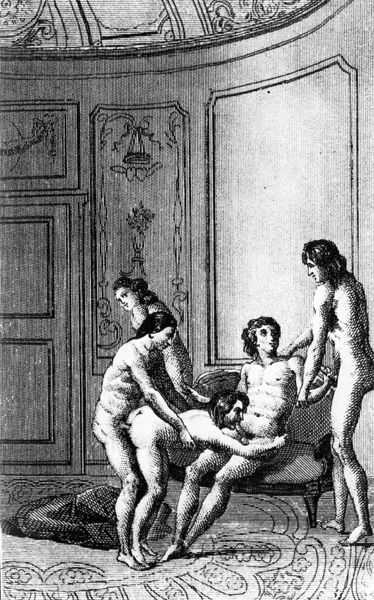
a Sadean scene or a typical Adelaide party


I’ve been reading the Marquis de Sade’s work Philosophy in the Bedroom, for which I’ve been criticized because he’s apparently so boring and his sex especially – so this means I shouldn’t read him? The thing is, I’ve started writing this ongoing open-ended sex thing myself, La Poursuite du Bonheur, and I’ve borrowed a couple of elements from Sade, namely the novel in dialogue form, and the rhythm of a work which involves talk then sex then talk then sex. These are the only elements, as I have little interest in causing shock and scandal, and I have little interest in violence or sadism.

It’s a pleasurable fantasy as the male and female involved in this dialogue [others may join in later] are both simply aspects of myself, so they understand each other beautifully and there’s no conflict – fantasy indeed.

Philosophy in the Bedroom discusses, inter alia, childbirth and abortion. Unsurprisingly, Sade extols individual freedom and sweeps aside anything that interferes with it, including unborn children. Of course he’s out to shock the established order, particularly organized religion, but some of his arguments sound uncannily like those of the most fervent modern pro-choicers – which actually worries me. Basically his argument is a survival of the fittest one. Don’t worry about the unborn, they’re weak and it’s basically a pleasure to do away with them because it’s an exercising of power, and the exercising of power is for Sade the primary source of pleasure. Forget charity and welfare, it just makes for dependence, life should be a battle in which the most ruthless win out and spread their genes across the globe. In earlier times, I’ve read criticisms of Sade along the lines of the ultimate failure of ultra-rationalism [and therefore the need for more ‘spiritual’ solutions], but Sade’s arguments aren’t particularly rational I feel, they’re just fueled by emotions or obsessions which most of us don’t have, or not as much. The argument fails because it doesn’t take nurturing and family feeling into account, it starts with an atomistic individualism which is mere fantasy. It starts with false assumptions about what human beings are. The issue of abortion, for example, is always going to be fraught even without the religious red herring of the sacredness of all human life [as opposed to the lives of other beings, whose purpose is merely to entertain us or feed us], because it often creates, within the mother, a clash between the nurturing impulse, the general, vital desire to procreate, and economic and other issues, including that of individual freedom. Sade simply ignores certain well-defined and well-documented human tendencies and needs to become a propagandist for individual freedom. When I first read him, I thought he had simply concocted a colossal ongoing joke, by taking one side of the individual/social debate, which rages in all of us as thoroughly socialized individuals, and running with it as far as he could. Now I’m not so sure it’s a joke for him, though I’m sure the scandalous nature of his sexual writings gave him quite a few comic thrills. Anyway, I think Sade has his uses and even his charms – he’s remarkably free of hypocrisy, he has a relentless energy and he challenges us to refute him, to show why it is that we need a more balanced approach to sexuality and society than he offers. We need our extremists, to define our world more clearly, and to feel superior to.

Labels: ,

Saturday, April 26, 2008

Haidt's awkward position


Having commented here recently with a reference to Jonathon Haidt, I spent a bit of time reading this Haidt article in which he critiques ''the new atheists''. Basically he uses his moral intuition findings to argue that such public advocates of atheism as Dawkins and Harris are so strongly guided by an intuitive sense of the wrongness or immorality of religious belief that this clouds their judgment when it comes to the possible benefits of such belief. Haidt has little to say about whether beliefs in supernatural forces are true - which is, to say the least, a weakness in his argument - but what he has to say about benefits is worth reflecting upon. He quotes some lines from Dennett's Breaking the spell about the morality of unbelievers v believers:
"Perhaps a survey would show that as a group atheists and agnostics are more respectful of the law, more sensitive to the needs of others, or more ethical than religious people. Certainly no reliable survey has yet been done that shows otherwise. It might be that the best that can be said for religion is that it helps some people achieve the level of citizenship and morality typically found in brights. If you find that conjecture offensive, you need to adjust your perspective. (Breaking the Spell, p. 55.)
Here's Haidt's commentary on the above:

I have italicized the two sections that show ordinary moral thinking rather than scientific thinking. The first is Dennett's claim not just that there is no evidence, but that there is certainly no evidence, when in fact surveys have shown for decades that religious practice is a strong predictor of charitable giving. Arthur Brooks recently analyzed these data (in Who Really Cares) and concluded that the enormous generosity of religious believers is not just recycled to religious charities.

Religious believers give more money than secular folk to secular charities, and to their neighbors. They give more of their time, too, and of their blood. Even if you excuse secular liberals from charity because they vote for government welfare programs, it is awfully hard to explain why secular liberals give so little blood. The bottom line, Brooks concludes, is that all forms of giving go together, and all are greatly increased by religious participation and slightly increased by conservative ideology (after controlling for religiosity).

These data are complex and perhaps they can be spun the other way, but at the moment it appears that Dennett is wrong in his reading of the literature. Atheists may have many other virtues, but on one of the least controversial and most objective measures of moral behavior—giving time, money, and blood to help strangers in need—religious people appear to be morally superior to secular folk.

Assuming this is true, and though I haven't independently examined the evidence, I suspect that it is, it needs to be accounted for. Not only that but, as Haidt suggests, we need to tap into this force for helping others that appears to be driven by religion, and utilise it for a secular society.

So what is so socially cohesive and happiness-making about religious belief, and do all religious beliefs have this tendency? How does Judeo-Christianity compare with the Dreamtime beliefs of Oz Aborigines in this regard?

To stick with Christianity, I think Haidt is right in saying that the beliefs of modern Christians are more complex and eclectic than some atheists give them credit for. Most of them don't read the Bible, and aren't familiar with it except through the many and various interpretations of priests whose sermons mix Bible stories with everyday modern observations, homespun homilies and more or less sophisticated treatment of current political and social issues. Bible passages are dealt with selectively and according to changing attitudes. Some quietly fall out of favour, as do whole religious concepts, such as the concept of hell. Some atheists think that, because the Bible is a fixed document - at least since the Council of Trent - Christian morality must also be fixed, in the time those texts were written, but this is plainly not so [in spite of what Christian leaders themselves say about eternal verities]. Certainly it's a largely conservative morality, which drags behind progressive secularism in terms of reform, but there's no doubt that it's always changing, just as today's conservative political parties don't support the institution of slavery, as they once did.

Haidt makes a distinction between contractual society and the beehive society, the first being more individualist and egalitarian, the second being more authoritarian and rigid. The first requires constant adjustment to balance individual and social needs against each other, the second requires constant vigilance against enemies from without and within. And although Haidt generally plumps for the contractual society, he seems to feel that the alternative shouldn't be contemptuously dismissed, but studied and learned from. Whether this is itself mere liberal posturing is hard to say. His main argument against the new atheists is that they're more driven by commitment to a cause than reason, and that their reasoning is heavily skewed by that commitment. It's an important point, of course, but it needs to be pointed out that new atheism has also grown out of a serious threat to scientific autonomy and scientific education, in the USA at least, coming from creationists and their very vocal fundamentalist supporters. It's also a response to the growing power of Islamism, to the violence of militant religion, and to the real danger posed by the politicisation of religious views. There really is something of a battle being waged here, and aren't we right to be concerned that not enough people are speaking up? And they should do so with carefully crafted, evidence-based arguments, as well as an awareness of where they're coming from, and of the dangers of bias.

I enjoy some of the rhetoric of the new atheists, but not all of it. I'm more interested in solid argument, such as those used by scientists to refute the anti-evolution claims of believers, arguments that are painstaking, patient and comprehensive, arguments that themselves promote science as a discipline for producing results, knowledge and insight. The effectiveness of the practice of science is always its best argument.

Science needs to turn to religion in the same spirit, to seek to explain it. Haidt touches on this when he refers to the work of Boyer and Atran and the exploration of religion as an evolutionary byproduct. He himself wonders whether religion isn't an adaptation, that's to say, a much more successful evolutionary product than is given credit for, though it must be hard to sustain that view as a secularist who seems, personally, to have no need of religion. He points out that anthropologists are much less interested in the truth of religious beliefs than in the social functions attached to ritual and ceremony, but this seems to me rather to fudge the issue [and functionalism in the social sciences has been criticised for just this reason].

The bottom line is that Haidt is trying to defend religion while not believing in it. It's an awkward position to take, and to some it might look like a patronising one. The only real defence he has provided for religious beliefs is that that they seem to make people more happy and more generous. The first claim can be dealt with along 'ignorance is bliss' lines, the second one may look a bit more difficult to deal with, but I would say that if you are a regular church-goer you would be constantly the target of sermons touching on civic responsibility. Helping the poor, helping those in need, caring for children and the elderly, loving sinners, if not the sin, and encouraging and reinforcing the bonds of community everywhere. It's also quite likely the case that you're drawn to churchy organisations because you want your sense of community and civic responsibility strengthened. It fulfils a need in you. But let's not pretend that there aren't other things that go along with these positives - the myths about gods and faith, the fear and loathing of the godless and such. And there are particular truth-claims, reiterated again and again, the central one being the existence of and the need to constantly worship a supernatural entity. There's no getting around that one, either it's true or not.


Labels: , ,

Sunday, April 20, 2008

Primary Colors and political morality


I do get a bit behind in my film reviews, or my film viewing - sixty-two years behind in the case of Dragonwyck, but only ten years in the case of Mike Nichols's Primary Colors, but with this latter, the subject at least is not out of date, and we find it in every political campaign. In the recent federal election campaign, Rudd's one-time visit to a strip club, and a tenuous link with WA inc's notorious [I'm not entirely sure why] Brian Burke, were just two attempts to bring the scandalous and salacious into the political fray.

Primary Colors takes aim at the most magnetic of recent politicians, Bill Clinton [magnetic especially in attracting scandal], by creating a fiction with obvious parallels. Presidential hopeful Jack Stanton [John Travolta] and his savvy wife Susan [Emma Thompson] have a way of sucking people into the stream of their ambition and enthusiasm, and the film is largely seen from the perspective of one such sucked-in character, Henry Burton [Adrian Lester], who becomes Stanton's campaign manager. It's an extremely well-written film, and the performances of Thompson and Travolta, and Kathy Bates as a torrential and formidable campaign force who joins up with the Stantons after years of questionable absence, are a joy to watch.

I'm not going to review the film, though, as such. I'm more interested in the dilemmas raised. I should start with my general view, which will of course soon be qualified, that having sex more often, and with more people, is a Good and Healthy thing.

First qualification, or problem, is that most people don't agree with this statement, or at least with the 'more people' bit. Fidelity and loyalty are viewed as a positive, and Robert Manne amongst others has emphasized this. My own view is that having sex with a variety of people isn't necessarily proof of disloyalty, and that there is a confusion between sex and love, though admittedly the road of promiscuity is a hard road to hoe for a genuinely loving and loyal person, given human jealousies and possessiveness. And to travel that road under the spotlight of a political life is essentially impossible, unfortunately.

While a lot more could be said about the above confusion [about the meaning of sex in the context of human relations], I'll leave much of that to my online fiction which tries to explore many of these issues. Another matter dealt with in Primary Colors is that of sex and power. The high-flying Presidential candidate who takes advantage of a friend's bedazzled daughter, the Governor who has no trouble and no compunction about seducing his secretary, etc. As the film shows, these issues cut more than one way - the secretary may have no compunction about exaggerating a dalliance into a full-blown affair, for the purpose of extorting money or favours. Jack Stanton tries to 'clear his name' via DNA tests and such, but some might feel that this misses the point, which is that Stanton shouldn't use his personal charisma or political status to exploit the vulnerable and naive. On the other hand, there seems to have been enough people willing to turn a blind eye, or even to have been quietly approving of his behaviour, for him to have gotten away with it [sorry, I'm switching my thinking here from Stanton to Clinton, though Stanton too was successful in the Presidential race].

One possible explanation for this is that people are aware [however consciously] of the harm principle, and that the question of the harm caused by a few, or even more than a few, dalliances in the context of a marriage the openness of which is itself an open question, is at the very least difficult to determine. One of the problems for me, I confess, is that the Stantons/Clintons would never admit to their marriage being an open one, if that's what it is, for fear of losing the support of vast numbers of more conservative voters. This is one of the points of the film, of course - how pragmatic are we allowed to be, in order to get elected? If Clinton's 'closed' - and close - marriage is a sham [but note that the pair are still very much together], what about, say, his religion? After all, we all know that, more than in any other country, the USA's leadership aspirants have no option but to be practicing Christians. So is Clinton really a god-fearer? How much is sincere, and how much pretence?

These issues are perennial for all campaigners in all democratic elections, and they come with the territory of representative democracy. You could even say it's the poison at the heart of this system. Is this candidate/incumbent saying what she's saying in order to get into/stay in power, or does she really feel and believe it? Did Howard throw money and resources at the tax payer because he felt they deserved it, or to get re-elected? Were his actions re Aboriginal communities and the abuse of Aboriginal children a matter of sincere conviction or political expediency? Some of these question are much more easy to answer than others.

The Clinton warts-and-all Presidency was something of a victory for flawed, ambitious humanity, though I see the flaws rather differently from most. In the film, someone commits suicide because she has ideals that the Stantons don't live up to - but nobody can be expected to live up to the ideals of others, or even to be aware of them. As it happens, the Stantons are by turns exploitative and compassionate, as we all are. I suppose the best way to judge them is also the most painstaking - to analyse who gets hurt and who benefits, how many and by how much.
It's essentially a never-ending process.

Labels: , ,

Friday, December 28, 2007

on god, Einstein, religion and world peace: get it all here


My favourite Christmas present was the one I bought myself, a reasonable brick of a tome, recently released, called The Portable Atheist, edited by Hitchens, a reader presented chronologically.

Lucretius' De Rerum Natura starts it off. I first read this work, or a part of it, many years ago in my vie boheme. I was at a friend's party and ended up staying the night, in a sleeping bag. I was a little drunk, but energised, and I raided his bookshelves and settled on Lucretius. Of course I'd never read anything like it, an epic poem in rhyming stanzas [in translation], treating of the essential nature of the universe, arguing that all matter consisted of atoms, and spurning all superstition and religious dogma. I was blown away, and stayed up reading it till dawn. Mais ou sont les neiges d'antan?

I'm already about a third of the way through, and there are contributions from many brave souls, some from the height of religious persecution in Europe, like Spinoza and Thomas Hobbes, whose 'free-thinking' endangered his life on a few occasions. Hume's essay on miracles is here, though it's not so impressive now as when I first read it, and some nineteenth century heavies like Shelley [expelled from Oxford for this particular essay - at least the consequences of speaking were becoming gradually less grim], J S Mill, and Leslie Stephen being very serious and comprehensive. Karl Marx waxes more or less incomprehensible [from his Hegel-shadowed years]. H L Mencken produces an impressive list of dead gods who once held Ozymandias-like sway.

Perhaps the most impressive contribution, and hopefully not just because it's the last one read, comes from Einstein. Not an essay, but a collection of his pronouncements and quotes from letters on the issue from his last years, presumably gathered by editor Hitchens. They're often repetitive but essentially consistent. They're a reminder that Einstein, in his last years, was revered as a kind of seer, much like Mandela today. I think he had a similar personality, a generally benign disposition but with an underlying fierce concern about the state of humanity, about truth and fairness, and a willingness to speak out on occasions, making him the target of many a well-meaning focus group. Much argument has been raised about the nature of Einstein's 'religiosity' but I think his own pronouncements settle the issue [leaving aside the possibility of selectivity and suppression from the editor]. Einstein had no use for a personal god, one who intervened in human affairs and answered prayer. He felt that such a construction was naive and self-serving. He described himself as a 'religious unbeliever', awed by the natural world and its laws, of which he felt we had a far from perfect understanding. He several times cited the pantheistic 'god' of Spinoza, a god identical with nature, with no transcendental - and certainly no anthropomorphic - features.

I'm of course not doing justice to too many of these thinkers with these perfunctory remarks but I've really enjoyed spending time with them over the last few days. Some lost their face slowly and with great reluctance, others were strictly educated into atheism, and others - and I put myself into this group - 'have been so made that they cannot believe' [Pascal's words]. All of them I see as fore-runners, pioneers, like the early feminists, chipping away at the power of religion over people's minds, helping to loosen its grip over educated people, finger by finger. May it never be allowed to rise again, especially not to cast its pall over everyday life.

I note that the Pope, [the Goddess bless him] has recently presented a Christmas day message, arguing inter alia that abortion and same-sex marriage [in other words any legitimisation of homosexuality] are as much a threat to world peace as the usual suspects, and that the nuclear family is our greatest bulwark against violence and instability. Obviously he hasn't heard of the bonobo. It's my contention that intolerance and bigotry are a much greater threat to world peace, and the Holy Roman Catholic and Apostolic Church, with its shocking history as well as its current pronouncements, is the greatest promoter of those tendencies in the west. I chafe at the continued existence of such a grotesque institution, and its my fervent hope that it won't survive this century. Interestingly, Einstein also had something to say about their shenanigans:
I am convinced that some political and social activities of the Catholic organisations are detrimental and even dangerous for the community as a whole, here and everywhere. I mention here only the fight against birth control at a time when overpopulation in various countries has become a serious threat to the health of people and a grave obstacle to any attempt to organise peace on this planet.

A retrospective hit, indeed.

Labels: , ,

Thursday, December 27, 2007

bring out that inner bonobo


les be friends, or how to avoid stress


Human sexuality, in the developed west, is tending towards bonoboism, me likes to think [actually it's far more a hope than a thought].

Bonobos are a wonder. According to primatologist and psychologist Frans de Waal, who's made a study of them, they might better have been named Pan satyrus rather than P paniscus [the diminutive one], because of their considerable predilection for sexual activity [meaning they love to fuck, with whoever, whenever, however]. As you might expect, I can't wait to write about this, but I'll get the less stimulating part of their story out of the way first.
Bonobos, along with their larger cousins, the chimps, are our closest living relatives, but bonobos are very different from chimps. For starters there are far fewer of them, and their habitat is very confined, and becoming more so with human encroachment. They inhabit an area south of the Zaire River, and number only a few thousand, falling rapidly. They were only identified in the late twenties, and classified as a new species in the early thirties. The chimp and bonobo lines separated not so long ago, with the chimps moving on to a wider, drier savannah-like habitat.

Although originally described as pygmy chimpanzees, they’re no smaller than the smallest sub-species of chimp, about 45 kgs for males, and 33kgs for females. De Waal, perhaps with some bias, describes them as more ‘stylish’ or gracile in their movements than chimps [they do in fact have proportionally longer legs than other apes], and they have flatter faces, higher foreheads, and a distinctive hair-style, parted in the middle. Their diet is similar to that of chimps, but with less meat. They’re described as very sensitive, with very expressive eyes. They’re also less aggressive, and this relates, inter alia, to their social structure.

And their social structure brings me, not before time, to sex.

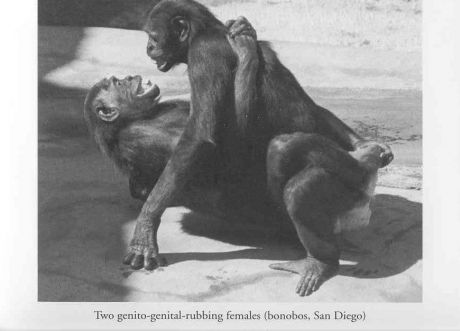
Okay, I exaggerated when I say they fuck all the time, but the truth is even more interesting. They use sex – and I don’t mean fucking as in full penetrative hetero-sex – as a way of bonding and curbing aggression. And because the closest bonding occurs between females, female-female sexual activity, especially in the form of ‘genito-genital rubbing’, is the most common type.

Here’s the social set-up. As with chimps, young bonobo females move away from ‘home’ to another mating group, whereas the males stay forever within the home group. But unlike their cousins, the adolescent females gradually develop close bonds, facilitated by sexual activity, with senior females of their new group. This allows them to band together to keep any larger, would-be aggressive males in check. In fact, it has essentially allowed them to become the dominant sex, spite of sexual dimorphism. Sisterhood is powerful. One reason for this sort of alliance, which male bonobos don’t seem to engage in, may be to prevent infanticide, a common practice among other species, including chimps.

It’s not just a matter of ganging up though. They also use sex to soothe the savage beast [male or female] – and for many other reasons. In fact, I’ve just found a fabulous blog, written by an Oz researcher in the Congo, who’s discovering almost more than she can handle about bonobo [and young chimp] sexual behaviour as we speak. It’s so full of useful and up to date info as to more or less render this post redundant. So I’m going to quit this post and start reading her blog – and so should you, dear reader.

I’ll just finish though by returning to my first line. It would be nice to think we’re becoming more like bonobos, make love not war and all, but my sense of the possibility comes from the increasing power of women in western society. Young women are more sexually confident, and even sexually exploitative than they’ve ever been before, and they’re also engaging in female-female sex play like never before. They’ve taken to hunting in packs, which have provided them with the security to go further than they would normally go. So-called ‘raunch culture’, female-driven, has provided women with a new sexual empowerment, and I’m not sure that I agree with feminist critics who claim that it’s just another form of enslavement [surely raunch culture is emphatically not about stripping for your man]. Sexual empowerment is only one form of empowerment certainly, but it’s far from an insignificant one, for sexuality is always going to be central, and if you can gain control of the sexual agenda, it’s likely everything else can fall to your hands as well. Could this be the real sexual revolution? All I can do is echo an earlier enthusiast. Vive le bonobo! I’d like to be one.

Labels: , ,

Wednesday, December 19, 2007

Taylor's critique of secularism

Charles Taylor, winner of this year's Templeton Prize

I read here yesterday that Charles Taylor is a Roman Catholic.
I read some of Taylor's essays at uni. He wrote critiques of social theory, and I was particularly taken with his analysis of Foucault. His style had all the best of Anglo-American clarity, infused with a sort of gentleness and patience which was very becalming. I wasn't myself inclined to be so generous with Foucault. I read other essays of his, and was generally impressed. I know that he's something of a Hegel scholar, which in itself would require almost supernatural patience, as well as a certain kind of mind, one far removed from my own.
So, on hearing that he's RC, I'm frankly gobsmacked. I've always been tempted to claim that the term Roman Catholic thinker is oxymoronic, pace the Jesuits and their ilk. I would amend that, though, to RC thinkers about religion. Taylor didn't mention religion in the essays I read, but now he has written a lengthy book called A Secular Age, in which he apparently writes approvingly of the religious mindset while stringently avoiding the issue of God as broached by Dawkins and others. This is hardly surprising, given that as a catholic he must not only believe in a god but in that God, the mass murderer and moral monstrosity later reshaped by Aquinas et al as the sum of all perfections, etc. Presumably he also believes in the trinity, the virgin birth, the resurrection and transubstantiation. He may also believe in the infallibility of the pope. Then again, he might be an unorthodox catholic with dissenting views on any or all of these doctrines. I suspect that A Secular Age, in spite of its 874 pages, will answer none of these questions.

The NYT review of the book says this:

[Taylor] argues for “the ‘deconstruction’ of the death of God view” proclaimed by Nietzsche. To see secularization as simply the separation of church and state, the alienation of truth from power, and the rise of skepticism and worldliness, he writes, is to miss the deeper and more enduring residues of religion and the spiritual life, the true “bulwarks of belief” that in his view have hardly eroded. Taylor argues against the “subtraction stories” of modernity, in which religious belief and other “confining horizons” are “sloughed off,” leaving the mind without faith or piety. Instead, he argues, “Western modernity, including its secularity, is the fruit of new inventions, newly constructed self-understandings and related practices, and can’t be explained in terms of perennial features of human life.” Even the old distinction between the sacred and the profane has taken on new meaning. Instead of disappearing, God is now “sanctifying us everywhere,” including “in ordinary life, our work, in marriage, and so on.”

Now, what does all this actually mean? It's not quite as murky as theology, but it's getting there.
Firstly, the Nietzschean proclamation of the death of God is problematic. He presumably meant the death of God as concept, but his rhetoric lays itself open to a type of concrete thinking - and of course Nietzsche played on this. Not only does it paradoxically invoke the death of an immortal, but it plays into the concepts of death and immortality that are part and parcel of all religions - ancestor spirits, transfiguration, reincarnation etc. The 'deconstruction' of the idea makes me shudder, so I think I'll just ignore it.

The key sentence in the above para is, to me, the second one. To see secularization as simply the separation of church and state, the alienation of truth from power, and the rise of skepticism and worldliness, he writes, is to miss the deeper and more enduring residues of religion and the spiritual life, the true “bulwarks of belief” that in his view have hardly eroded.

It's possibly true that 'the bulwarks of belief' haven't faded that much, though those places where they have been most eclipsed have been those most affected by Enlightenment thought. The separation of church and state in those countries, and its spread around the globe, is a very positive phenomenon, as is the 'alienation of truth from power', most particularly the waning power of the Catholic church. Skepticism, too, is a healthy thing [I would say that, but note: nothing in excess], and worldliness has always been a pretty useful survival strategy. Just what the deeper residues of religion are, exactly, is unknown to me, as I'm one of the growing number of people in the West who has no need for religion or spirituality as commonly defined [or, more often, not defined]. That a great many people do profess some kind of 'faith' or adherence to a spiritual life is an interesting and important phenomenon, and one which requires investigation. A number of people are investigating the phenomenon, though these investigations are still in their infancy and a great deal more work needs to be done.

From the point of view of science, religious belief is indeed a confining horizon. Early scientists had to do battle with the confining belief that the Earth must be the centre of the universe, then there was the confining belief that humans were 'special', made in God's image, with 'dominion over the Earth'. Even liberal believers are still contending that the universe must be purposeful, and that the ultimate purpose must be the complexity of consciousness [as exhibited, of course, in homo sapiens]. It seems that this is what faith and piety is reduced to among some liberal theologians, a self-serving view about humanity's centrality in the scheme of things, for which we must thank our supernatural 'father'.

Taylor seems to have been rather more evasive about these terms, which is hardly more satisfactory. In any case, I would challenge his assertion that Western modernity [a too-vague term] is about new constructions of self-understanding, unrelated to 'perennial features of human life'. What are these perennial features? Presumably he's again referring to religious belief and its related rituals. We cannot as yet know how perennial these are [or indeed how perennial are any features in the constant flow of evolving human life and behaviour], but by constructions of self-understanding I suspect he means modern science, an impressive construction indeed. Science has been so phenomenally successful in such a short time-span, that to see it as atypical of or somehow contrary to the abiding concerns of humanity is perhaps forgivable, especially as it has so revolutionised our understanding of ourselves as a species in a mere 150 years. The question is, are these understandings mere ephemeral constructions? I doubt it, and I think the methods by which we arrived at those understandings will bring us many more surprises and revolutions in the years to come.

That'll do for now. I might look further into this review later. I think Taylor will have many interesting things to say in his book, but evading the particularities of religious belief looks like a bit of a problem for him.

Labels: , ,

Thursday, December 06, 2007

weighty fantasies


Beijing Man, I believe


The dreaded lurgie has struck me again - something absorbed from the environment has set off my compromised immune system and again I'm sniffling and coughing and going through two or three hankies a day and it won't go away until I visit the doc and get antibiotics to clear things before it turns to pleurisy or pneumonia. Apart from that I feel generally hale, but the constant sniffling and throat-clearing affects my stamina a bit, as well as my sociability.

Just wondering about the word lurgie. Its etymology seems pretty uncertain but the phrase the dreaded lurgie was popularised by an episode of the Goon Show. Well done lads.

I'm still not free of commitments, but I'm catching sight of the light, and I have a few challenges ahead, re making a living. I'm also trying to get fitter - I bought some quite snappy trousers today, not uncomfortably tight, just enough to draw attention to the wrong kind of bulge above the waistline. Could've gone for wider, but I needed to bring my target into better focus. I'd say I'm about 7 or 8 kilos above perfect trim. My diet's fine, it's mostly the exercise that's the problem [bad word - I've been told not to think of it as exercise, just activity]. Trouble is, guys always put their weight on around the tum, and find it well-nigh impossible to remove it from same.

Avoiding the internet a little lately too, getting my stimulation from more traditional sources. Everything stimulates, and an article in Cosmos about important and puzzling archaeological finds in Dmanisi, Georgia, as well as more reading about the ongoing Homo floresiensis controversy have made me want to summarise, for my own benefit, the current thinking, insofar as it can be summarised, on hominid ancestry. This has led to further fantasies, of giving talks on various mainly philosophical issues, before a select audience...

1. Human self-knowledge and self-deception: a scientific approach.
We've known for millenia that we can't be trusted to be judge in our own case, and experimental evidence suggests that even people who have known us for no more than five minutes are better predictors of our behaviour than we are. At the same time, immediate, internal access tells us that in some essential way we know our minds better than anyone else possibly can. How can these two findings be reconciled?

2. Human origins: the current state of knowledge
Does anyone remember Java Man? Peking Man? How about Cro-Magnon Man? Why were they all men? What place do those old guys have in the current picture of human and pre-human ancestry? What exactly is a hominid? How does Australopithecus relate to Homo erectus? Is John Howard really the last Neanderthal?

3. Morality: a triumph of reason over impulse, or a rationalisation of survival instincts?
David Hume notoriously wrote that reason is the slave of the emotions, but until recently this view has found few champions among philosophers. Professional prejudice? What role does reason really play in our sense of right and wrong? And what exactly is reason anyway? Important new work in cognitive anthropology and evolutionary psychology throws some fascinating light on these questions.

4. Philosophy and science: friends, enemies or strangers?
What's the difference between a philosophical question and a scientific question? Does the philosophy of science have any relevance to scientific practice? What exactly is a scientific theory, and what makes the term so controversial? Is it true that science can only answer how questions and not why questions? How so - or why so?

5.
Evolution and religion: what's at stake?
Various thinkers, religious and non-religious, have been at pains to argue that the theory of evolution and religious belief are entirely compatible. Others have been at pains to point out precisely the opposite. Certainly the vehemence of religious, and particularly Christian, attacks on evolution suggests a certain discontent amongst those lucky enough to be made in God's image. Surely the Primate can't really be a primate?

And so forth. Don't hold your breath.

Labels: , , ,

Sunday, November 18, 2007

there's life in them there lies


I've just finished the previously-mentioned Lies we live by, by Eduardo Giannetti, one of the better books I've read in recent times, for its deliciously quotable quotes, for the lively style, and for its general perspective on ethics, politics and the relationship between them. For example, he clearly endorses the findings of Pinker in The Blank Slate, though neither Pinker nor the slate are mentioned. He puts it very succinctly near the end of his book:
The moral equipment of the human animal is what it is. To imagine that it might be radically improved or regenerated, whether by means of sermons, intensive training courses and inspired exhortations, or by political engineering and new modes of production, is to embrace fantasies that may provide short-lived consolation but have no validity. If well-intentioned speeches, leaps forward or violent breaks with the past could produce the doubtful miracle of a 'moral regeneration of man', then the promise of a 'new man'- whatever the 'new human nature' that we want to put into him - would have occurred innumerable times in the course of history.

Since I have to take this book back to the library, I'd like to squeeze out as many quotes from it as I can beforehand.

Francis Bacon: The faculty of wise interrogating is half knowledge.

Fernando Pessoa: Although I have been a voracious, avid reader, I don't remember any book I have read, to such a degree were my readings states of my own mind, dreams of mine, and, even more, the things which kindled my dreams.

Denis Diderot: It's at times when everything is false that people love what is true, it's when everything is corrupt that the theatre is at its most refined. A citizen who goes to the Comédie leaves all his vices at the door and picks them up
again as he goes out. Once inside, he's just, impartial, a good father, a good friend, a lover of virtue; and I've often seen, sitting next to me, rogues who get deeply indignant at actions they would certainly have committed if they'd been in the same position as that in which the poet placed the character they detested.

Ludwig Wittgenstein: Nothing is so difficult as not deceiving oneself.

Friedrich Nietzsche: That which, from the earliest times to the present moment, men have found so hard to understand is their ignorance of themselves! Not only in regard to good and evil, but in regard to what is much more essential! The primeval delusion still lives on that one knows, and knows quite precisely in every case, how human action is brought about... Actions are never what they appear to us to be! We have expended so much labour on learning that external things are not as they appear to us to be - very well! the case is the same with the inner world!... So we are necessarily strangers to ourselves, we do not comprehend ourselves, we have to misunderstand ourselves, for us the law ''Each is furthest from himself'' applies to all eternity - we are not 'men of knowledge' with respect to ourselves.

Charles Darwin: He who would understand the baboon would do more towards metaphysics than Locke. [to which Giannetti shrewdly adds True enough. The only trouble is finding out how to get rid of metaphysics in our attempts to understand the baboon'.]

The two Delphic inscriptions:
Know thyself.
Nothing in excess.

Duc de la Rochefoucauld: We are so used to disguising ourselves from others that we end by disguising ourselves from ourselves.

William Shakespeare:
I do believe you think what now you speak;
But what we do determine, oft we break.
Purpose is but the slave to memory,
Of violent birth but poor validity,
Which now, the fruit unripe, sticks on the tree,
But fall unshaken when they mellow be .
Most necessary 'tis that we forget
To pay ourselves what to ourselves is debt.
What to ourselves in passion we propose,
The passion ending, doth the purpose lose.
[from Hamlet]

And finally that bobbydazzlingly discombobulating conundrum
When my love swears that she is made of truth
I do believe her, though I know she lies
[sonnet 138]

Labels: ,

Wednesday, November 07, 2007

passions, promises and pretence


I'm trying to divest myself of stuff so I can write more here, but this is temporarily creating more work. What I'm doing may also lead to a considerably reduced income and a redirecting of attention to the domestic sphere, which may be a good thing, but who knows.

With the assistance of a fascinating book, Lies we live by, by Brazilian writer Eduardo Gianetti, I'm reflecting on self-deception and self-knowledge, a theme I've also followed through the writings of Pinker and others. Gianetti plays on the Delphic prescription to know thyself. The Greeks apparently knew a thing or two when they put that one up for consideration. Some even knew that such knowledge was essentially impossible. Aristotle once wrote that nobody should be judge in his own cause, and let's face it, we all know that autobiography is generally less reliable, if often more entertaining and even enriching, than biography, and that the last person we would go to to find out about a person's character is the person herself. Gianetti takes us on a stimulating tour of ideas about self-knowledge, introspection and privileged access, noting some intriguing paradoxes and problematic entrapments in the battle for self-knowledge as self-improvement. He checks out some old favourite writers of mine - take this from Montaigne:
Not only does the wind of chance events shake me about as it lists, but I also shake and disturb myself by the instability of my stance: anyone who turns his prime attention on to himself will hardly ever find himself in the same state twice. I give my soul this face or that, depending on which side I lay it down on. I speak about myself in diverse ways: that is because I look at myself in diverse ways. Every sort of contradiction can be found in me, depending on some twist or attribute: timid, insolent; chaste, lecherous; talkative, taciturn; tough, sickly; clever, dull, brooding, affable, lying, truthful, learned, ignorant; generous, miserly and then prodigal - I can see something of all that in myself, depending on how I gyrate; and anyone who studies himself attentively finds in himself and in his very judgment this whirring about and this discordance. There is nothing I can say about myself as a whole simply and completely, without intermingling and admixture.

We are whole worlds, in which the best and worst can be found, so that our failures can always be pasted over with other successes or memories or attempts, or reduced to a place in a far distant corner of the buzzing enterprise of the self.

Gianetti is fascinated by the paradox of our endless capacity for self-deception [nothing is more difficult than not deceiving ourselves, Wittgenstein has written] together with our immediate, certain self-knowledge [nobody else can feel our pain]. That enormous enterprise and treasury of the self is our exclusive possession - the rest of the humanity is forever locked out of it. Their only access is via our reporting. And we're forever locked in, only able to enter other minds through their reports and actions. Along the way he outlines the work of American philosopher Thomas Nagel, who effectively put a spanner in the work of the identity state theorists, those who have it that memories dreams and reflections are identical with brain states. I might post further on this after reading some of Nagel's work directly.

It's a wide-ranging book, full of deliciously quotable quotes, engendering an enthusiasm for the original works of many thinkers. I hope to mine it thoroughly before sending it back to the library. For now though I'll focus on self-deception in the political sphere, since it's so topical.

Amongst the many enterprises we engage in - trying to be successful in the world, trying to get laid regularly, trying to win all the arguments and so forth - one is the satisfaction of our curiosity about how the world works. A search for the truth about the world, if you will. This search requires that we keep an open mind and listen to and take on board other perspectives than our own, for the world - we surely know this - is multi-faceted and complex. Nothing could be more of a barrier to our search for truth than the conviction that we already know what it is. And yet, in the world of politics, we expect and demand such conviction - or at least politicians believe that we do, for nothing is more important, especially come election time, than that an air of absolute certainty and self-confidence regarding party policies is preserved. This creates a double image of the politician, as a source of strength and deception. It may be that we don't even mind our politicians lying, as long as they do so convincingly, but many of us, too, are uncomfortable with these displays of certitude, mindful of the Yeats line about the politics of his day - ''the best lacked all conviction, the worst were full of passionate intensity''.

This is where self-deception comes in. Better to be convinced yourself that your policies are the best thing since sliced bread than to simply present a veneer of confidence over a mass of doubts. That part of politics which is the art of persuasion - and it's a large part - militates against true reflective analysis of the efficacy of your policies and those of your opponents. Certainly this kind of analysis, the common wisdom has it, can never be conducted in public. The danger of all this, of course, is that you can sweep others into your deception, seduced by your self-confidence, at great cost [think of Nazism, but also of the invasion of Iraq], with the destruction of politicians' reputations for truth-telling being the least destructive of all the destructions that result.

All of this makes election time the most uncomfortable and often distasteful period for the philosophically inclined. Some of us - myself certainly - might look forward to a change of government - but we want to get the embarrassing beauty contest over with as quickly as possible.

Labels: ,

Thursday, November 01, 2007

on harmless deism


ceci n'est pas Dieu


As mentioned in a recent post, I have qualms about focusing too much on the religion issue to the neglect of so much else, being one with a perverse antipathy to specialisation in any case, but since I do love a bit of an argument, and since I've kind of committed myself, I''ll have a look at an apparently innocuous, even 'kindly' liberal religious belief - here in the form of the professed beliefs of a writer, one John Hewitt. In order to make my exploration easier to follow, I've pasted the beliefs here rather than linking to them. The only change I've made is to enumerate the beliefs for ease of reference. The numbers don't represent any order of importance.

My beliefs

  • 1. I believe that God is infinitely wise and intelligent.
  • 2. I believe that because God is infinitely wise and intelligent, God knows that even if God wrote down for us exactly what we should and should not believe or do, we would misinterpret it.
  • 3. I believe that because God knows this, God has never written a single word of guidance for us.
  • 4. I believe that humans, inspired by the presence of God, have written many words about God. Sometimes those words are wise and sometimes they are not, but those words are interpretations of God by humans and not the word of God.
  • 5. I believe that God is very interested in us, but that we are not God’s sole concern. The Earth and mankind are a tiny part of a much larger creation with goals that the human race will probably never fully understand.
  • 6. I believe that God occasionally steps in to guide or help the human race, or even individuals, but that God does so quietly and it is impossible to know for sure whether something was God’s work or our own work or blind chance.
  • 7. I believe that because it is always possible that God did step in and help out in any given situation, it is all right to be grateful when you think God has helped you or others.
  • 8. I believe that overall, God prefers that we fix our own problems.
  • 9. I believe that the universe, while a creation of God, was built to follow rules of science.
  • 10. I believe that because God’s creation of the universe followed the rules of science, the scientific explanation of the creation of the universe does not in any way require a discussion of God’s role, which we cannot fully understand anyway.
  • 11. I believe that when science and our interpretation of God are at odds, science is generally right and our interpretation of God is generally wrong.
  • 12. I believe that religion, like most intoxicating things, is fine when used in moderation but dangerous when used in excess.

Now, I've been challenged to find anything objectionable about Hewitt's beliefs. My first response is to say that I find them philosophically objectionable, in the sense that I find Kant's more or less arbitrary positing of a noumenal world outside the realm of the perceived physical world objectionable. That's to say, it just seems too obviously a construction, one that cannot by its nature be provable, and it serves no useful explanatory purpose. It offends against Okham's razor [do not multiply concepts beyond necessity], and just adds more air to windy metaphysical speculation. Kant's move, designed apparently to answer Hume's famous problem of induction,
has aptly been called a version of the 'worst argument in the world', the invention of an unknowable world to somehow explain our limitation to the world we can only know. The obvious rejoinder is that Kant doesn't know anything of this noumenal world, including whether it exists or not. Bad though the argument is, it's really the only argument believers have left.

Hewitt's beliefs are another version of this worst of all arguments, a sort of personalised version of Kant's noumena [which, incidentally, comes from the Latin numena, meaning spirits]. We humans, trapped in the phenomenal world, can never really 'get at' God. Everything written about God [Hewitt cleverly avoids giving his deity a gender] is more or less wrong, a misinterpretation, or at best a mere interpretation, which gropes well short of the Reality [beliefs 2, 5 and 10]. This of course invokes God's mystery, the eternal escape clause. For example, quite apart from the long list of God's misdeeds related in the Bible, the cruelty and wastefulness of the evolutionary process might suggest a capricious or even an incompetent God, but no no, belief 5 more or less covers that, the fault is in our understanding, never in God.

Is Hewitt a Christian? Presumably not. In belief 4 he dismisses the claims of all the world's 'sacred texts' to be the word of God. This releases him from all traditional, text-based beliefs about God and our relationship to God. His God is apparently ahistorical, but surely only apparently, for Hewitt hasn't derived his belief from nothing. For example, the fact that he believes in one God rather than many reveals modern theological influences. It's fashionable to believe that monotheism is an advance on polytheism, though I've heard no convincing argument to this effect. The ancient Greeks, Romans and Egyptians were hardly unsophisticated. In fact, I would argue that Hewitt manages to keep his God as ahistorical, as generalised as possible by avoiding some of the tough questions. He makes no mention of the soul - does it exist, do only humans have one? Nor does he say anything about the afterlife. Does he believe in it? If not, what can he make of a God that creates all these creatures with a finite span of life between infinitudes of nothingness? It's a mystery.

There are other questions to be looked at here. Can a personal god be reconciled with the theory of evolution? Can we really rip gods from their historical context and expect them to have a living reality to most people, who like their gods anthropomorphised and nearby? Isn't there a problem with the remoteness and reduced space allowed for God by the advancement of science? I might look further at these questions later, or I might not.

Labels: ,

pavlov's cat