Thursday, November 05, 2009

What is Christian morality - part 6

essential life lessons: Jesus teaches his mates how to curse a tree with a fish-bowl on your head


10:17-27 someone ran up, knelt before him, and started questioning him: ‘Good teacher, what do I have to do to inherit eternal life?’ Jesus said to him, ‘Why do you call me good? No one is good except for God alone. You know the commandments: You must not murder, you are not to commit adultery, you are not to steal, you are not to give false testimony, you are not to defraud, and you are to honour your father and mother.’ He said to him, ‘Teacher, I have observed all these things since I was a child!’ Jesus loved him at first sight and said to him, ‘You are missing one thing: make your move, sell whatever you have and give [the proceeds] to the poor, and you will have treasure in heaven. And then come, follow me!’ But stunned by this advice, he went away dejected, since he possessed a fortune. After looking around, Jesus says to his disciples, ‘How difficult it is for those who have money to enter God’s domain!’ The disciples were amazed at his words. In response Jesus repeats what he had said, ‘Children, how difficult it is to enter God’s domain! It’s easier for a camel to squeeze through a needle’s eye than for a wealthy person to get into God’s domain!’ And they were very perplexed, wondering to themselves, ‘Well then, who can be saved?’ Jesus looks them in the eye and says, ‘For mortals it’s impossible, but not for God; after all, everything’s possible for God.’ [see also Matt 19:16-26, Luke 18:18-27].

This passage has always struck me as one of the most uncompromising in the gospels, and the most embarrassing, because least followed, for any modern Christian. Luckily, Jesus gives everyone an ‘out’ by readily admitting, in the last lines, that it’s impossible for mortals to be saved, given such conditions, so presumably there’s no point in trying. The last line is ambiguous, to say the least – is he saying that it’s easily possible for God to save himself [which is surely absurd], or is he saying that it’s possible for God to save others, even though they can’t save themselves? Perhaps he’s just pointing out that God is ‘powerful as’, which seems a bit beside the point.

One might argue that the whole Christian monastic tradition sprang from these lines, though there are a number of other ‘inspirational’ passages in the Old and New Testaments [for example, the lifestyle of John the Baptist, described in Matthew 3], and there are people even today who abandon all their wordlies for a life ‘devoted to Christ’, but it’s by no means a popular tradition. It seems that the most popular Pentecostal-type churches of today tend to wallow in their own opulence. Who of all these people can be saved?

The problem here of course is that the wealth/poverty distinction is surely no guarantee of moral worth/worthlessness, however much we might assume that the rich are more ‘corrupt’. Elsewhere Jesus congratulates the ‘poor in spirit’, for they’ll surely inherit God’s domain. Why? No explanation is given. So not only are we offered no moral guidance, but the issue seems to be deliberately confused by introducing anti-materialism as a ‘good’ without providing any grounding for this attitude.

10:42-45 ‘You know how those who supposedly rule over foreigners lord it over them, and how their strong men tyrannize them. It’s not going to be like that with you! With you, whoever wants to become great must be your servant, and whoever among you wants to be ‘number one’ must be everybody’s slave. After all, the son of Adam didn’t come to be served, but to serve, even to give his life as a ransom for many.’ [see also Matt 20:24-28, Luke 22:24-27]

These words are spoken in the context of a couple of disciples bugging Jesus about which of them would be sitting at his right hand ‘in his glory’, that’s to say, in the glory days of God’s imperial domain. The squabbling and dim-witted nature of the disciples is something of a theme in Mark. It’s also quite obviously spoken in the context of Judaea’s colonisation by the Romans. Jesus inverts the expected order, the greatest being the most effective servant, or the lowliest, just as ‘Many of the first will be last, and of the last many will be first’ [Mark 10:31]. Jesus shrewdly promises that the domain of the guy who might be his Dad will be a different kettle of roses altogether, though no bed of fish [just in case you were falling asleep]. There’s also of course the observation that it’s Good to serve, which again isn’t particularly original.

11:12-14 On the next day, as they were leaving Bethany, he got hungry. So when he spotted a fig tree in the distance with some leaves on it, he went up to it expecting to find something on it. But when he got right up to it, he found nothing on it except some leaves. [You see, it wasn’t ‘time’ for figs.] And he reacted by saying: ‘May no one so much as taste your fruit again!’ And his disciples were listening.

11:20-25 As they were walking along early one morning, they saw the fig tree withered from the roots up. And Peter remembered and says to him: ‘Rabbi, look, the fig tree you cursed has withered up!’ In response Jesus says to them: ‘Have trust in God. I swear to you, those who say to this mountain, ‘Up with you and into the sea!’ and do not waver in their conviction, but trust that what they say will happen, that’s the way it will be. This is why I keep telling you, trust that you will receive everything you pray and ask for, and that’s the way it will turn out. And when you stand up to pray, if you are holding anything against anyone, forgive them, so your father in heaven may forgive your misdeeds.’ [see also Matt 6:14-15, Matt 17:20, Matt 21:18-22, Luke 6:37, Luke 17:6, John 14:13-14, John 15:7, John 15:16, John 16:23-26].

The best New Testament scholars, who are always on the lookout for the authentic words and deeds of Jesus, supposing there are any, and disentangling them from the propaganda and aspirations of the early Christian community and the gospels writers who were part of that community, are naturally drawn to stories such as this of the fig tree. The story, or at least some of it, has an authentic ring to it. It’s even quite funny in a Pythonesque way. I particularly like the sentence ‘And the disciples were listening.’ Poor old Jesus, caught without his make-up on. I like to wonder what words he used when he cursed the tree. Maybe it was nothing more than ‘you unpleasant, thoughtless little tree’, but then that wouldn’t be much of a curse would it? Of course, the gospel writer wouldn’t have had much trouble transforming this story into a very minor miracle. The tree was probably half dead anyway, but I prefer to imagine it was Jesus whodunit, by shaking and throttling and kicking the tree in his temper [naturally played down in the story]. He’s bad.

I also like the way Jesus ‘recovers’ in the second part of the story, by diverting attention from his embarrassing outburst as well as utilizing it: faith can move mountains [and wither fig trees, but let’s not dwell on that], and uhhh... forgiveness, yes forgiveness, when you ask for things, always remember to forgive everyone a lot, because then God’ll look kindly on you...

But that fig tree, Jesus...

Look, forget the bloody fig tree... think of mountains and... and forgiveness and all that...

But you...

Labels:

Wednesday, November 04, 2009

What is Christian morality - part 5

The Jesus industry - a $100 book presumably based on a few words in Mark

The book of Mark, continued

7:14-15 Listen to me, all of you, and try to understand! It’s not what goes into a person from the outside that can defile; rather it’s what comes out of the person that defiles [see also Matt 15:10-11].

Again this is more a jibe at orthodox Judaism, with its obsessions about oral defilement and food prohibitions, than a moral truth, though of course it does have moral implications – what we say and what we do, whatever springs from us, is what we should be judged by. In case we don’t get the idea, Jesus elaborates it at some length [Mark 7:18-23], but you could hardly describe it as insightful stuff.

9:42-48 ‘And those who mislead one of these little trusting souls would be better off if they were to have a millstone hung around their necks and were thrown into the sea! And if your hand gets you into trouble, cut it off! It is better for you to enter life maimed than to wind up in Gehenna, in the unquenchable fire, with both hands! And if your foot gets you into trouble, cut it off! It is better for you to enter life lame than to be thrown into Gehenna with both feet! And if your eye gets you into trouble, rip it out! It is better for you to enter God’s domain one-eyed than to be thrown into Gehenna with both eyes, where the worm never dies and the fire never goes out!’ [see also Matt 5:29-30, Matt 18:6-9, Luke 17:2]

What are we to make of this famous but strange passage? The last words, about eternal fire, are cribbed from Isaiah 66:24. Richard Dawkins, of course, would applaud the first sentence about misleading children, but the passage generally is just a striking way of saying that we must reform ourselves even if it means deforming ourselves. It would have been particularly striking in Jesus’s day, when deformities were considered abhorrent. Yet, apart from its striking formulation, and the notion of Gehenna or Hell, which is thankfully foreign to most modern sensibilities, the idea is familiar enough. I recall in my younger days that my eyes so troubled me, so guilty did I feel about the ‘male gaze’ so castigated by feminists of the time, that I made conscious efforts, when out and about, to stare at the pavement, or to focus specifically on elements of architecture or interior design, to make myself ‘blind’ to attractive passersby or party guests. Here we have the same idea, rendered apocalyptically. I doubt that my response to my troubles was inspired by this passage. These are issues around desire, temptation and control that humans have wrestled with since long before Jesus’s advent.

10:3-12 ‘What did Moses command you?’ They replied, ‘Moses allowed one to prepare a writ of abandonment and thus to divorce the other party.’ Jesus said to them, ‘He gave you this injunction because you are obstinate. However, in the beginning, at the creation, ‘God made [them] male and female. For this reason, a man will leave his father and mother [and be united with his wife], and the two will become one person,’ so they are no longer two individuals but ‘one person’. Therefore those God has coupled together, no one else should separate.’ And once again, as usual, the disciples questioned him about this. And he says to them, ‘Whoever divorces his wife and marries another commits adultery against her; and if she divorces her husband and marries another, she commits adultery’ [see also Matt 5:31-32, Matt 19:3-9, Luke 16:18].

This passage, some of which is still used today in Christian marriage ceremonies, has no doubt been influential. Jesus here shows himself to be stricter than ‘Moses’ [i.e. Judaic tradition] on the permanence of marriage – though an exception is made in the case of the wife’s infidelity in Matt 5:32, another example of inconsistency in the reported ‘message’. This may well have led to a tightening of marriage laws once Christianity became the ruling religion in the west. Whether this would have been better or worse for society is of course a huge question – but essentially an empirical one, and thus answerable. Regardless of the answer, though, I’m prepared to concede that the Christian concept of marriage – particularly the heavy notion that these two people have been joined for all their lives by God, has profoundly affected and reinforced notions of commitment and family. This is not, of course, a statement of approval or disapproval, but it’s an acknowledgement that Jesus, or the gospel writers, came out strongly on this matter, with little room for interpretation. Nevertheless, different Christian denominations, and before that different Popes, have chopped and changed on the sanctity or indissolubility of marriage.

10:14-16 ‘Let the children come up to me, don’t try to stop them. After all, God’s domain is peopled with such as these. I swear to you, whoever doesn’t accept God’s imperial rule the way a child would, certainly won’t ever set foot in [his domain]!’ And he would put his arms around them and bless them, and lay his hands on them [see also Matt 18:3, Matt 19:14-15, Luke 18:16-17].

This is one of a few examples of Jesus’s kindness towards children. I don’t think too much should be made of this, as we’re all drawn to innocence, not always for innocent reasons. It will no doubt seem grossly offensive to some that I’m reminded in this context of footage of Adolf Hitler laying his hands on and smiling affectionately at children. I saw this as a child, and it left an indelible impression. It made me aware that these moments of tenderness and affection, which might be quite frequent, are not what we should judge, it’s the totality of a person’s life and actions.

Of course, the call to accept religion like a child, unquestioningly, is not quite as acceptable as it once may have been.

Labels:

Saturday, October 17, 2009

What is Christian morality? Part 3


Mark
1:15 The time is up: God’s imperial rule is closing in. Change your ways, and put your trust in the good news! [see also Matt 3:2, Matt 4:17, Matt: 10:7, Luke 10:9-11]
This is Mark’s summary of the message of Jesus, placed before he actually starts telling Jesus’s story. It morally exhorts people to change their ways – pretty vague - and provides a rationale. That is, if you don’t change you’ll miss out, because with the new rule will come God’s judgement, presumably. It’s the old story of year zero, renewal, the blank state – one of the oldest tricks in the book, and not original to the gospels or the Bible. Matthew [3:2] puts more or less the same words in the mouth of John the Baptist.
1:17 Become my followers and I’ll have you fishing for people! [see also Matt 4:19, Luke 5:10]

This is the first, and probably most well-known, of a number of calls to possible recruits, made much of in subsequent sermons. To be a good Christian you have to spread the word. Hard put to find anything ethical in this, though it might require bravery and self-sacrifice.
2:5 Child, your sins are forgiven [see also Matt 9:2, Luke 5:20, John 5:14].

This isn’t so much about right conduct, but I think it’s crucial. The remark, directed at a paralysed child, whom Jesus also cures, is soon followed by outraged comments from some scholars listening in. They question, not surprisingly, the moral authority of Jesus. It also, of course, suggests a connection commonly made in this era, but rejected by the modern world; a connection between ‘sin’ and sickness or injury.
When we’re young, the moral authority generally comes from our parents. They have a near-absolute power to punish us or forgive us. Who hasn’t experienced the fear and anxiety of waiting for their judgement? When, say, you’ve broken something precious in the family home. They might just forgive you if you have a good explanation or show sufficient remorse. And their response will have some effect, however slight, on how you behave, and how you justify your behaviour in future. Of course, your parents are unlikely to say, we forgive you for everything bad you’ve done in the past, and you probably wouldn’t know how to take it if they did. You may well even lose respect for them, for this undiscriminating forgiveness. Does this mean they’ll forgive you for all the bad things you do in the future too?
The point is that forgiveness isn’t really what we want, or need. What we need is justice and consistency, together with an understanding of and sympathy for our human frailties.
2:17 I did not come to enlist religious folks but sinners! [see also Matt 9:13, Luke 5:32, Luke 19:10]

This remark emphasises the Christian appeal to outsiders – the sinners, the lost, the marginalised. Also the sceptics, and those who were dissatisfied with the current Judaic orthodoxy. As a recruiting slogan, it’s probably quite effective, and I’m sure missionaries use it still. But even if we choose not to treat this openness cynically, it tells us little about the moral behaviour expected of those recruited.
2:22 And nobody pours young wine into old wineskins, otherwise the wine will burst the skins, and destroy both the wine and the skins. Instead, young wine is for new wineskins [see also Matt 9:17, Luke 5:37-39].

This ‘common wisdom’ remark is made in the context of a dispute with the Pharisees and the disciples of John the Baptist regarding religious traditions, especially fasting. Assuming Jesus was a real person, his fame or notoriety during his lifetime would’ve sprung from his religious heterodoxy. The Messianic and deistic claims would’ve come later, largely. Jesus here is comparing himself to a young wine, which needs a new container or framework to be fully appreciated. Again, this is about renewal and year zero. However, in Luke 5:39 Jesus adds this assertion: Besides, nobody wants young wine after drinking aged wine. As they say, ‘Aged wine is just fine’. This is of course generally true of wines, but how does it relate to Jesus’s ‘new’ teaching and the traditional teaching of the Pharisees? It’s completely confusing, and has no doubt been ignored by sermonisers, but these are the anomalies that the sceptic has to highlight. No doubt it can be explained by the gospel writers’ own confusions as to what they’re trying to say, or get Jesus to say.
2:27-28 The sabbath day was created for Adam and Eve, not Adam and Eve for the sabbath day. So, the son of Adam lords it even over the sabbath day [see also Matt 12:8, Luke 6:5].

3:4 On the sabbath day is it permitted to do good or to do evil, to save life or to destroy it? [see also Matt 12:10-12, Luke 6:9]

Probably Jesus’s most interesting remarks so far, again made in the context of a dispute with the Pharisees, this time over the sabbath. Essentially it’s a liberal v conservative dispute, with the conservatives emphasising tradition and the liberal Jesus emphasising freedom and the priority of people over tradition. We should be in charge of tradition, tradition shouldn’t be in charge of us. I’m not sure if this is an example of Christian morality, but it’s worth reflecting on in the light of the Catholic Church, for example.
3:28 I swear to you, all offenses and whatever blasphemies humankind might blaspheme will be forgiven them. But whoever blasphemes against the holy spirit is never ever forgiven, but is guilty of eternal sin [see also Luke 12:10].

This is the first nasty pronouncement. To a modern reader, it might seem almost meaningless. What is the holy spirit anyway? Have I just blasphemed against it by wondering what it is? Why are other blasphemies forgivable? A blasphemy by definition involves using the name of a god in a non-religious way, or in a way disapproved of by religious authority. Of course by this definition, god’s name is used blasphemously far more often than in any other way these days, at least in this part of the world. Jesus seems to be saying that a blasphemy against a god is forgivable, but one against the god in its manifestation as the holy spirit is not. It might be argued that he’s distinguishing between the letter of god and the spirit, it being much worse to blaspheme against the spirit, or the very idea of god. That, however, would surely be an unacceptably modern take on Jesus’s actual words. Such passages seem to me to indicate the obvious; that Jesus, however constructed, was a creature of his time, and all too human.
Perhaps more interesting is the distinction here between eternal sin and the ordinary garden variety. Eternal, unforgivable sin presumably dooms you to the forever fires of hell. So you’d better brush up on your holy spirit, brethren. We’re very far here from the gentle, forgiving Jesus of Christian spin.

Labels:

Tuesday, September 15, 2009

What is Christian morality? Part 2


I'm having some blog troubles, but here at last is part 2 of my longest essay [12,000 words and still incomplete].

Still I intend to stumble on. I’ve decided to base my exploration of Christian morality on the first, tightest definition above, and as my source and guide, I am relying on the collaborative work The Five Gospels: What did Jesus really say? The search for the authentic words of Jesus, published by a group of New Testament scholars collectively known as The Jesus Seminar. However, I’ve chosen to ignore the fifth gospel, Thomas, because, however authentic it may be as a representation of Jesus, it has remained ‘buried’ for almost all the Christian era, only coming to light in the twentieth century. My aim here is not to uncover the ‘real’ Jesus, but to answer the question in the essay’s title, with an eye to the influence of Christian morality on our society.
There’s a question as to whether Christian morality is really Christian, in the sense that what we call the west has been dominated by Roman Catholicism, and the Protestant reactions to it. The central figure in Catholicism was Paul of Tarsus, not Jesus. Paul knew virtually nothing of the life and teachings of Jesus, and it certainly shows in his writings. Though Paul often extolled Jesus as the son of God, something never claimed by the gospel writers [though John came as close as may be] he was notoriously vague on the details. However, he was the first to commit to writing what seems to have been an oral tradition [albeit only twenty or thirty years old] which underpinned the fledgling religion.
That Christ died for our sins according to the scriptures, that he was buried, that he was raised up on the third day according to the scriptures. [1 Cor 15:3-5 – New International Version]

This idea that Jesus [but now, importantly, identified as Christ] died for our sins is arguably more important for Christian morality than any of the parables and pronouncements, so it’s worth dwelling on. It’s not particularly easy to get your head around the concept. Much has been made, usually in very negative terms, of the relationship between this idea and the idea of the scapegoat, an animal ritually slaughtered to wash away the crimes of the community with its blood. This idea, that you can do what you like, individually or communally, as long as you perform the requisite sacrifice afterwards, is of course anathema to most modern sensibilities, even though it still exists, in modified form, in the Catholic confession, in which you’re encouraged to ‘come clean’. Ideas around purification and cleanliness are of course integral to all religions, but, to be fair, the idea of the scapegoat or the Christ-figure, permitting believers to get away with anything because some other person or animal has ‘taken on’ their sins, seems inadequate. Whatever the idea means, it has rarely been used as a recipe for anarchy or moral licence. There is surely a sense in which Christ’s death, and the idea that he had to die for our sins, is an attempt to focus on sin itself, on its enormity. The wages of sin is death – that seems, at least partly, to be the message.
But if Christ’s dying for our sins doesn’t mean that we can sin with impunity, what does it mean, and what difference does his dying for such a purpose make? There’s an elaboration in the first book of Peter:
He himself bore our sins in his body on the tree, so that we might die to sins and live for righteousness; by his wounds you have been healed [1 Peter 2:24 – New International Version].

We carry our sins about like injuries or scars – if we could be magically absolved of them we’d be healed, and this would be like a rebirth, encouraging us to go off and sin no more. It can be a powerful idea, especially as a tool to convert non-Christians - though you’d first have to convince them of the whole concept of sin and its associated burden of guilt – but it is only indirectly a moral idea. It’s the idea that you’ll be a better person if all of the bad things you’ve done in the past could be wiped away – the ever-attractive myth of the blank slate and the new leaf. The trouble is that the convert or the born-again can’t keep on wiping clean the slate or turning over the leaf – they have to learn to settle down with the same old same old sinning self.
More importantly, none of this gives us half a clue as to what sins are, and how to ‘live righteously’. So what did Jesus himself –real or constructed – teach us about right conduct?
So let’s look closely at the canonical gospels [there are some thirty or so different gospel texts or fragments, and many were destroyed during the early Christian era] to see if anything coherent and foundational can be derived from Jesus’s moralising pronouncements and stories, and exemplary acts, described therein. In doing so, I’ll follow the order of the gospels in The Five Gospels. While there is endless contestation in this field, the majority of New Testament scholars agree that Mark is the oldest of the extant gospel writings, dating from around the time of the destruction of Jerusalem in 70CE. I should also point out that, due to the repetition of stories and remarks, particularly in the synoptic gospels, most of the analytical work will be done in looking at the first gospels in this order. In any case the gospel of John contains no parables at all, and it concerns itself much more with the status of Jesus than with moral issues.

Labels:

Sunday, May 31, 2009

God may be great, but is he good? Plato's Euthyphro


I'm well under way with these essays. Only another month's work should see them ready. Here's a finished one.

One of the problems with a god who is transcendant and also personal, a problem felt heavily not only by Christian theologians but also the Islamic faylasufs, is the problem of free will and its essential opposite, predestination. Interestingly, this is a problem not only for humans, but for the god or gods. So Christians might ask, is God making me sin or am I sinning against God's wishes? If God is making me, then I have no reason to feel any shame [but nor should I feel pride in doing good things, as this also is God's responsibility, not mine]. On the other hand, if I'm free to do what I want, how do I know that what I'm doing is something God approves of? I feel pride in my actions, I'm winning the praise of others, but what about God? Are God and the good one and the same? We often hear that God is good, but is this an equation of precise identity? And if not, which is more important, God or the good? Is God constrained by the good, or is the good constrained by God?

The problem's a very old one, dating to well before the advent of Christianity, and it was addressed head on in an early Platonic dialogue, the justly famous Euthyphro.

In this dialogue Socrates encounters Euthyphro outside the court-house, where Socrates is facing a charge of impiety [he is later to be found guilty and sentenced to death]. Euthyphro, an expert in religious law and lore, is there, we discover, to prosecute his own father on a charge of murder.

Socrates is keen, or at least pretends to be, to probe Euthyphro on this life and death issue of piety and impiety:

Soc. And what is piety, and what is impiety?
Euth. Piety is doing as I am doing; that is to say, prosecuting any one who is guilty of
murder, sacrilege, or of any similar crime-whether he be your father or mother, or whoever
he may be-that makes no difference; and not to prosecute them is impiety. And please to
consider, Socrates, what a notable proof I will give you of the truth of my words, a proof
which I have already given to others:-of the principle, I mean, that the impious, whoever he
may be, ought not to go unpunished. For do not men regard Zeus as the best and most
righteous of the gods?-and yet they admit that he bound his father (Cronos) because he
wickedly devoured his sons, and that he too had punished his own father (Uranus)

for a similar reason, in a nameless manner. And yet when I proceed against my father, they
are angry with me. So inconsistent are they in their way of talking when the gods are
concerned, and when I am concerned.
It should be noted that the murder Euthyphro accuses his father of is a murky affair. The victim was a farm labourer, a dependent of Euthyphro's family. He had slain one of the family's domestic servants in an argument. Euthyphro's father had tied him up, thrown him in a ditch, and then sent to Athens for advice as to the next step to be taken. The messenger was delayed, and by the time he got back, the bound and neglected labourer was dead. Certainly there is blame to be attached, but Socrates is taken aback at Euthyphro's certitude about how the gods view his father's act – that is, as an act of impiety.

Euthyphro's response above, that he is following the example of the gods, prompts Socrates to express doubts about these tales of the gods, a scepticism which, he speculates, might be the reason for his being accused of impiety. Euthyphro assures him that all the stories of the gods are true, whereupon Socrates returns to the general category of piety. He wants a more catch-all definition than 'doing as I do', or 'doing as the gods do'. The next definition Euthyphro comes up with is that piety is that which is dear to the gods, and impiety that which is not dear to them.

However, as both interlocutors agree, the gods are often in discord, and when they argue, it's always about Big Issues; right and wrong, justice and injustice. And the same goes for humans. So, as Socrates points out, the gods appear to be on both sides, arguing for 'right' one minute, and 'wrong' the next. So it's impossible to tell whether piety or impiety is dear to the gods – which way they will go on any particular Big Issue.

Socrates next gets Euthyphro to agree that the gods don't argue about whether just actions should be rewarded or unjust actions punished; they accept that's how it should be, as do mortals. Instead they argue the particulars of cases, whether such-and-such an action was right or wrong. So Socrates amends Euthyphro's definition to say that piety is that which is dear to all the gods, impiety that which is hateful to them all, and any action or thing about which they're in dispute is neither pious nor impious. He then asks a question which greatly perplexes Euthyphro. He asks – but are these acts loved by the gods because they are pious, or are they pious because they are loved by the gods?

The question here, of course, is one of priority. Which came first, piety [roughly equivalent to our morality] or the gods? Do we do what is right because it is right [and the gods too are subordinate to right and wrong], or do we do what is right because the god – when they're in agreement - will it as right [in which case we must be constantly trying to determine the will of the gods]? The crucial nature of this question, for all religions and for all believers, cannot be underestimated. To put things monotheistically, if God simply determines the good, or if goodness is an attribute or defining characteristic of God, then it would be as pointless to praise God as it would be to praise [or blame] a cat for having fur, or a fly for producing maggots. If, on the other hand, the good is something antecedent to God, something which God strives to achieve along with the rest of us, then this puts something of a dent in God's omnipotence and all-round Supremacy.

This issue has indeed proved a headache for all three major monotheistic religions. Different positions have been taken on it, and many lives have been taken as one side or another has gained power. The position of Plato is clear enough, both in the Euthyphro and the Timaeus. He gives priority to piety, justice and all the general 'forms' of virtue. Interestingly, the writer or writers of Genesis also seem to give the good a prior existence to God. In the very first chapter the phrase 'God saw that it was good' is written several times. The chapter begins with a satisfying crescendo, 'And God saw everything that he had made, and behold, it was very good'. I wonder who he was trying to please?

To return to the Euthyphro, Socrates continuing treatment of the relationship of piety to the gods, and to justice in general, of which he sees piety as a subset, only succeeds in bewildering Euthyphro all the more, until he's reduced to agreeing with whatever Socrates suggests to him - a familiar pattern in Plato's dialogues. When he finally gets Euthphyro to assert himself once more, Euthyphro can only come up with an elaboration on a previous statement of the nature of piety:

Euth. I have told you already, Socrates, that to learn all these things accurately will be very
tiresome. Let me simply say that piety or holiness is learning, how to please the gods in
word and deed, by prayers and sacrifices. Such piety, is the salvation of families and states,
just as the impious, which is unpleasing to the gods, is their ruin and destruction.

Socrates is very disappointed with this answer. Why would prayers and sacrifices be pleasing to the gods, who have no need of them? Or if they need them, how could they be omnipotent? Are offerings and supplications good in themselves? We appear to be back at the starting point, and Socrates prepares to begin the exploration from scratch. Euthyphro is having none of this, and begs off; he has a court case to attend to. Whether his confidence in his cause has been affected by the dialogue is anyone's guess.

The implications of Socrates' central question, though, should be clear to all believers. If morality is just the will of God or the gods, that doesn't help us much, as nobody seems quite to know what that will is. There are interpreters, mediators between the god or gods and ourselves, who try to teach us this will, but they notoriously contradict each other, just as the sacred writings of the deities are full of apparent contradictions. If morality is separate from the gods then we have to work it out for ourselves, just as, presumably, the gods do. Either way we appear to be on our own, morality-wise, no matter how fervently we believe.


Labels:

Monday, May 11, 2009

the end of the journey: chez nous


I've continued reading Journey of the Magi, and sure enough it has only irritated me the more. In this passage he gets more blatant, and ridiculous.

Freedom without divine laws results in, to paraphrase Shakespeare, humanity preying on itself like monsters of the deep; and progress has brought us to the brink of doing to the world what God promised he would never do to it again himself.
First, to exonerate Shakespeare. The beauty, and to some the frustration, of the reflections expressed in Shakespeare's plays is that none of them can be pinned on the bard himself. The words belong to Albany, in King Lear, who mordantly asserts that, without the 'visible spirits' sent down from the heavens to tame us 'humanity must perforce prey on itself, like monsters of the deep' - and yes, he uses the plural, just as Gloucester does when he famously says, 'as flies to wanton boys are we to the gods, they kill us for their sport' - which gives an idea of what he thinks of divine law, a view not dissimilar to that of Mark Twain. King Lear is a pagan play, so what is asserted here about 'divine law' is hard to ascertain, suffice to say that humanity needs taming - something we can perhaps all agree on.
As to progress, that long-suffering whipping-boy, if we define it, uncapitalized, as positive change, or improvement, it reflects a thoroughly human and indispensable striving. The notion that we're on the eve of destruction, going to hell in a handcart etc, is as old as civilization itself, and hardly needs any effort expended on it here.
It might be pointed out, though, that divine laws, whatever they are, are inimical to the notion of progress, because of course they're eternal, as divine stuff tends to be. How can anything which is eternal change? This is, of course, a big problem, bigger than is recognised, for all proponents of 'divine law'. If you think biblical injunctions, or sharia laws, really are divine, then you're stuck with them for ever and ever. Hardly any wonder then that so many experts on divine law, imams and rabbis and so forth, have sprung up over the centuries to 're-interpret' the laws for changing times. Not that they've done a particularly impressive job - sharia law, in particular, continues to be a gross insult to anyone who has any respect for human rights [that construction of miserable, despised human beings].
Of course, there are no divine laws. Roberts should have written 'freedom without laws leads to humanity preying on itself', as, basically, Hobbes asserted. But that would've been way too prosaic, I suppose.

I feel almost guilty about getting stuck into Roberts like this, searching for 'gotcha' moments, or passages. I remember Glenn Gould, the pianist, saying that he gave up concert performances because he felt that the audience was only there to hear him fail, to wait for that 'gotcha' moment when the whole performance might collapse on a bum note. Roberts' book, which he sees as an entertainment, is contradictory, muddled, funny, angry and occasionally inspired. He has apparently written acclaimed reportage on both gulf wars, and he has some of the footloose, rambling quality of a Hunter S Thompson. Also, I read on his website that he has gone blind in both eyes, a fate I don't even want to begin to imagine. Yet I also feel something like a duty to challenge sentences such as the one quoted above. To not let people get away with hazy-lazy religious talk, to show up the emptiness at its heart. Human laws are imperfect, but they're all we have, and if we accept they're always going to be only human, we'll accept the challenge of constantly modifying them. Unlike the mysteriously misplaced ones given to Moses, they're not written in stone.

Labels: , ,

Sunday, February 08, 2009

the problem of compatibilism 1


see him?

Religious thinking is hard to encapsulate in a single simple definition, though we generally know it when we encounter it. Rather than trying to capture the whole of religion, from Australian Aboriginal Dreaming to ancestor worship in China or Africa, to the deistic hierarchies of the Vikings or the Greeks, I'll focus on the inter-related monotheistic religions we in 'the west' are most impacted by. These religions require belief in a creator god, and in some notion of the soul and another world.

The biblical god created humans in his own image [Genesis 1: 27, Genesis 5:1], but no such claim is made in the Koran, which seems rather to emphasise the otherness of god - there is no god but god is chanted some 2700 times throughout the book, and more specifically, There is nothing comparable to him [112: 4] and vision cannot grasp him, but his grasp is all over vision [6: 103]. Clearly, the biblical references help to cement a special relationship between humans and their god, very much like producing a 'chip off the old block'. We're all god's children, which is more than can be said for rats, bats and mosquitoes. Yet it's notable that despite this biblical assurance that our god is like us, this god is almost never depicted in Christian iconography [in fact there were intense arguments in the early centuries of Christianity on just this issue]. Many would have considered such depictions as blasphemous, as all Moslems did vis-a-vis their god [arguably the same god], but the real issue around whether or not to forbid images of god was that there must be a gap between human and god, and to depict would mean somehow to depict the gap, and how could this be done? The safest approach would simply be to forbid.

This gap is of course a major problem not only for iconographers, but for the compatibility of religion and science. It's the gap that must be crossed in a leap of faith. Nevertheless, in many people's understanding of their personal god, there isn't much of a gap; their god answers their prayers, soothes them, reassures them, watches over them and so forth, or so they claim. He also offers them a life after death, though again, as with the shifting nature of the Christian god, from raging biblical tyrant to omnipotent omniscient effulgence, the nature of the afterlife has shifted, as the literal concepts of heaven and hell have become a growing embarrassment to thinking believers. Not that such concepts were ever particularly fixed. Hell isn't mentioned in the Old Testament, but it was one of Jesus's favourite subjects - or perhaps rather a favourite subject of the 'gospel' authors. When it's described, it's usually in terms of fire, but also darkness, and everlastingness. The most fulsome descriptions are in Revelations, not surprisingly, but they aren't very fulsome either. The really imaginative work on the subject was done in later centuries, culminating in Dante's dazzling but idiosyncratic vision of nine circles, and the more populist representations of the mystery plays.

Labels:

Sunday, February 01, 2009

dostoyevski’s tears

perfect and European

I’ve mentioned in these pages Lanfranc, Archbishop of Canterbury under William the Conqueror and, after the council of Winchester in 1072, first primate of England, and without wishing to make primate jokes, Lanfranc’s surviving writings are something of a disappointment for such a reputed intellect. Fast forward near a thousand years to the current incumbent, Rowan Williams, much more circumscribed in terms of political power, but certainly a lover of writing and ideas, even if in the rather tendentious way of religious types. Having recently published a book on the faith of Dostoyevsky, an old favourite of mine, Williams spoke in a radio interview of how Dostoyevsky’s eyes welled up with tears every time Jesus’s name was mentioned.

This is very very likely to be bullshit. It’s quite possible that it happened once. Dos was capable of much sentimentality, as revealed towards the end of Crime and Punishment. It’s also quite possible that the old stager managed a repeat performance, but it’s unlikely to have occurred every time. Who were the eyewitnesses from whom Williams got this information? This is how romantic legends are created, with monotonous regularity. Even were it true, we must remember that Dostoyevsky was writing at a time – a very long period indeed – when the legend of Jesus as both deity and real man of unparalleled goodness wasn’t allowed to be questioned. The application of scientific methods to religious questions and entities dates from the early twentieth century in the main, with, I think, significant negative impact on religious belief in those regions where scientific methods are respected. Works such as Lewis’s Mere Christianity were written in reaction to attempts to more thoroughly examine JC’s claims to fame. Dostoyevsky’s tears over Jesus, however many or few, were tears over a well-guarded mythical figure of practical goodness who hardly bore any relationship to the man of the ‘gospel’ writings, who in turn seems little more than confection. Tears in other words, for the mythical idealism that we humans are so eminently capable of, tears for the reality in which we let people down and let ourselves down on a daily if not hourly basis, unlike that perfectly courageous and knowing and good and simple person so many of us carry around within ourselves, and who some call Jesus. 


This entry is for the final miscellaneous section of the book.

Labels:

Wednesday, December 17, 2008

reason science faith


all god's critters


I watched some of last weekend's repeat of Qanda with some interest and amusement, formulating my own responses as I watched, but only after talking to a friend who was outraged at Angela Shanahan's contribution did I think of putting down some of my responses here, because they were probably mostly responses to Shanahan. I didn't bother before because it has all been said, time and time again, and Shanahan offers such a soft and limp target as to be hardly worth typing over. 

One of the questions was something along the line of do you think faith is compatible with reason/science?, to which Shanahan responded with the feeble response that a lot of scientists are believers, ergo... My response to that would be that this is an example of compartmentalisation, which we all engage in. The real question isn't whether a person can hold incompatible beliefs - they can, they always have and probably always will. The question is whether scientific explanation is compatible with religious explanation. There have been various attempts to argue for compatibility, from the scientific perspective and from the religious perspective. Stephen Jay Gould tried to argue that science and religion dealt with separate and non-overlapping spheres of thought and being, but you don't have to read chapter 2 of Richard Dawkins's The God Delusion to recognise the inadequacy, indeed the absurdity, of that argument. If Gould's argument for non-overlapping magisteria [the high-falutin terminology here should make us wary straight away] is correct, then the established churches were simply wrong to harrass Galileo and to object to the idea that we're closely related to chimps. They didn't realize, apparently, that the heliocentric theory and the theory of evolution by natural selection had not the slightest relation to their religious views about God as the creator of the universe, and about humanity as central to his divine plan. 
This is absurd, of course. The church knew exactly what was at stake when it went after Galileo. It knew that it was directly in competition with the emergent sciences, that these two 'spheres of influence' offered clearly alternative, and incompatible, explanations of our place in the universe and on earth.
Science is a product of rigorous reason harnessed to technique, to put things simplistically. As such, it has been the most spectacularly successful human phenomenon by any measure over the past few centuries. Established churches have, in the west, been rather blown away by this success. One of the main reasons for this, I think, is that churches, in becoming established, have had to enshrine rules and statutes, organising principles and the like. The establishment of churches requires this kind of order and reason, which by its nature invites scrutiny. When you start issuing decrees about the nature of the soul, or the trinity, or the relationship of the priesthood to the laity [and the deity], you are trying to transform something essentially metaphysical, and perhaps non-existent, into something practical and measurable and agreed-upon, but unfortunately religious matters don't fit very well into that regimen, unlike scientific matters. This is why the religious authority of established churches tends to be punitive, because the authority they derogate to themselves is so weak, when tested by reason. Science, on the other hand, has passed the test of rigorous reason with flying colours, and has therefore been one of the chief generators of cultural evolution in the west.
 

Labels:

Thursday, November 20, 2008

drifting and gospel dating

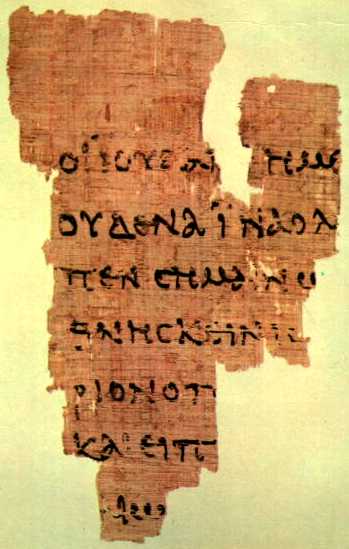
P52

Currently suffering a touch of emotional and intellectual drift and sadness, which often happens.

Via Pharyngula, I've been listening to a talk by the atheist biblical scholar Hector Avalos. In it he showed a papyrus fragment of New Testament MS, the earliest dated fragment, called P52, which he mentions as dating from around 125CE. The purpose of showing this evidence was to underline the fact that we have nothing whatsoever from the time of Jesus to prove his actual existence. It interested me, though, in terms of addressing again the dates of the gospels. This fragment is from John, which I seem to recall is generally agreed to be the last-written gospel. In fact, according to this site, the fragment's dates are estimated as between 125 and 150CE. It has not been carbon dated, according to Avalos, it has only been dated through paleography [hand-writing]. However, though there are no other extant manuscripts dating before the third century, the gospels are dated according to the events recorded within them [eg the destruction of Jerusalem in 70CE, apparently prophesied in Mark, possibly because it had already happened], and according to their political treatment of the Romans and the Jews [there were obviously great tensions between them both before and after Jerusalem's destruction], as well as the use of Latinisms and other possible markers. Scholars are generally agreed that the writing of Mark, the earliest gospel, falls between 65 and 75CE. 

Avalos is keen to cast doubt on the very existence of Jesus, which is very easy to do. He says in his talk that the name Jesus isn't mentioned in fragment P52 - though he doesn't deny that it's a genuine fragment of John. The above-mentioned site gives a translation [the MS is in Greek] which, through reconstruction of the missing words, mentions Jesus and Pilate a number of times [both sides of the papyrus are written on]. It was discovered in Egypt, which suggests, well, nothing much more than the gospel had spread to Egypt by that time.

Another, smaller and older fragment, 7Q5, from the Qumran caves, is purported to be from Mark, but the evidence is very doubtful.  

I happen to have been reading a bit on anti-semitism lately - first, only sketchily, in Rebecca West's book, in which she merely points out William Joyce's anti-semitism, but more powerfully in Niall Ferguson's The War of the World, which looks at all the cultural, economic, imperial and other forces swirling around in the first half of the twentieth century. Amongst all that is European [and American] anti-semitism and its role in WW2. And I'm also reading Rome and Jerusalem: the clash of civilisations, by Martin Goodman, which focuses primarily on the destruction of Jerusalem by the Romans, its causes and consequences. The book has a brief epilogue entitled 'the origins of anti-semitism', which I read this morning [though I've only read a fraction of the book itself]. 

So there's always material to write about, to keep depression at bay. 


Labels: ,

Saturday, August 30, 2008

The Vessel of Wrath


Lanchester's Miss Jones

For all his limitations Somerset Maugham is still a pleasurable read, and a writer we can gain from. I’ve just read ‘The Vessel of Wrath’ from volume 2 of his collected short stories. It was written in 1931 [and in fact filmed in 1938 by Erich Pommer with an impressive cast including Charles Laughton as Ginger Ted, Robert Newton as the Dutch Contrôleur and Elsa Lanchester as Miss Jones, though for some unfathomable reason it was released in the USA as The Beachcomber] and set on the Dutch controlled island of Baru, principal island of the Alas Islands. Nowadays, these islands, just to the west of the Solomons, are part of Papua New Guinea.

There’s a certain datedness in Maugham’s surface style which is revealing as it preserves attitudes and considerations well. Early on in the story, for example, he writes ‘The population of the [Alas island] group is estimated at about 8000, of whom 200 are Chinese and 400 Mohammedans. The rest are heathen.’ It’s an odd and arbitrary division in which Chinese is apparently counted as a religion, but it’s pragmatic enough. The point being that the vast majority of the populace will provide raw material for the missionary work that is a part of the story.

It’s a story of four white people, set against an amorphous background of restless natives, and Maugham tells his story with an eye for detail and a mordant humour that masks a certain remoteness and lack of empathy. The fat controleur and Ginger Ted the scapegrace are in a sense pitted against the humourless Joneses [brother and sister rather than husband and wife] who are missionaries with a bit of doctoring on the side [or vice versa, I’m not sure]. Miss Jones [her first name isn’t provided] is middle-aged and unattractive but strong-willed and competent, much like her brother, yet the more laid-back controleur and even the drunken Ginger Ted have their practical capabilities, and the author clearly finds this pair the more congenial.

Miss Jones might be described as the stereotypical ‘old maid’, disapproving of but obsessed with sex. Having just watched D W Griffiths 1916 film Intolerance, which features middle-aged matronly do-gooders wreaking destruction on those they regard as depraved, I recognise the zeitgeist out of which these ‘types’ are constructed, but Maugham does at least make us feel sympathy as well as a callous amusement at poor Miss Jones’ self-concocted excitation at the prospect of being raped [she finds herself, in a key scene in the story, forced to spend a night on a desert island with Ginger Ted, who has a reputation for sexual depravity]. We might also feel a grudging admiration for the woman’s final sexual victory, when in the end she wins over the former scapegrace, persuading him to at least give lip service to the missionary position.

In the end, it’s a story about sex. Miss Jones imagines being raped by Ted, and when he doesn’t do so but covers her up instead, she’s able to combine the qualities of a gentleman with those of a sexual conqueror, thereby purefying her lustful thoughts, while still retaining them. Not that it’s likely that Ted will remain totally tamed, or that the missionary position will retain much flavour for too long.

The author’s own view is of course not explicit, he speaks through his characters, variously. Some remarks on god and providence, however, struck me as well calculated. Miss Jones and Ted had become stranded on their island [in an ingenious touch Miss Jones insists on consummating their marriage on this same island] when they were off together fighting a cholera outbreak on outlying islands, in which 600 islanders lost their lives. Miss Jones believes, of course, that the Lord’s will has brought them together:

‘Do you think so?’

Í know it. Don’t you see? Except for the cholera Edward would never have found himself. Except for the cholera we should never have learnt to know one another. I have never seen the hand of God more plainly manifest.’

The Controleur could not but think that it was rather a clumsy device to bring those two together that necessitated the death of six hundred innocent persons, but not being well versed in the ways of omnipotence he made no remark.

These kinds of grotesque arguments are still made by even the most supposedly sophisticated of believers, as Dawkins [God Delusion, chap 2, p64] well illustrates.

Labels: ,

Tuesday, August 12, 2008

brief altercation


gospel? - I doubt it

I’m not a very sociable person – I don’t get close to people, though I generally get on well enough with them. It occurs to me, though, that though I’m a social animal through and through, I’m never more sociable, more relaxed, more witty, more thoughtful, more loving and caring than when I’m alone.

I teach English to people from Vietnam and other mostly Asian countries, and I perform quite well for them and no doubt give an impression of being affable and friendly, and I’m friendly enough with those I associate with through foster caring, but I’m very bad at keeping up with friends, I don’t always, or often, respond to emails, I never visit or ring people unless I have to, and I generally avoid. I’ve completely lost contact with my ‘real’ family and things are pretty rocky too with the family I married into. My former wife keeps promising to divorce me, but she hasn’t yet. We’re quite good friends, but she’ll be moving further away from me in a few days.

I would really like to have someone to argue with. Someone knowledgeable and secure in themselves who can takes things I say and scrutinize and question them and give me a hard time without being in any way personal, someone who’ll add to my thoughts and deepen them, not letting me away with anything lax, urging me on, with a kind of unserious but really very serious respect. Why are such energizing people so incredibly incredibly rare?

I had the briefest of altercations yesterday. One of my former step-daughters, a theology student, was talking to the recent spouse of another former step-daughter about the various texts that did or didn’t make it into the holy book. She ‘explained’ to him that those other texts were rejected because they were full of myths[?!!] I’d just arrived on the scene at this point, and I couldn’t help chipping in with the sarcastic, “Yes, and those texts that were included contained no myths at all’’. “No, they didn’t,” my former step-daughter said, loudly and emphatically. At the same time, the husband of my other former step-daughter said laughingly, “oh no now, settle down, settle down”, for he’d no doubt heard of my belligerent atheism though I’m quite sure he’d never heard anything from me. Meanwhile, my response to my former step-daughter was a forehead-slapping “Of course they did,” to which she responded with some claim to being an expert, as a long-time and high-flying student of theology. I muttered something about the uselessness of theology, while the husband of my other former step-daughter went on trying to becalm the ruffled waters. That’s when I let it go. End of altercation. Bloody boring. And then went on chatting with my former step-daughter about the house she was hoping to buy, and it was all very amicable… and boring.

Of course [ah, alone again] the question of whether the Bible tales are myth or historical fact isn’t a theological question, it’s an empirical one. Perhaps more specifically an archaeological one, and it’s already been largely answered by that discipline. There is, as far as I’m aware, not a single historical claim made in the bible that has been backed by a scrap of archaeological evidence. Not a single scrap. Of course, theologians don’t take much of an interest in archaeology. And they wonder why they’re considered irrelevant!

Labels:

Thursday, July 24, 2008

more education, less religion


Delighted to hear recently that, overall, teenage pregnancies have fallen to a virtual all-time low in Australia [they've been steady at that low rate for a few years now] though there are still problems in the top end and in rural areas.


This is an impressive result considering that the stigma attached to teenage pregnancy is surely much less than it used to be. Leaving aside planned pregnancies, it would seem that teenage pregancy is largely a result of ignorance and/or carelessness. Not that I want to sound callous about it, for it's often the most traumatic event in a young person's life, and it can often lead to retreat from the kind of assistance that's generally readily available these days.


The good thing is that the reduced numbers are another stab to the heart of the death cults with their anti-contraception and anti-sex prejudices. These cults are being increasingly rejected in our society, which is growing more healthy as a result.

Labels: ,

let's keep on pluggin

godlessness - is it worth it?


Thank anyone but the gods for the internationalism of the net. I read this beauty via Pharyngula.

Labels:

Sunday, June 29, 2008

The Stewtape Letters, No 1


lashing Lash: easy pickings to start with

Dear Nicholas Lash
I've picked you out more or less at random to be the first recipient of my Stewtape Letters, which are a hopefully polite and civilised approach to the issue of religion, particularly Christianity - it being the dominant supernatural belief system in the west - and its costs and benefits in our society. Generally these letters will be addressed to believers, though sometimes they'll be addressed to critics of those advocating entirely 'non-supernatural' belief systems. These critics may or may not be believers themselves.

While websurfing I happened to come across an abstract of an article you wrote for New Blackfriars magazine, entitled ‘Where does The God Delusion come from?’ I’m afraid I haven’t read the whole article and would prefer not to do so as I would find it tiresome – which would put you offside immediately of course, but there are so many other things to read, learn and do, and I can well imagine what an elaboration of your abstract would be like.

In any case, the abstract itself provides plenty of material to sink my teeth into, if you’ll pardon the expression father [if you’re a father]. First I ‘ll note that New Blackfriars is ‘’A Review: Edited by the Dominicans of the English Province, published on behalf of the Provincial Council of the English Province of the Order of Preachers”, and so the article is designed principally for consumption by your own [dwindling] constituency, so to speak. For my readers [ho ho] I should point out that you’re a Catholic theologian, and that you’ve written various texts, with religion, theology and god in the titles. Wikipedia describes you as a loyal and obedient Catholic – the term obedient being an important operative, as good Catholicism seems to be as much about submission as is Islam.

That this article is designed for your own people is more or less obvious from the abstract. Your readers will give a bright hallelujah to these sentences:

Given The God Delusion's lack of extended argument, historical ignorance and unfamiliarity with the literature, the praise it has received from some distinguished scientists is troubling.

to address the question of what it is about the climate of the times that enables so ill-informed and badly argued a tirade to be widely welcomed by many apparently well-educated people.

It isn’t my view that Dawkins’ book is badly-argued or ill-informed, though it steers clear of theological literature and only dwells lightly on the various philosophical arguments put forward for the existence of a god or gods. I think it’s probably the lightest of Dawkins’ books, and I think that is entirely fitting to the subject, a subject he can’t quite take seriously. I also think that, like your article, it’s addressed largely to his own [expanding] constituency, a group to which I belong. We find the book hugely entertaining and amusing, as well as accurate.

It’s also a book full of optimism. Let me take, for example, his comments about practising scientists in the USA and their religious views:

A study in the leading journal Nature … showed that of those American scientists considered eminent enough by their peers to have been elected to the National Academy of Sciences… only about 7% believe in a personal god. This overwhelming preponderance of atheists is almost the exact opposite of the profile of the American population at large, of whom more than 90% are believers in some sort of supernatural being. The figure for less eminent scientists, not elected to the national academy, is intermediate. As with the more distinguished sample, religious believers are in a minority, but a less dramatic minority of about 40%. It is completely as I would expect that American scientists are less religious than the American public generally, and that the most distinguished scientists are the least religious of all.

These remarks could hardly be described as badly argued; they’re merely a commentary on some fairly conclusive hard data. More importantly, they emphasise Dawkins’ focus – a reasonable hope that religion is losing its grip, especially amongst those who most matter, those in the process of shaping and changing our understanding of the world. Like many of us, he believes that science and religion are in conflict, and that religion has lost and will continue to lose every battle.

Of course, the Holy Roman Catholic and Apostolic Church, recognising the damage it has done to its cause in backing the loser in the scientific stakes on every historical occasion, has chosen more recently to back evolution, though in an unsurprisingly half-hearted way. Most scientists and non-believers are far from fooled by this move, and see it as entirely political, just as the move to pronounce the infallibility of the pope in the 1860s was a political move in response to the Vatican’s loss of material power in Italy and Catholicism’s giving way to the protestant ascendancy in Northern Europe. Dawkins claims that the Catholic church makes it up as it goes along, a remark that you, with your huge investment in that particular set of interpretations of your religion, will undoubtedly see as awfully glib, but to most of us the evidence speaks for itself.

You clearly don’t come from a science background, but you do make a claim about science in your abstract. You write of the illusion, unique to the English-speaking world, that there is some single set of procedures which uniquely qualify as "scientific" and give privileged access to truth. These words are quite revealing. Of course, science’s aim is to discover how the world works, and scientists, largely by trial and error, have worked out various methods for uncovering the truth about this, though in fact setting these methods in stone, so to speak, has proved more difficult than might have been thought, as philosophers of science can attest. In any case, a complex and painstaking combination of model building, experimentation, theorising, careful observation and the like, has resulted in a great furthering of our knowledge over the past few centuries, and scientists should feel rightly proud of the great strides they’ve made. Yet though it would be hard to define absolutely the scientific method, or set of methods, we’re fairly clear about what constitutes an unscientific approach. Results must be repeatable and verifiable, and hypotheses must be rigorously tested before being accepted as genuine theories. It isn’t about ‘privileged access to truth’, which is a curious term, presumably used in religious discourse but quite foreign to science. Scientists don’t follow their procedures in the expectation that they will give them privileged access to truth, they follow them because they work. As to the claim that scientists in the English-speaking world are under an illusion not experienced by Italian, French, German or Korean scientists, such absurd claims aren’t worthy of a response.

Presumably you’re suggesting there are other forms of truth apart from scientific truths, which is the usual way religious thinkers try to avoid the call to provide evidence for their claims. Of course, ‘truth’ by divine revelation really is privileged access to truth, isn’t it? My contention, and that of most non-believers, is that there is no such thing as privileged access to truth. It’s arrived at through hard work, mainly – a modicum of inspiration or insight, and lots of perspiration. Perhaps in the body of your essay you’ll point out other forms of truth than that which relies on evidence and verifiability, but I doubt if you’ll convince anyone outside your own constituency.

I now want to focus on what you describe as Dawkins’ unfamiliarity with the literature, which you also refer to in terms of his book’s ignorance of the grammar of “God” and of “belief in God”. This clearly refers to theology, and many of Dawkins’ critics have focussed on this.

Amusingly, Dawkins anticipated this by placing at the front of his book the story of Einstein and his theological critics. Einstein rejected in no uncertain terms any belief in a personal, interventionist, anthropomorphised deity, and of course was jumped on by theologians who claimed he should shut up about matters about which he was ignorant. In those days, a mere 70 years ago, theologians and church leaders felt safe about being openly abusive and offensive in their responses, but their authority has fortunately slipped a bit since then, and they now have to at least provide a semblance of a real argument. But the theological ignorance argument is no less bogus now than it was then.

Theology’s a funny old subject isn’t it? I believe Isaac Newton wrote far more on theological issues than he ever wrote about mechanics. What theological issues did he write about? I’d have to look it up, for the fact is, those writings are of merely historical interest, and Newton would be a rightly forgotten figure today if that was all he wrote. Which raises the question of whether any theological work has ever had even a tiny fraction of the impact of the work of Galileo, Newton, Darwin or Einstein on our understanding of the world. There are, of course, thousands of Islamic, Judaic and Christian scholars wasting tonnes of ink today on such matters as ‘the grammar of God’ and ‘the nature of belief’. If all of that work was erased from the planet tomorrow, what difference would it make? You tell me – I would love to know. As a theologian yourself, you would find even this probing to be grossly offensive, for it suggests that you’ve wasted your life. No comment to that. As Dawkins points out early in The God Delusion, the subject of theology creates the illusion that there are people who are experts on the nature of god, and that in order to comment yourself, you should train rigorously in this area. Such an illusion is much-beloved of hierarchical, authoritarian organisations like the Catholic Church, for obvious reasons. It needs to be challenged and rejected as the self-serving sham that it is.

You’ve mentioned Dawkins’ paradoxical belief in progress, and also his book’s lack of interest in ethics. I don’t see anything paradoxical about such a belief. We do make progress. A simple example. In the nineteenth century, in Britain and Europe, there were a number of quite commonplace beliefs. It was generally believed that white people were superior to black people, that men were superior to women, and that homosexual behaviour was a mixture of the criminal and the diseased. Of course, the Catholic Church still officially believes in the third of these, but it can be safely ignored. It also still believes in the inferiority of women, to all intents and purposes, but the majority of us have progressed beyond these false and damaging beliefs. How was this progress achieved? Generally in the teeth of established religion, through universal, secular education, through international travel and trade, and through a more scientific understanding of what human beings actually are. And these changed beliefs have quite massive ethical implications. The most ethical thing that we can do is learn about ourselves and our world. I have no doubt that Dawkins understands that, and as such, his book is in fact steeped in ethics. It is a highly ethical pursuit to seek to divest people of their delusions, and that is his whole purpose, and it’s the purpose of many of us, and we continue to grow in strength and numbers. Where does The God Delusion come from? It comes from a questing spirit, and a sense that enough is enough – it’s time to put away childish things , and to drive out the self-appointed ministers of gods, and expose their bogus expertise on eternal verities about submission and worship.

I’m sorry that I’ve not ended up as politely as I’ve started out, but I am indignant about this issue, and impatient to see the end of the claptrap that, unfortunately, you and your ilk represent. The truth is at stake.

I wanted to email this to you personally, and I almost got hold of your email address, but unfortunately it escaped my grasp. I'll keep trying, i'd love to hear your response. It's never to late to change.

Yours from the USSR.

Labels:

Wednesday, June 25, 2008

letters from the new ussr


I’ve not written much lately on the religious turn, but believe me, I’ve not stopped reflecting on it. The other day I stopped in at Borders bookshop and gravitated naturally to the philosophy/religion section. I took from the shelves a new Australian title by a lawyer who, he said, had never been much of a religious person until he married a catholic [I think – anyway, someone devout]. He’d gone to Sunday School as a kid [as I did], but it didn’t have much impact – he said. He’d gone onto university, and obtained his law degree, and then, at some stage had suddenly or gradually realized that the Christian revelation was true. I sat and read the preface to this personal/intellectual story [rifling through the rest, I noticed much argument on ID and much mention of Michael Behe and Richard Dawkins] and found the fellow gentle, polite, likeable and a bit sad – as I tend to find all well-meaning religious liberals – but I also found much, just in this preface, that was plainly absurd. The back page blurb said that the book refutes Dawkins and makes a convincing case for Christianity, etc etc, but only a few pages of reading were enough to show how hollow such a claim was. At the same time, the recommendation by Gideon Haigh [a sportswriter, and a very good one, but the Christian name in more ways than one gives the game away] that ‘this book cannot fail to move the reader’, struck me as largely true. The sincerity and apparent humility of the writer made me feel almost as much a desire to defend him as to attack him. Almost.

So I half-formulated there and then to blog-write a series of sincere, humble and polite letters, like Dear Terry [Eagleton], Dear John [Polkinghorne], and even Dear Saint [Augustine, Paul, Jerome, etc], to address in a kind-hearted manner their unfortunate and untenable views. A sort of P Z Myers with a charm transplant approach.

The first letter should be to this lawyer-writer I was reading in Borders, but sadly I no longer remember his name or the name of his book, so half-hearted I am in my commitments. So will anything come of this? We shall have to wait and see. I’m trying to think of some amusing secular play on The Screwtape Letters. I’ll sleep on it.

Labels:

Wednesday, June 18, 2008

more on bullying, and sunlight at the end of the tunnel

home made beer bottle solar panel [China]. It works, apparently

While the issue of bullying is important, and the Della Bosca Belinda Neale fracas [the night of the iguanas] is one example of the corruptions of power, which I was going to write about, there are plenty of other examples, some of them even more globally important.

It might be a stretch to speak of the rise of primitivist religions, or primitivist branches of established religions, as a form of bullying, but maybe not too much of a stretch. Certainly it’s not about reasoned debate – it’s about tactical maneuvering and aggressive lobbying for unrepresentative control of politico-social agendas. A small example of this is the threat, apparently from conservative Catholic MP Ron Boswell, that the government will experience a serious backlash if it tries to decouple overseas aid funding from a moralistic position regarding abortion and contraception. They wouldn’t get away with it in Australia, as pointed out in Mobile Science. Cheers too, to the Sunday Mail columnist [I forget her name] who strongly criticized the likes of Boswell and the bullying moral minority in last weekend’s paper.

That we’ve tied funding to such matters in the first place is something of a scandal – only the US, of course, also does this. It’s been happening here since 1996, thanks largely to the efforts of another conservative, ‘unrepresentative swill’ senator Brian Harradine. The labor government is about to overturn it, or such is our fervent hope.

The thing about political bullying is that it isn’t about convincing people about the truth of your position through evidence and argument, it’s about hectoring, playing the numbers game, threatening to remove backing if you’re a powerful organization like an established church, or a powerful person like a house leader, making a lot of noise and so forth.

In Indonesia, currently, it’s being taken to a whole new level. A weak central government is being blamed for the rise of, and increasingly aggressive tactics of extremist Islamic groups such as the Islamic Defenders Front, along with the rising power of the fatwah factory, the Ulema Council [originally set up by Suharto to keep the conservative clerics in line]. Recently, Islamist thugs broke up the annual rally of moderate religious folk which celebrates Pancasila Day, and generally there’s a lot of lawlessness of this kind around the country, polarizing the population. The strange and disturbing thing seems to be that, because of the perceived weakness of Yudhuyono’s government, the police and local authorities are taking the Ulema’s derees and pronouncements as law, and acting accordingly, in a most naughtily unconstitutional manner. It doesn’t look as if shari’a law is going to be instituted tomorrow, but still it’s a situation to watch and worry over. All this is well covered by the ABC’s Religion Report.

Meanwhile on the almost domestic front, our co-op is just going to install its first solar hot water system. We have a few properties with solar hot water at present, I think our two most recently built ones, and the three new ones that we hope will be handed over to us in August. We had to insist on getting solar hot water for them, even though we were given systems with out previous two houses, and even though they’re going to become mandatory for newly built houses soon. I’ll write about this next.

Labels: , ,

pavlov's cat