Wednesday, October 15, 2008

Gymnorhina tibicen


At this time of year, Homo australis often experiences, of a morning, one of the simple pleasures of a complicated life, when he awakes to the call of the magpie, Gymnorhina tibicen. Here in beautiful Bowden, around my mud-brick cluster, there’s a pleasant pack of them. Magpies tend to form groups of about ten in my part of the world, though the numbers can be quite a bit larger in less built-up areas. I’ve been meaning to write about them for a while, as they’ve always given me a bit of a thrill, but after going for a local ramble the other day, and watching a magpie hop and warble nearby as a sat reading in the park, I’ve decided today’s the day.


I was reading about how the universe is likely to end [not with a bang but a whimper], so it was pleasant to focus on something else for a while. I noticed this magpie on a picnic table a few metres away, being hassled by two hovering and semi-swooping magpie larks. It’s chick-raising season, maybe that’s the problem. The magpie larks were making these single, simple squealing sounds, while the magpie, when it was ready, came out with its distinctive quardle oodle ardle wardle doodle, to quote from the popular poem by New Zealander Denis Glover.


The magpie’s call is one of the most elaborate of all bird calls. I once heard that this was because the bird is double-throated. I don’t know what that means or if it’s true. I also heard that each individual’s call is slightly different, and I don’t know about that either. As I often do, I’m writing this piece as a process of self-education.


It’s interesting, and perhaps not coincidental, that magpies and magpie larks are often found in the same areas. It’s hardly surprising that people confuse them. Names, too, are confusing, what with the magpie, the magpie lark, the murray magpie, the piping shrike, the butcher bird and the currawong. So let’s sort things out.


The magpie lark, Grallina cyanoleuca, is neither a magpie nor a lark. That makes sense, especially when you consider that the magpie isn’t really a magpie either. That’s to say, the Australian magpie was named after the European magpie, a completely different bird from the Corvidae family, allied to crows and ravens.


In South Australia the magpie-lark is also called the murray magpie. In Victoria and Western Australia it’s known as the mudlark, and the peewee in New South Wales and Queensland. The more I look into it, the more complicated it gets. These birds are fiercely territorial and not afraid to have a go at larger encroaching birds like my magpie.


The piping shrike, emblematic bird of South Australia, turns out to be just another Australian magpie, a subspecies also known as the white-backed magpie, Gymnorhina tibicen leuconata, common to southern and western Australia. Four subspecies have been identified, the others being the black-backed magpie, Gymnorhina tibicen tibicen, the Tasmanian magpie, G tibicen hypoleuca, and the western magpie, G tibicen dorsalis, found in a specific region in the south-west of Western Australia.


Neither the butcher bird nor the currawong are found in these parts, but they cause confusion elsewhere. Butcherbirds come in many colours, and it’s the pied butcherbird, Cracticus nigrogularis, which in fact inhabits most of Australia apart from our region and Tasmania, that I'm really talking about. The picture tells the best story.


The solid and crow-like pied currawong, Strepera graculina, is very much an eastern seaboard bird. And they’re plentiful over there as we all know. I’ve heard them referred to as magpies too [probably by South Australians or other invasive species].


So that’s the run-down of Aussie magpie-like birds. Now what about the magpie itself and its call? Is it double-throated and what does this mean? My net ramblings took me to the deadly double-throated cassowary [no explanation as to why it might be more deadly than a single-throated type], and double-throated fykes [a type of trap], but nothing much at all about what being double-throated entails [maybe the term is too obviously self-explanatory?]. Maybe I’ll return to the subject later – what I’m really looking for is something of the science of birdsong. Meanwhile I’ll enjoy the communications. 

Labels:

Friday, June 20, 2008

our solar moves


photo soon to be replaced by one of our first solar hws

On the news just now on Radio National – but I believe it’s old news – I heard that householders in South Australia will be paid for sending excess solar energy back into the electricity grid, thereby enhancing the state’s ability to deal with peak load. Of course, photovoltaics, that’s to say complete solarisation, is still a distant dream for La Luna.

The state has a rebate scheme for solar hot water systems that apparently comes to an end on June 30, so that many providers are being inundated with orders as the deadline approaches. La Luna Co-op has just ordered its first solar HWS from a Victorian company, and we’ve been lucky to get in ahead of many others, even though the rebate deadline doesn’t affect us! As a co-op we’re ineligible.

What we are eligible for is Renewable Energy Credits [RECs]. On this system, costing $4095, we’re eligible for 42 RECS at $49 each, for a total rebate of $2058, a little more than half the cost price. Installation will be between $1600 and $2000 on top.

From July 1 2008, SA will have new greenhouse and flow rate standards for residential HWSs. A major aim appears to be the phasing out of electric hot water systems. Alternatives are gas, solar and heat-pump systems. Apparently up to a third of residential greenhouse gas emissions come from residential water heating, and electric systems have the highest greenhouse impact.

I don’t know the precise situation regarding our own properties [we have at least one electric HWS], but there may be increased pressure now regarding who gets solar next. Even making decisions on the basis of properties rather than tenants could be tricky.

The two panels we bought were TINOX [titanium-oxy-nitride] coated, which has increased their efficiency. Comparisons between TiNOX and black chrome coatings have shown that there is less thermal loss with TiNOX. It all sounds good, and has increased our RECs score. The only more efficient system is the vacuum tube system, which is apparently rare in Australia.

I’ve made enquiries to our maintenance officer to get the low-down on our water heating systems [I’ve little idea even about my own system, except that it’s gas, as were the systems at Exeter Tce], and whether any others need replacing. At this price [$4000 at most, in the wash-up], and with some 14 properties to be turned to solar, we’re talking more than $50,000. Our surplus this year will be around $10,000. If we did two a year, we’d all have solar hot water systems within seven years. We’ll need to check out the systems being put in place in our new houses too – what will the government install? I doubt if it’ll be exactly state-of-the-art.

As far as I know, two of our houses, at Browning Street, already have solar hot water systems, but I’ve heard nothing about their efficiency and cost. That’s another thing I’ll have to research. There’s also the possibility of upgrading from solar hot water systems to a more comprehensive use of solar power in our properties.

Labels:

Wednesday, June 18, 2008

more on bullying, and sunlight at the end of the tunnel

home made beer bottle solar panel [China]. It works, apparently

While the issue of bullying is important, and the Della Bosca Belinda Neale fracas [the night of the iguanas] is one example of the corruptions of power, which I was going to write about, there are plenty of other examples, some of them even more globally important.

It might be a stretch to speak of the rise of primitivist religions, or primitivist branches of established religions, as a form of bullying, but maybe not too much of a stretch. Certainly it’s not about reasoned debate – it’s about tactical maneuvering and aggressive lobbying for unrepresentative control of politico-social agendas. A small example of this is the threat, apparently from conservative Catholic MP Ron Boswell, that the government will experience a serious backlash if it tries to decouple overseas aid funding from a moralistic position regarding abortion and contraception. They wouldn’t get away with it in Australia, as pointed out in Mobile Science. Cheers too, to the Sunday Mail columnist [I forget her name] who strongly criticized the likes of Boswell and the bullying moral minority in last weekend’s paper.

That we’ve tied funding to such matters in the first place is something of a scandal – only the US, of course, also does this. It’s been happening here since 1996, thanks largely to the efforts of another conservative, ‘unrepresentative swill’ senator Brian Harradine. The labor government is about to overturn it, or such is our fervent hope.

The thing about political bullying is that it isn’t about convincing people about the truth of your position through evidence and argument, it’s about hectoring, playing the numbers game, threatening to remove backing if you’re a powerful organization like an established church, or a powerful person like a house leader, making a lot of noise and so forth.

In Indonesia, currently, it’s being taken to a whole new level. A weak central government is being blamed for the rise of, and increasingly aggressive tactics of extremist Islamic groups such as the Islamic Defenders Front, along with the rising power of the fatwah factory, the Ulema Council [originally set up by Suharto to keep the conservative clerics in line]. Recently, Islamist thugs broke up the annual rally of moderate religious folk which celebrates Pancasila Day, and generally there’s a lot of lawlessness of this kind around the country, polarizing the population. The strange and disturbing thing seems to be that, because of the perceived weakness of Yudhuyono’s government, the police and local authorities are taking the Ulema’s derees and pronouncements as law, and acting accordingly, in a most naughtily unconstitutional manner. It doesn’t look as if shari’a law is going to be instituted tomorrow, but still it’s a situation to watch and worry over. All this is well covered by the ABC’s Religion Report.

Meanwhile on the almost domestic front, our co-op is just going to install its first solar hot water system. We have a few properties with solar hot water at present, I think our two most recently built ones, and the three new ones that we hope will be handed over to us in August. We had to insist on getting solar hot water for them, even though we were given systems with out previous two houses, and even though they’re going to become mandatory for newly built houses soon. I’ll write about this next.

Labels: , ,

Wednesday, June 11, 2008

more reveries of the solitary walker


clipsal bowden


Kissing, or osculation, according to a theory first propounded by Desmond Morris and generally accepted, probably first began with primate mothers feeding their young semi-masticated food by mouth. The young would get into the habit of approaching their lips for a bit of tasty slime, and mum would either feed them or comfort them with a lippy version of a dummy tit. We humans of course, have taken the art of osculation to dizzying heights, revealing a ravenous appetite for more than just food.

The ventral tegmental area of the brain, which produces dopamine, is stimulated by kissing and by thoughts of love. My own ventral tegmental area is many times larger than that of most humans, but it remains largely unstimulated.

So I walk, and contemplate, in the damp night. I live quite close to the heart of the city, and I intend that this house, into which I moved last December, will be mine for a long time. I don’t want to move again. So I’m interested in plans for the area, and in transport plans for the city centre so close by. I’ve rarely used public transport, mea culpa, since becoming a driver 15 years ago, but petrol prices are starting to take their toll, and there’s a chance I’ll lose my licence for a while from next month, with a court case coming up.

The Committee for Adelaide Roads, a lobby group made up of engineers and transport industry boffins, has come up with a multi-billion dollar plan involving light electrified rail, dedicated bus and ‘car-pooling’ lanes [can’t quite imagine that], and a strategic road network, with duplication of the Southern Expressway being marked as a high priority.

Some of this might be pie in the sky, but the state government has unveiled a 2 billion dollar transport plan which involves extensions to the new and very successful [indeed already overcrowded] tram system. For starters, trams will be running out from the city to the entertainment centre, presumably up Port Road, by 2010. And I just took a brief promenade to the entertainment centre this evening. This is fabulous news.

The major train systems to the north and south will be electrified, new trams will be bought to reduce congestion, and a new ticketing system will be installed. It’s all rather trifically exciting.

Nearer home, here in Bowden, the 10 hectare Clipsal site is going to be redeveloped at a cost of about $42 million. Here’s some very new stuff about this redevelopment, with the state government prioritizing areas around traffic corridors. Transport Minister Kevin Foley has said the site at Bowden could become the best inner city development area in Australia, after Clipsal moves its manufacturing site to Gepps Cross. Yeah, yeah, I’ll believe it when I see it, but I can’t pretend I’m not excited at the prospect. This little loner will have so much more to observe and contemplate.

Labels: , ,

Saturday, June 07, 2008

a meandering dawdle, finally about the weather


I don’t work for Mister Krudd, I prefer to work for myself, at my own snail’s pace, and I’ve always been a dawdler and a dreamer. I remember as a kid, walking to school. Younger kids, disabled kids, parents with kids in tow, they all steamed by, leaving me dawdling in their wake, wondering at the cracks in the footpath, dreading arrival. I heard the teacher say something interesting, and I took it and retreated into the little back room of my brain, poked and prodded it, tried to find uses for it, tried to fit it into other bits and pieces I’d secreted there, and when finally I emerged, the lesson was over and people were packing up to go home. I suppose that means that I don’t share Mr Krudd’s work ethic. Maybe I don’t share anything, just horde and forget. I’ve forgotten why I sat down here. To put my queer shoulder to the wheel? To forget, more like. But I have looked up this and that, learned that I don’t understand much, such as how to interpret the climate change data. Some are saying that the global climate has cooled in the last ten years, others are saying that’s bunk, and everybody is interpreting it differently, and I’m not at all sure what I mean by it, since nobody seems to agree on it, and there are so many different data sets.

Outgoing longwave radiation is somewhere in the mix, and this is affected by the presence of greenhouse gases such as nitrous oxide, methane and water vapour. OLR is the amount of energy leaving the earth at low levels. It almost equals the shortwave absorbed radiation coming in from the sun. We should apparently be grateful for this balance.

Research suggests, apparently, that the uptake of CO2 by the oceans, particularly, or specifically, the North Atlantic, which is an intense sink for CO2, has been slowing, though of course too little is known to make many inferences from this – as to whether it is cyclical or has been affected by GW or AGW, etc.

It’s shown here and elsewhere, by those more expert than myself, that the recent coolness – a particularly cold northern winter – was due to it being a La Nina year. It seems that this La Nina, the first since 1998, has been a ‘textbook case’, though of course its effects on life in the oceans will be influenced by a variety of other climate-change patterns.

Those who say that AGW is bunk, or even that GW is bunk because nothing out of the ordinary is happening – taking millennia into account rather than a few years of monitoring – seem to be showing extraordinary complacency in the light of worsening King Tides in Tuvalu, accelerated melting of the Greenland ice cap, rising temperatures in the atmosphere above Antarctica and so forth. Sure you can always find conflicting data, and the scientists themselves are ever-concerned about the quality of climate modelling, but the trends are surely unmistakable, and we can always throw our hands up and say, this is all within the bounds of normal and so what if a few species get wiped out even maybe our own, but the fact is we don’t have a death-of-our-species wish, and we can reverse the degrading situation, so let’s start looking to solutions. There comes a time when scepticism becomes self-defeating, we all know that.

Labels: ,

Thursday, June 28, 2007

solarisation


As the treasurer of a small but proud housing co-op, one that is thriving under new financial arrangements with our government funding body, I've actually been having sleepless nights imagining our future and the possible complete solarisation of all our houses - some 21 by the end of next financial year - over the next five years or so. Others in the co-op are equally excited, but I have to admit that I for one have only a vague idea what solarisation means. There's a part of me that treats it as an all-transforming magic; no more aircons, no more electric lights, no more heaters, no more anything electrical - we have solar.
So now I'm going to educate myself as to how domestic solar energy works, how much it's likely to cost and how it will benefit the co-op.
First, as this site informs us, there are two types of solar panel currently on the market, which use quite different technologies. They are the solar water heating panels, used simply to heat water, and the solar electric or photovoltaic panels which transform solar radiation directly into energy. It's the latter, of course, that this post is concerned with.
This Australian site provides a comprehensive guide to photovoltaic ''modules'', their types, their siting and installation and their output, but is silent on costs. Further, it says that ''with a few solar modules, the homeowner can capture some of [the sun's] abundant energy''. A few? Just how many are needed to power a house such as mine twenty four hours a day?
Clearly this will depend not only on the number of solar modules but their type. There are two main types currently on the market, crystalline silicon and amorphous silicon thin film. The latter technology is likely to lead to lower cost modules in future, and is a more flexible technology in general, though thin film modules are currently less efficient than crystalline silicon modules. With the further development of thin film modules, greater integration into building materials is expected.
Another factor is, of course, sunlight in your area. Adelaide gets more hours of sunlight per day, on average, than Sydney, and more still than Melbourne, but Perth gets more than any of the other capitals. Panels ideally should face north, and having enough north-facing roof-space on our dwellings could be an issue.
Another major factor is consumer usage, which varies considerably between households. Energy conservation still needs to be promoted throughout the co-op, regardless of solarisation.
It’s quite difficult to get clear information on cost, but I did read somewhere of an array of panels at a cost of $18,000 reducing electricity costs by about a third – or maybe it was two thirds. In any case, this sort of return may not be worth the cost to our co-op, especially as federal government rebates of up to $8000 per installation are not currently available to us, under the rationale that, as a taxpayer-subsidised organisation, we shouldn’t be eligible for further subsidies.

This is an issue we could lobby government on. There’s also an organisation called Solar Sales, based in WA, which provides consultancy for PV module installation, and helps in accessing government grants and rebates.

So, that's a start, but we have a long long way to go in terms of solarisation of our properties. It will probably be impossible, for example, to equally spread the savings among co-op households, as some homes would be able to accommodate more panels than others. It may be, though, that we could do two modules per home, to spread the load more evenly, and then add panels as we become more financial - but this would perhaps unnecessarily increase installation costs. Clearly we'd need advice tailored to our particular homes.


Labels:

Sunday, May 20, 2007

gleanings


this picture not taken in russia

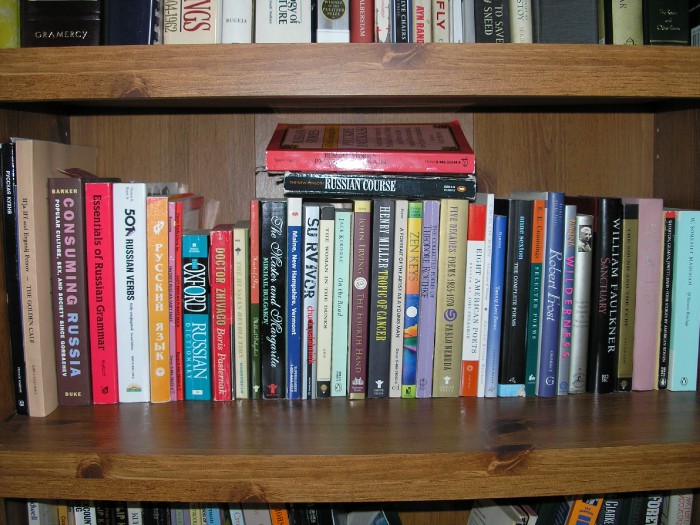
I’ve heard that reading, and personal libraries, once status symbols in old USSR days, are no longer fashionable in the new Russia.

I’ve heard that there may be something for La Luna to exploit out of the environmental funding in the recent Federal budget. I’ll be looking into that more closely soon.

I’ve read that the second, third and fourth Presidents of the USA may have been atheists, or at the very least non-Christian deists, a la Thomas Paine. The first and fifth Presidents too perhaps. It should be noted that these five – Washington, Adams, Jefferson, Madison and Monroe, were all among that country’s finest leaders. How have the mighty fallen.

Jefferson -liked Jesus sans miracles

I heard that the only economies in the world that aren’t growing at present are those of East Timor and Zimbabwe. No doubt an exaggeration, but it nicely contextualizes the supposed economic credentials of the incumbents [I mean the Howard government for my international readers hoho] come election time.

I’ve read a review of Hitchens’ anti-religion book by Jack Miles, whose own book on God [that’s the Judeo-Christian one] so intrigued me last year. Miles, a professor of English and religious studies and apparently a liberal Christian, is only mildly critical, admonishing Hitchens largely for being overly polemical and insufficiently substantive. However, he makes an initial, somewhat gloating point I must take issue with:

The atheist alternative has been around from the beginning, after all. How dispiriting it must be for the neo-atheist pamphleteer to pick up "The Cambridge Companion to Atheism" and read even Chapter 1, "Atheism in Antiquity."

The answer is that it isn’t at all dispiriting, because the fact is – and the evidence for this is overwhelming – that atheism was almost never used before the eighteenth century except as a term of abuse. Before the Enlightenment, the term and its variants [infidel being the most common] were used to demonise those who either weren’t members of the critic’s religion or didn’t toe the orthodox line within that religion. Most condemned and persecuted ‘atheists’ were far from being atheists at all, and positive atheism is a very recent vintage indeed.

I’ve read that Paul of Tarsus, about whom opinion is so vastly varied, was a masochistic, misogynistic anti-intellectual and thanatophiliac, and that Christianity’s spread, under the noses of authorities, was largely due to its grassroots anti-intellectual formatting by Paul, who advised his uneducated followers to kowtow to local authorities. Not considered much of a threat, it spread as a message of hope [in the next world of course] among the numberless disenfranchised peoples of the Roman Empire. When Constantine came to power, he considered it expedient to convert, to please the ranks of poor Christians in his armies, and from that day forward the real repression began, of intellectual pagans in the name of the saviour god of the rabble. Shades of Pol Pot, the Bolshies and so many other revolutions.

Labels: , ,

Monday, May 07, 2007

Adelaide the solar city

we want sliver cell panels

A federal Government media release on August 30 last year announced that Adelaide had been selected to host Australia’s first solar city trial. To quote from the release:

The Adelaide Solar City proposal will install solar panels in more than 1700 homes in north Adelaide, roll out 7000 smart meters and help people save around $200 a year on their electricity bills by changing energy use and adapting energy efficiency measures. The solar panels will be made in Australia by BP Solar at their Homebush plant in Sydney and the SLIVER ® cell technology will come from Origin Energy's Adelaide plant. Consumers will be able to purchase these solar panels using special discounted loans.

Apparently this proposal involves a consortium of businesses and local councils. The businesses include Origin Energy, BP solar, Delfin, ANZ and Big Switch. The councils involved are Adelaide, Playford, Tea Tree Gully and Salisbury. Unfortunately none of La Luna’s houses are in these council areas. Whether the discounted loans are available to house owners/managers outside those council areas is unclear. Presumably not. The period of the proposal is seven years, to 2013.

The Origin Energy site also provides some useful pricing on solar. They offer a hot water ‘solarise’ package for $2175 including all rebates and GST. A total home solarisation makeover can be done for $9875. Bearing this in mind, La Luna could provide solar hot water to all our homes over, say, a three year period, starting now. However, there’s another important issue to be considered, and that is the quality of the solar panels. Currently, we’re told, the cheap solar panels – presumably the ones being offered in this package, have a life-span of only ten years. If this is true, ongoing costs will prove to be a problem. The panels being sold as a part of this package come with a ten-year warranty, but the Office of Community Housing, who allowed us solar hot water on our Wilkins Street properties, built a couple of years ago, weren’t going to allow us the same thing on our yet-to-be built Klemzig properties, apparently because they felt that it wasn’t cost-efficient due to the short lifetimes of the panels. We’ve managed to do a deal, however, purchasing solar panels at the expense of floor coverings.

Most of our current homes use gas to heat their water, so the monetary and greenhouse savings would be less than would be the case with electrically heated water. If there are any electrically heated water supplies, I’d suggest they would be our top priority for conversion. We’d also have to look at it from the point of view of the property as a whole – whether we would consider that property to be a permanent part of our portfolio.

There are some questions we wouldn’t mind answers to. First, if we install solar hot water systems, would they be a step toward full solarisation, or would they have to be dismantled and replaced? Second, what kind of PV technology is used in these panels, and are there better more long-lasting systems commercially available [the commercialization of sliver technology still seems to be away into the future], and what about rebates on them? Also, from the Solar Cities perspective, how can La Luna get in on the act?

Labels:

Wednesday, May 02, 2007

solar - the larger picture


concentrator photovoltaic technology in Central Australia

The most recent issue of Cosmos carries an article on solar technologies, a subject of some interest for La Luna Housing Co-op, a co-op that is looking into enviro-friendly technologies, small and large, for our properties.

Sales of solar panels have soared in recent years, what with global warming concerns and oil price rises and the rising cost of electricity. The increase in sales is also most definitely tied to subsidies. Government interest has meant a greater mainstreaming of the technology. As Cosmos points out, the grid-connected market today accounts for some 83% of solar sales. The Japanese and German governments have led the way in this area, but many other countries, and powerful not-quite-countries such as California, are hurrying to catch up. These subsidies, together with increasing taxation of emissions from the traditional fossil fuel industry, not to mention increasing extraction and other costs, have made solar technology much more competitive, and double-digit growth is predicted for the foreseeable future.

Unfortunately, though, the real cost of manufacturing solar panels has increased significantly in recent times, largely because of a shortage of silicon. The shortage has meant that the price of the raw material has risen by almost a factor of 6. Boosting production of the purified silicon involves a great deal of expense.

So, can photovoltaic cells be manufactured without silicon, or with much less silicon? This is where Australian research is coming to the fore. The sliver cell panel, which uses micro-machined slivers of silicon instead of the traditional silicon wafers, was developed at the Centre for Sustainable Energy at the ANU. A square metre of such slivers will do the job of a 15cm wafer. Another Australian innovation is CSG – crystalline silicon on glass. This is an enhancement of wafer technology which requires 99% less silicon. The technology has been driven offshore due to lack of reliable funding and support. Australia’s government occasionally tries to get in on the act with rhetoric about solar cities, but there’s been little substantial funding for Australia’s solar pioneers, when compared with the funding of solar technology in Europe, particularly in Germany. This has meant that graduates in photovoltaic systems as well as the technologies they develop are being forced out of the country.

Along with photovoltaic panel technology there is a technology called concentrator technology which has been gaining lots of attention lately. The name provides the idea: rather than broad panels which trap as much of the sun’s generous spread of energy as possible, concentrator approaches direct the resource in much the same way as a lens, to create a powerful beam. In fact the latest developments have employed both beams and panels to provide power to remote Aboriginal communities, with curved-mirror tracking dishes concentrating light by 500 times and reflecting it onto specially insulated solar panels, and more ambitious systems are currently being built in regional Victoria. Meanwhile efforts are under way in California to reduce the cost of silicon manufacture substantially. Solar technology is getting hotter all the time at the moment.

Labels:

Friday, February 16, 2007

school days: on power, policy, littering and self-expression


whodunit?

The foster child is having tomorrow off – he has a 'take home', one of his teachers says. There have been a few niggly things, and so he has been given this time out before things escalate. The teacher suggested that the heat wouldn't have helped matters. He certainly has difficulty restraining himself, something I was a bit better at when I was his age – though I should admit I was altogether too reserved. I'm inclined to think him much misunderstood, his loudness seeming more aggressive than it is. His gangly height also makes him stand out. The issue was tackled, I think a little clumsily, by the Anglicare worker during the weekly review meeting earlier tonight, and the boy stormed out of the room. Everybody says he's greatly improved since a year ago – otherwise, they say he would never have been placed with me. I think it's fair to say I have a healthy disrespect for authority, and I'm not sure that anyone, including teachers, should command a priori respect, simply by virtue of their status. They have to earn respect like anyone else. The boy clearly feels this too, though he hasn't the power to articulate it as yet. He refused to pick up a piece of paper after being directed to do so by a teacher. His argument was that he wasn't responsible for putting the piece of paper there, so he shouldn't have to pick it up. The Anglicare rep and I both attacked the self-centredness of this argument, which he acknowledged by changing tack: that particular teacher, whom he couldn't stand, was always picking on him in this way….

When I think about this – and it takes me back to my own schooldays – the request by a teacher to a student to pick up a piece of paper is, or can be, something that carries enormously complex hidden implications. Did the teacher ask the question in a tone of disdain? Did he ask it in response to a disdainful look from the boy? Did he ask politely, timidly, angrily or contemptuously? Was the boy acting up at the time, regaling his mates with his masturbation technique or his impersonations of various teachers? Was the teacher trying to humble the boy or was he simply concerned with the untidiness of the yard? How much did this involve a battle of wills? Was the boy being set up to fail? Was the ulterior motive to break him in like some wild, clumsy but altogether too arrogant animal? Did the teacher fix him with a long stare, or did he randomly select him? What's the history between these two individuals? The answers to these questions are essential to determining the justice or injustice of the case, but considering the number of such fleeting, fraught instances, we hardly have time to disentangle each one, apportioning praise here and blame there.

I just hope that those teachers responsible for the big decisions re his attending or not attending this school will recognize and accept that he isn't going to become a straightforward respecter of their authority, he isn't going to be obedient and well-behaved. Of course there are other issues, such as influence and disruption. If he's more loud and disruptive than other kids, why should he be treated with greater leniency? If he is treated with more leniency, wouldn't that encourage other kids to disrupt? He has expressed a general refusal to pick up papers [not dropped by himself], and this principle on which he stands might influence others to take a similar stand. So, imagine that, during a general 'picking up papers' session [they do actually happen] none of the students comply. This is a problem since the papers in the yard were all dropped by students.

It's more or less a given that those students who litter wouldn't own up to it. It would therefore be an impossible task to get the students who actually did the littering to pick up after themselves. What then if, rather than forcing students, most of whom are innocent of littering, to pick up the papers, the teachers simply picked up the papers, or got cleaners to do it? Quite likely if they saw teachers doing this they'd consider it a great lark, and an outbreak of littering would occur. If they saw cleaners picking up papers, they'd feel they could litter with impunity, and the littering level would rise, albeit more slowly.

What if the teachers tried this approach: they would continue to employ cleaners for the littering, but would emphasize to the students the undesirability of littering, and would punish individuals actually caught in the act.


This would seem to be a reasonable approach: it's essentially the approach adopted by the wider community. I suspect, though, that it doesn't work so well in schools, otherwise it would be adopted by them [but there's also the consideration that kids provide free labor compared to cleaners – mixing school budgetary considerations with issues of morality can be a tricky business, not necessarily beyond the understanding of the most alert students]. Kids tend to be more impulsive, less fully aware of the consequences of their actions.

So, the currently adopted approach of getting some proportion of the 1400 kids at the school to pick up papers dropped by some other proportion of the 1400 kids, seems reasonable considering the problems posed by alternative approaches. Those who refuse on principle to comply need to be able to support that principle and put up an argument for a more appropriate approach. Economic considerations should be part of the overall argument.

Labels: , ,

Tuesday, November 28, 2006

Direct Load Control – the SA option?

DLC - just stick your finger on A every ten minutes


As mentioned in the last post, South Australia has a greater percentage of air-conditioners in homes than any other state, by a long way, and this is the main reason why we’re the nation’s most inefficient electricity user, and Adelaide is ‘peak city’.
So ETSA here has developed a technology known as direct load control. It’s based on American technology and is already being used in some 10 million homes there. The South Australian adaptation utilizes a peak-breaker, a simple device connected to air-conditioners that turns off the compressor for five to ten minutes every hour, leaving the fan running. The technology’s proven, ETSA’s only concern is consumer response. They’ve already tried it in 20 homes, and the response was outstanding – the consumers didn’t even know it was operating, were delighted with the savings and felt it should be imposed statewide. ETSA are now about to trial it in 2000 homes.
These devices cost only $26 per unit, and La Luna could easily buy a unit for every home that requires it. They reduce the electrical cost of air-conditioning by about 20%, and, if introduced on a large scale, would reduce peak load, bringing the overall price of electricity down. That’s the theory anyway.
Apparently, there’s a battle going on between the proponents of smart meters, and the advocates of direct load control. Victoria has already backed the use of smart meters (which are considerably more expensive than our local peak-breakers), but ETSA argues that the direct load control approach is fairer. The argument goes thus: the direct load control technology operates within a fixed price system. The variable-price-dependent smart meter system will put peak prices up so high that people will turn things off because they can’t afford electricity at that price. Now, peak prices operate at certain hours – namely late afternoon to early evening. The people who will suffer from having to turn their aircons off in these hours will be the aged, the infirm, the sick, the housebound.
There’s also an argument that people don’t want to obsess about their electricity usage, and there does seem to be a falling-off-of-enthusiasm factor with smart meters, but I myself feel that there’s a place for both technologies. It’ll be interesting to see how things pan out in South Australia.

Here’s an account of the trials ETSA is conducting. It also provides a rationale for South Australia’s choice of direct load control rather than critical peak pricing.

In Victoria meanwhile, the government is promising that taxpayers won’t have to foot the bill for its smart meter technology roll-out. Other commentators are skeptical, but the government hasn’t properly trialled the system yet, so again we’ll have to wait and see.

Labels:

Saturday, November 25, 2006

smart meters

a Canadian version of the smart meter - best I can do


The smart meter is a device tied to a user pays system, where the price of electricity can vary between 7c per kwh in low general usage periods, to 39c per kwh during peak periods. Current usage for most Australians is based on a flat rate. As mentioned in the last post, I currently have three almost identical rates of between 16c and 17c per kwh.

The smart meter is about the size of a lunchbox and it sits in your kitchen – or anywhere you want to put it. It replaces the usual rotating disc meter, and consists of a set of traffic lights, green amber and red, corresponding to low and peak general usage periods.

What’s essential to note with this item is that it’s tied to an overall grid, and it depends on a retailer who works with a user-pays highly variable rate system. When the light is green, that’s the best time to switch on and use your big-ticket electrical items, such as dishwashers, air-conditioners, dryers and the like, if you really have to use them. It’s the sort of device that works well with kids – they’d take great delight in policing adults and their peak and off-peak usage, but also it’s a great educational and awareness tool for them, creating a more or less permanent sense of the importance of electricity usage, and hopefully spilling over into other areas such as the energy efficiency of individual appliances.

Still, in the current situation with a more or less flat rate operating, the smart meter has limited applicability (I was thinking of a similar sort of device, again replacing the often none-too-accessible spinning-disc meter, which simply monitors household usage rate – that’s to say, it goes into orange when the usage is higher than say, 3 revs per minute in the old spinning-disc measurement, and red when it reaches 6 revs per minute, or whatever. Why hasn’t anyone come up with such a device? Sounds simple to me).

One of the strange things about electricity meters, as it seems to me, is that they’re largely kept hidden away from prying eyes like a dirty secret. It’s almost as if we’re not supposed to worry our pretty little heads about how much electricity we’re using. Let’s bring the electricity meter out of the shadows and into our kitchens and living areas, attach bells and whistles to them, and properly raise awareness of our usage. Yay.

Labels:

Friday, November 24, 2006

electricity matters


I’m writing this piece for my own benefit and for my co-op. It’s about energy saving, and it’s based on a ‘background briefing’ radio program on electricity usage. A while back I got an electricity bill that rather shocked me, and made me determined to properly monitor and reduce my consumption of electrical energy.

Domestic electricity usage is measured in kilowatt hours (kwh). My ‘green earth’ electricity bill from Origin, described for some reason as an estimated account, covered a 92 day period from July 4 to October 4 2006. During this period I apparently switched from ‘saver choice’ to ‘green earth’ tariffs (I can’t remember doing so, but, hey, sounds good).

For the first 67 days I was on ‘saver choice’, and was charged at two different rates. I used about 220.5 kwh at the low rate – 14c per kwh, and 349.5 at the slightly higher rate of about 15c per kwh. Total usage was 570 kwh for the period, at about 8.5 kwh per day.

For the remainder of the period, 25 days, I was on ‘green earth’ tariffs, at 3 different rates, 16.2c per kwh, 16.3c per kwh and 17.5c per kwh. I’m not sure what these different rates correspond to, but the real shock, to me, was that I was charged for 587 kwh for that period, at a daily rate of 23.5 kwh, almost three times my usage for the ‘saver choice’ period. This made no sense to me. I have lived alone for this entire period, and haven’t upped my usage in any way. It is extremely suspicious.

I meant to contact Origin, in writing, about this matter, but never got round to it. However, I became interested in checking the meter. Even more suspicious was the reading I made on October 14, which covered the ten days of the new billing period. My meter had ticked over to the tune of another 59 kwh. That’s a mere 5.9 kwh per day, much much less than the 23.5 kwh per day for the immediately preceding period. This cannot be right. I’ve since, through careful monitoring and usage, reduced my usage to an average of just on 4kwh per day for the last 40-odd days.

I’ll try to get an explanation out of Origin. I’m well aware that air-conditioner usage is more costly than all other household usages put together, by and large, but I have no reason to believe that the weather of the ‘green earth’ period, which covered mostly the month of September, caused me to use the air-conditioner more than the earlier period, and there are no other appliances that could obviously be the culprit.

So it was with this heightened interest in electricity that I listened to the background briefing program.

The focus was primarily on air-conditioners. A retailer interviewed on the program said that domestic air-conditioners varied in size, from 2.5 kilowatts to a more commercial size of up to 10 kilowatts. Later, a critic of the large air-conditioners installed in modern ‘macmansions’ claimed that some of these had a 30 to 50 kilowatt size. Which raises the question of how La Luna tenants can find out the size of their air-conditioners. I’ll have to look around for the instruction manual.

One of the main problems with electicity-guzzling air-conditioners is that they tend to get switched on at the same time, during very hot periods, creating peaks which ultimately increase the cost of electricity to all consumers.

Some 45% of electricity cost is absorbed in distribution, including the upgrading of networks to cover increasingly sharp or high usage peaks. Considering that the users of those big electricity-guzzling air-conditioners are paying no more for the cost of upgrades than others, some are arguing that a user-pays system be introduced.

There have been some interesting innovations of late, called demand-side response programs, designed to reduce electricity demand. The first of these is called a smart meter, and I’ll write about that in my next post, which I promise will be v v soon.

Finally, some very interesting data. Adelaide is the air-conditioner capital of Australia. Some 92% of South Australian homes have air-conditioners, compared to only 50-60% in NSW, 40% in Queensland, and a minuscule 30% in neighbouring Victoria. Now why would this be?

Labels:

Thursday, August 03, 2006

recycled water - way of the future


dual reticulation - purple means don't drink - is a start at least

This site, which features people far more expert than I am about water resource management (they're scientists in the main), confirms what I said in the last post, that the yuk factor is having a disproportionate influence on the debate. The consensus seems to be that the Toowoomba decision revealed a failure in communication on the essential issues and that short-term political campaigning and scare tactics won the day. The story can't be allowed to end there.

The fact is that treated waste water is becoming more and more a part of urban water supplies worldwide. In Australia, the driest continent and becoming drier every year, Adelaide is leading the way. Already 21% of our waste water is recycled, far more than that of any other major Australian city. Sydney is worst, with only 3%. One of the main reasons for Adelaide's good showing, admittedly, is the fact that we have a lot of farmland around our sewage-treatment plants, with farmers more than willing to buy the treated water. Sydney's treatment plants are on the coast, surrounded by built-up suburbs with a built-in yuk factor. Not that there aren't suburbs - in Sydney as well as Adelaide - willing to use recycled water. Mawson Lakes in Adelaide's north is one such. It uses the recycled water for garden and toilets, employing a dual reticulation system that looks like becoming the way of the future - at least until recycled waste water for drinking becomes acceptable. It seems to me that dual reticulation - with water for express non-potable purposes being minimally processed - has some fairly obvious inherent hazards to it. Better, I should say, to bite the bullet and go all the way.

Labels:

water mainly

where we get our nasty water from - our local resources have become degraded, subject to 'diffuse pollution', over time

Struggling with ill-health and looking forward to being doped-up as from this morning, am still managing to keep up with a few things thanks to friends.

Last night attended a conversation-talk from the Californian climatologist and current Adelaide thinker-in-residence Stephen Schneider. I've written elsewhere on global warming and my tentative conclusions - but I can't find the stuff to link to. Anyway, I'm generally of the view that of course global warming is happening, and it's very likely that humans are contributing to it, though the extent of the human contribution is very difficult to determine, and the possibility of a natural cycle occurring can't be ruled out, especially given our limited historical data.

It's also fair to say that the global warming sceptics have rather more of a crusading, ideological tone to their arguments than the advocates, as for example, this anti-Schneider site. The evidence, in any case, is against them.

In any case, there are other reasons for energy-conservation and developing alternative, cleaner and greener energy resources. Reducing our own massive ecological footprint is inherently positive and improves the conditions for a greater diversity of species. Still, it would be worthwhile to know what we probably will never know, to any great degree of accuracy - whether, or how much we, as a species, are contributing to the hurricanes and other climatic conditions that have caused so much human suffering of late.

Water is another environmental issue much in the news. The failure of Toowoomba City Council's attempt to reuse waste water as its regular drinking or potable water supply has been something of a disappointment to those concerned about our current squandering of a scarce resource. I intend to bone up on this issue so that I can write some pieces informing myself and others on what looms as possibly the most important global issue for the 21st century. The June-July Cosmos magazine has an article on water as resource in Australia for starters. My initial feeling is that the negativity about the uses of recycled waste water isn't very soundly based (the yuk factor), and that it will be overcome over time, especially as reservoirs continue to fall, and no valid alternative is likely to present itself.

Partly related: I heard an interview with a dentist this morning on the subject of water and tooth decay. It seems that Australia has plummeted from having the best teeth in the developed world to having the second-worst. The drinking of bottled water and the avoidance of tap water is at least partly to blame. Certainly I won't be buying spring water ever again.

Labels:

Saturday, July 22, 2006

thermal conversion - coming to a site near you.


CWT - keeping up the pressure

V irritatingly I find that some of my posts, eg this one, preserve the date of my first saving them in draft form, so don't trust these dates, as I sometimes don't complete the pieces for days or weeks.

Just read a fascinating article in the current issue of Cosmos, the Oz science mag, about the commercialisation of a process for turning waste into oil.

Changing World Technologies (CWT) is a company based in Carthage, Missouri, the American mid-west. It's 'the first commercial biorefinery in the world that can make oil from a variety of waste streams', according to its CEO, Brian Appel.

It's taken some time, with many headaches along the way, to make the process viable, but at its heart the technology's disarmingly simple. It's called the Thermal Conversion process - originally called the Thermal Depolymerisation process, which is unwieldy but gives more insight into what's involved. The key to the process is temperature and pressure. The raw material can vary - the technology's incredibly adaptable - but currently it's mostly animal waste, eg tonnes of turkey remains and excrement from a food processing plant involved in a joint venture with CWT. Here's the mag's summary:

A pressurised pipe pushes raw material into a brawny grinder that chews it into pea-sized bits. Dry raw materials such as tyres and plastics require extra water at this stage, but offal is wet enough. A first-stage reactor uses heat and pressure to break down the material , after which the pressure rapidly drops, flashing off excess water and minerals. In turkeys, minerals come largely from bones, and are shunted to a storage bin to be dried into a high-calcium fertiliser.
The remaining concentrated organic soup moves to a second reaction tank where it is heated to 260 C and pressurised to 42 kg/cm (squared). In just 15 minutes, the process can shorten complex long-chain molecules of hydrogen and carbon into rather shorter and lighter molecules of oil.
Next, the pressure and temperature drop and the soup swirls through a centrifuge that separates the remaining water from the oil. The water, which in the case of slaughterhouse waste is laden with nitrogen and amino acids, is stored to be sold as a high-potency liquid fertiliser. Meanwhile, the oil goes into the storage tank to await the next truck.
It's very fuel-efficient, apparently, with only 15% of the potential energy of the feedstock being used to power the plant. It's also just giving a helping hand to 'nature' you might say, as this is just the process that creates oil in the ground over time. The Thermal Conversion process removes the haphazardness and chaos from nature's way, using optimal heat and pressure for depolymerisation to take place.

So how come it's taken so long to come up with this process? Well, some scientists have succeeded in converting organic molecules into oil on a small scale, but there have been many drawbacks to commercial-scale operation. One of the problems has been the removal of water, which requires a lot of energy. Superheating to drive off the water and break down the molecules in one step has proved highly inefficient - CWT's process involves harnessing the water to limit the reactions and then separating it out via centrifuges and rapid depressurisation.

Not that there haven't been enormous teething problems. The enormous stench involved in working with this waste material had local authorities and residents most upset for quite a time, but this has apparently been fixed up. Another major problem was adjusting the plant's pressure, temperature and water levels to a varying supply of waste material. A truckload of bones and feathers will have a very different chemical composition, and will be much drier, than a truckload containing a lot of blood, for example.

There were many other construction problems and delays, too, causing the 'moment' of the plant's commercial viability to be put back months and years. There were also issues around market response and subsidies, and these are ongoing to some extent but have improved in recent months, not surprisingly.

I must admit to a sense of wowness in reading about this - something of a fillip to my jaded nature. One of the most impressive things about the process is that all the products have a solid potential use (as per above quote).

The oil itself is of a type widely used to power electrical generators. It can be sold to utilities for this purpose or further refined into vehicle-grade diesel and petrol. And the fertiliser by-products are apparently of eye-popping standard.

Also the system is flexible enough to be adjusted to take in all sorts of raw materials, including junked car parts once the scrap metal is removed. Hydrochloric acid, for use in industrial solvents, become a useful by-product in this instance.

The technology obviously deserves support, but has struggled for it. Europe has shown rather more interest than the US, where only 3 states have provided incentives to make the process financially worthwhile. Needless to say, the conventional fossil fuel industry is v heavily subsidised.

And what about Oz? We have a company here called Ozmotech which uses a patented process called ThermoFuel to transform waste plastic to diesel. The possibility of thus diverting thousands of tonnes of plastic from landfill should have caught the imaginations [sic] of our leaders. However, no Australian plastics are currently used inthe ThermoFuel process, and it's doubtful if this will change in the foreseeable, as the federal government has proposed a tax on the fuel thus produced.

Labels:

pavlov's cat