Tuesday, June 24, 2008

unexpected connections


I’m taking much pleasure from my little job teaching English to a group of Vietnamese people at their community centre. Most of them are older people, part of the old order, I suppose, that was overturned with the fall of Saigon in 1975. The oldest student is one of only two women out of eight or so regulars. She walks with a pronounced stoop which further reduces her diminutive stature. I noticed that she spoke English with a trace of French, and that she always perked up when I highlighted the French or Latin origin of certain English words. The other day, when I was going through the future tense with them, I had them answer various future tense questions from the exercise book. The elderly woman, Kim, was asked what she would be doing in two years’ time. I was vaguely uncomfortable with the question – hoping she wouldn’t say ‘I only hope I’m still alive’, which would be treated with awkward, good-mannered humour by the rest of us. Instead she said ‘In two years time I will be in Paris’, which encouraged me to venture into some [very basic] French dialogue with her. Her face lit up charmingly, and I wondered then, both at her own particular life and background, and at the rich opportunities and experiences, not to mention the various forms of humiliation and misery, that have come in the train of colonialism.

Labels: ,

Wednesday, June 11, 2008

more reveries of the solitary walker


clipsal bowden


Kissing, or osculation, according to a theory first propounded by Desmond Morris and generally accepted, probably first began with primate mothers feeding their young semi-masticated food by mouth. The young would get into the habit of approaching their lips for a bit of tasty slime, and mum would either feed them or comfort them with a lippy version of a dummy tit. We humans of course, have taken the art of osculation to dizzying heights, revealing a ravenous appetite for more than just food.

The ventral tegmental area of the brain, which produces dopamine, is stimulated by kissing and by thoughts of love. My own ventral tegmental area is many times larger than that of most humans, but it remains largely unstimulated.

So I walk, and contemplate, in the damp night. I live quite close to the heart of the city, and I intend that this house, into which I moved last December, will be mine for a long time. I don’t want to move again. So I’m interested in plans for the area, and in transport plans for the city centre so close by. I’ve rarely used public transport, mea culpa, since becoming a driver 15 years ago, but petrol prices are starting to take their toll, and there’s a chance I’ll lose my licence for a while from next month, with a court case coming up.

The Committee for Adelaide Roads, a lobby group made up of engineers and transport industry boffins, has come up with a multi-billion dollar plan involving light electrified rail, dedicated bus and ‘car-pooling’ lanes [can’t quite imagine that], and a strategic road network, with duplication of the Southern Expressway being marked as a high priority.

Some of this might be pie in the sky, but the state government has unveiled a 2 billion dollar transport plan which involves extensions to the new and very successful [indeed already overcrowded] tram system. For starters, trams will be running out from the city to the entertainment centre, presumably up Port Road, by 2010. And I just took a brief promenade to the entertainment centre this evening. This is fabulous news.

The major train systems to the north and south will be electrified, new trams will be bought to reduce congestion, and a new ticketing system will be installed. It’s all rather trifically exciting.

Nearer home, here in Bowden, the 10 hectare Clipsal site is going to be redeveloped at a cost of about $42 million. Here’s some very new stuff about this redevelopment, with the state government prioritizing areas around traffic corridors. Transport Minister Kevin Foley has said the site at Bowden could become the best inner city development area in Australia, after Clipsal moves its manufacturing site to Gepps Cross. Yeah, yeah, I’ll believe it when I see it, but I can’t pretend I’m not excited at the prospect. This little loner will have so much more to observe and contemplate.

Labels: , ,

Wednesday, April 09, 2008

travels from Tibet to Cyprus

random hate-filled scumbags


I have mixed feelings about the current spate of protests over Chinese oppression, but for the most part I think that raising awareness about oppressed minorities - not only Tibetans - is more important than the smooth running of an international sportsfest. In fact it seems highly appropriate to raise these issues in the context of an event which is intended to promote international harmony, for reasons that I would hope are obvious. I’ll spell them out though. A harmony that seeks to keep oppression out of sight and out of mind is a harmony not worth having. It should have been obvious to the Olympic Committee that, in granting the games to China, a state renowned internationally for its cruelty to and oppression of its own minorities, they had provided a golden opportunity to those who have suffered from that state’s cruelties to raise issues of hypocrisy and the reality that belies the Olympic ideal.


So I must say I found the remarks made by one Kevan Gosper, an Australian Olympic official, on these events, to be particularly lamentable. On last night's news he made the claim that most people have probably not even heard of the cause being highlighted by the protesters, as if this was some kind of decisive argument against them. That's to say, oppression that people haven't heard of isn't really oppression at all. What his remark really highlights [or would highlight if it were true] is the woeful ignorance of most people about the crimes committed against minority ethnicities or belief systems by large, closed nations such as China, or Indonesia under Suharto. This may be true, though I suspect Gosper is merely generalising from the position of his own woeful ignorance.

I've read further absurd remarks today from Gosper, claiming that the protesters were 'professional spoilers' who 'take their hate out on whatever the issues are at the time'. I know there are professional protesters out there, usually one or two in a hundred at your average demo, but to brand them all in this way is laughable. Gosper apparently knows what makes all these people tick, and he doesn't think the actual issues they're upset about rate a mention, presumably because he's never given them a moment's thought in his life. Such appalling complacency tips me over to the side of the protesters, though I don't think that assaulting torchbearers is acceptable.


On a completely unrelated issue, I read this the other day in Lawrence Durrell’s Bitter Lemons, a novel cum political appraisal of Cyprus in the fifties:

... a village like Amiandos made us catch our breath in pain. It lies against the side of a mountain which has been clumsily raped. The houses, factories and shacks are powdered white as if after a heavy snowfall; mounds of white snow rise in every direction, filling the cool still airs of the mountain with the thin dust of asbestos. Men and women walked about in this moon-landscape, powdered into ghoulish insignificance by the dust. A man with a white wig and white moustache shouted 'Hullo' as we passed.
Durrell wouldn't have known then what we know now, which only makes the passage all the more ghoulish.
Apparently, as with tobacco, asbestos manufacturers are still aggressively pursuing markets in 'developing' countries. Ghoulish indeed.

Labels: ,

Thursday, October 11, 2007

Southern Cross saunter


Southern Cross station - a relief of light and space


The next morning, first thing, I parked the Yaris in a pay-park off Franklin Street, and we set off for breakfast across the road from the Stork. Sarah had had a word with the Stork's management, and found that there was more going on there than immediately met our eyes. They regularly staged plays - based on such works as Camus' The Fall, The Outsider and The Plague, as well as on the writings of Sappho [a World Premiere], Proust and Duras. Unfortunately we wouldn't be able to catch anything in our three-day stay.

Our brekky spot on Therry Street fronted the Victoria Street Market, and advertised itself as a home of the French breakfast and of multifarious croissants. It was relatively busy and I noted that just about all the staff were of Asian descent, and not a French accent to be heard. The French Brekky was fine though of course.

I suggested a walk to Spencer Street to examine the architecture of the controversial Southern Cross Station, and so we sauntered down some of the main streets, noting all the nearby eateries, buying phone credit and other bits and pieces.

I was impressed with the station, though I was probably determined to be, having been told once that it was a terrible eyesore by someone whose line in cut-and-dried contempt has always irritated me. The wavy roofing might seem pretentious and downright ugly to some - a gauche attempt to imitate something 'natural' - but it does manage to create an effect of tent-like lightness, the beige material stretched between looping tubular struts resembling canvas. Lots of glass connects spaces between and around these long flowing structures, bringing in plenty of natural light and providing sight-lines to many of the older buildings clustered around the station, and the open-air effect within is liberating and relaxing, as well as practical [easier to spot people]. Apparently the design has incorporated environmental requirements, relating in particular to train fumes. I don’t know if these effects are measurable, but I can certainly feel the breezes flowing through. An unfortunate side-effect of the classy redevelopment is that it makes the trains it uses look tawdry and tired, and makes the rubbish around the tracks more visible, but as you raise your eyes, as in a cathedral, it’s hard not to feel inspired by its beauty and vision. The structure won the Lubetkin Prize back in June, awarded by the Royal Institute of British Architects for the most outstanding new building located outside of the European Union.


After wandering about in this space, we ventured up and across the Burke Street bridge, past Telstra Dome, also perhaps known as Docklands Stadium. In any case, this was the Docklands area. Our journey was disrupted suddenly when, stepping out from a sheltering wall, we were blasted by a wind that ripped my specs from my head and sent them skidding across the footpath. Chairs were blown across our path as we walked. Sarah was already exhausted from our foot-slogging, so we doubled back and took refuge among the new shops and cafes sidling the station. Recovered somewhat, Sarah went shopping for leggings while I settled down to finish Dennett's Breaking the Spell.

Labels:

Wednesday, October 10, 2007

the Stork, books and such, and a memory


our first lodgement


So I drove into Melbourne at about 10.30pm. I'm not accustomed to driving in big cities other than Adelaide [which is more a long city than a big one] but I handled it ok, with a sort of beginner's naivety, with only one hairy moment - a double lane seemed suddenly to shrink into a single, and mine and my neighbour's car braked simultaneously at the bottleneck. Don't know how that happened, must've been my fault.

We were lucky to be able to check in at our first lodgement, the Stork Hotel on Elizabeth Street, as the doors were just being locked. I was a bit unnerved by the congregation of raggedy people outside, one dishevelled young woman wheeling an old shopping trolley backwards and forwards, lost in a personal fug. We hadn't expected much of course, with the price of our room, and all we wanted was something hassle-free and clean. We got that. There was a lot of tattiness about, but a few attractive relics, like the old chest at the top of the stairs, and the art-deco bathroom sinks. Our twin-bed room was tiny and basic, but I had no trouble sleeping.

I brought three books with me, Dennett's Breaking the Spell, which I was just finishing off, Diamond's Guns, Germs and Steel, and a little moral philosophy primer by Simon Blackburn, Being Good.

I've noticed that I read less fiction than ever these days. It certainly doesn't hold my attention like it used to, or maybe it's that I'm more urgently interested in the unmediated real world, or commentaries on that world - the mediated unmediated. It's the same even with watching TV - most films or dramas bore me [I often only watch if there's a beautiful woman in the cast], while most documentaries, even bad ones, grip me. Even the worst of true crime docos is more fascinating to me than any of those CSI Law & Order Boston Legal fantasies.

I was reminded this morning, while reading George Packer's singularly stimulating book The Assassin's Gate, about the horribly intriguing lead-up to the US invasion of Iraq, of something I read as a teenager - fifteen or younger - in a discarded Reader's Digest. It was possibly my first reading of a political article, though I was already keen on current affairs. I still recall the title - ''Why not call China's bluff in Asia?''. It was written a few years before, in the late sixties, by a retired general. I was reading it at a time of Vietnam moratoriums, MAD and nuclear winter scenarios and on the eve of destruction protest songs - yet does this background really account for the alarm I felt? I doubt it. The good general’s idea was simple – China was posing as a superpower, backing the Vietnam War and other communist ventures and movements in the region and worldwide, and tying up and bogging down American forces in far-flung theatres. Wouldn't it be better to let this upstart nation know what a superpower really was, by nuking a few of their cities?

The article brought a few things home to me at an early age - that morality was not something necessarily treasured or even much contemplated by those of the ruling class, that bad ideas must be argued down, that our elders can't always be trusted, and that I felt more comfortable on the side of the unempowered. I may have also felt a certain anti-American bias, which I would've struggled with and largely overcome, for basically my political and philosophical outlook hasn't changed since I was old enough to wonder about world doings. Perhaps above all, I was fascinated, and quite proud, of how engaged I was by the piece. I railed in my head over it, developed the policy's consequences and wished I could share my passion with someone. I still do.

Labels: , ,

Monday, October 08, 2007

a rare excursion

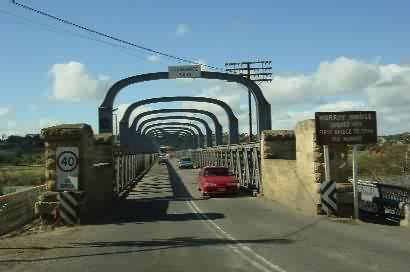
murray bridge - a brief highlight


I've just returned from a week in Melbourne, my first time out of my home state in years, though I'm sure I'd enjoy nothing more than the life of a ponderously romantic traveller-writer, speculating on what the architecture or politics or any other traces of particular places might mean to a middle-aged déclassé celibate libertine with something of an attention deficit problem. My excuses for not achieving such a goal are predictable enough - competing aspirations, distractions, cowardice, poverty, laziness...

There's not much really to tell about this trip. I hired a car and Sarah accompanied me, but unfortunately she can't drive, and my time in the saddle to and from was more extensive than expected. I was assured it would be eight or nine hours on the quick route through Bordertown and Ballarat, maybe an hour or so more via the Great Ocean Road. In fact, with only fairly brief stops through the day, and driving faster than I've ever driven before in the zippy little Toyota Laris, I took eleven hours to get there and about thirteen hours to get back on the long route, and I'm left wondering if I've been the victim of others' retrospective optimism. I did want to take my time, listen to the Southern Ocean, quaff from the Coonawarra, wax quizzical upon country quaintness, nestle for awhile amid the green, but we were pressed, having rooms booked in Melbourne and a vague itinerary of gallery-hopping, local shopping, wining, dining and tram-riding to get through.

Of course, though people say life’s the thing, I prefer reading. Our initial plan was to travel on The Overland, a daytime journey much improved I’m assured [watch those assurances] from the excruciatingly uncomfortable and boring all-night trips of my youth. I envisaged pleasant hours whizzing though a scenic diorama, finishing my Dennett book and maybe starting on Guns, Germs and Steel, while making ingenious notes and waxing philosophico-historical with Sarah over a lunch-time port or an evening martini, and maybe even – apogee of adventure – buttonholing or being buttonholed by some entertaining wiseacre, preferably flirtatiously female, in the dining car. Unfortunately we didn't get in early enough, and The Overland was booked solid the first week of school holidays. I would've put it off to the second week but Sarah was intent on catching the last week of the Guggenheim exhibition at the NGV.

So, I drove, and drove, zombie-like, but at least appreciating that rarity for me, a car that doesn't develop a death rattle at above 100kph. Still it was nerve-wracking, especially the last section driving into Melbourne on a totally unfamiliar road, dog-tired, dark in the night.

I'm not going to spiel on about Melbourne in the manner of some of my favourite travelling speculators, Nooteboom or Raban, as it'll raise the spectre of comparison, at least in my mind, and anyway I didn't get too many chances to take notes, so I'll just blog on about whatever comes up... a spiel of sorts.


Labels:

Monday, December 18, 2006

hope inn briefing

Palmerston - dishonourable mention


Sarah and I visited the Hope Inn, on Port Road (should start taking pics of these places for daily illustrated), for our weekly, or less than weekly, briefing. It was a briefer briefing than usual, just a glass each of Cockatoo Ridge sparkles.


The Hope Inn is basically on the corner of Port and South Roads, next to Abbotts, a shop I've used regularly for years for co-op purposes without ever noticing the pub's existence, which isn't surprising.

I made the usual tired old jokes – should be called the Abandon Hope Inn, etc - provoked by my need to feel superior but mainly by the fact that on entering the place from the back carpark, we had to negotiate inter alia the usual neonised pokie machines and their hapless aficionados. The first patron I encountered in the bar was a thin elderly madam with a greased grey mullet. This front bar – possibly the only bar – was dominated by the biggest television screen in the southern hemisphere, belting out fox sports so loud that talk endangered the vocal chords. We found the only table from which it was impossible to see the screen, a window table looking onto a semi-demolished building across the driveway. It looked as if someone had got bored with demolishing it months before.


But enough snidery, the fact was that this pub didn't pretend to be other than basic and working-class; low-brow and down market, in my infamous and inadequate pub taxonomy. Having said that, the carpet was new and clean, and the walls were quite freshly painted. No smoke haze, no autumnal piles of bingo or lotto tickets to crunch through, no defensive territorial glances, or not too many. As environments of this sort go, quite bearable, without being in any way appealing – and we couldn't help but reflect that the place's spruceness, the ginormous foxtelly and the shiny new pool table were all achieved largely at the expense of the losers in the poky back room. The building itself was quite likely late nineteenth century, like many of the watering holes dotted along the Port Road, but otherwise of no great interest – a modest establishment in every sense.

As to the briefing – can't remember much of the discussion, but Lord Palmerston and his relationship with Queen Victoria was one topic.

Labels:

pavlov's cat