Saturday, February 14, 2009

the soul of the white ant


I remember a dog-eared paperback on the shelves of my first bohemian inner-city residence, shared with a book-collecting bowerbird of an art student. It was called The Soul of the White Ant, by one Eugene Marais. I never read it, or even looked into it, though its title somehow encapsulated for me something of the new life I was entering, mad and unexpected, surrealistic and romantic. It would probably have been better for me to have read the book.
For its South African author was a strange and tortured genius, a bewitching story-teller who loved and was beloved of children, a drug addict and a suicide. Above all though, he had transformed himself, for a time, into a painstaking, patient and insightful observer and recorder of the lives of termites and baboons. Mr Darwin, I feel sure, would've been proud to make his acquaintance.
All of this I've only recently discovered, and it's not the subject of this piece, more's the pity. The book's title has long symbolized for me the weirdness of the religious, and particularly Christian, notion of the soul. I've heard that some Buddhists claim that every living thing, prokaryotic or eukaryotic, has a soul, which transmigrates in the process of reincarnation. If you've led an exemplary life as a bug or a germ, you will migrate to a higher form next time, maybe a booby or a red panda. It sounds pleasant, as anything does if you put it the right way. I've probably got this Buddhist teaching quite wrong, but in any case it seems problematic to me to impose morality on the life of a bacterium. Then again, how much more problematic must it be to impose morality on the life of a human being.
Be that as it may, Christians are supposed to believe in the soul as a specifically human apparatus. As such, it has taken something of a battering since the theory of evolution by natural selection has gained wide acceptance [among the intelligentsia]. Those Buddhists and others who believe in a soul for every organism have at least the advantage of consistency.
The Holy Roman Catholic and Apostolic Church has generally been quite woolly in its response to evolution, while all the time insisting that its god, formally known as Yahweh, now called God, created everything. If you don't accept this, you're anathema. Now of course this doesn't necessarily pit the HRCAC against evolution, even though it's highly unlikely, and possibly impossible, that the Darwin-Wallace theory would ever have been developed by a Christian. The HRCAC can simply say that God created evolution, and let's see you prove otherwise.
Unfortunately for Christians, though, they have to have to believe what they believe through a set of sacred texts called the Bible, written by God apparently through various scribes.* We find there no hint of evolution or natural selection, not to mention fossils, dinosaurs, plate tectonics, other galaxies, black holes or anti-matter. What it does say is that God created humans in his image.

*Why god chose this method, rather than just writing the stuff himself, is one of those mysteries that form the backbone of religion. After all, he wrote the ten commandments in his own hand, on two stone tablets, now lost to posterity, and I can't help but feel that to lose one such tablet was unfortunate, but to lose two was downright carelessness. To think how much the divine handwriting might've fetched at Sotheby's is surely to bring the spiritual and material world together in the most delightful way.

Labels: ,

Monday, January 12, 2009

Darwin's struggle


periplus: from Robert Hughes, The Fatal Shore. He likes throwing in these bits of arcana. He's discussing a painting, what else, of Joseph Banks by Benjamin West; around him are the trophies oh his periplus, collected from around the Pacific. It comes from the ancient Greek, and is a description, generally in writing, of a shoreline itinerary.

I've been reading, inter alia, the biographies of Wallace and of Darwin, switching from one to the other, like channel hopping, and both men are putting jottings in their journals, Darwin in the late 1830s and early 1840s, Wallace in the mid to late 1850s, tantalising themselves with clues to the great mystery of species variation and connection. 

Now I've read the Darwin book - The Kiwi's Egg. The title refers to the flightless bird whose egg is almost monstrous in proportion to its body, so that the gestation period is long and presumably arduous. It's a metaphor for Darwin's dangerous idea, natural selection. 

One of the most interesting chapters deals with the doldrum period of natural selection - essentially between the publication of The Origin and the rediscovery of Mendel's work. This was touched on too in one of Gould's essays in Eight Little Piggies. Scientists weren't too happy about the toughness of natural selection, its wastefulness and brutality, and some of them didn't want to relinquish the creator, who must be benevolent. Darwin's insistence that there was no deterministic or goal-oriented element in evolution was very much out of step with his time. All sorts of problems were raised - that the planet was too young to have allowed for all that slow evolution [Lord Kelvin's  point of attack, since refuted with the advent of radiometric/isochron dating], that blending inheritance [much touted at the time] would dilute the selected traits over time [since refuted by Mendelian genetics], that soft inheritance [neo-Lamarckism] was more prevalent than inheritance by natural selection, that orthogenesis [an evolutionary approach based on linearity but which could not reveal its mechanisms] was the thing, and so on. Yet the theory of evolution by natural selection has managed to emerge more or less triumphant. 

Interesting reflections on Darwin and Wallace. Darwin the procrastinator, nervous about the implications of his views, finally pushed into action by the emergence of Wallace’s work. Wallace the man in a hurry as he called himself, talking about his theory before he had well worked out the detailed mechanism. Imagine if their positions were reversed – if Wallace had been the older man, travelling on the Beagle, and Darwin the later impoverished Amazonian adventurer. Something like the theory of natural selection, perhaps under a different name, would have emerged as early as 1840, and Darwin would hardly be known at all. But such hypothetical reversals are of course impossible. 

Labels:

Sunday, January 11, 2009

on to meta-Lamarckism?

Ted Steele at the launch of his book lamarck's signature

Anchsluss: Generally the term used for the merging of Austria into greater Germany in 1938, which was a stepping stone for other incorporations or annexations [the Sudetenland in Czechoslovakia, the Memelland in Lithuania] prior to WW2.


Neo-Lamarckism, etc continued

Arguably this is a minor error – Weismann certainly did propose that the germ cells alone [the gametes] were the carriers of inheritance [he wouldn’t have called it genetic inheritance], influencing the formation of all the somatic cells to follow, but unable to be influenced by them. Lamarckian evolution must require changes in somatic cells to be transmitted to the germline. The Weismann barrier, if it exists, specifically rules out such transmission, thus ruling out the possibility of Lamarckian evolution.

Dawkins doesn’t explicitly mention the Weismann barrier in his attempted refutation of Lamarckism. He takes a different tack, referring to two ways of looking at the relationship between the germline and the fully fledged organism, preformationism and epigenesis, which he in turn describes as the blueprint model versus the recipe model - and basically he characterizes the preformationist/blueprint model as wrong. 

The idea is that the blueprint model argues that the germline cells somehow contain a blueprint or one to one correspondence for the differentiated somatic cells that are generated from them, whereas the correct model sees those cells as containing a recipe for that differentiation. 

Epigenesis dates back, in most rudimentary form, to Aristotle, but fell out of favour with the dominance of Christian creationism, and the different ways of understanding the problem are still infected by metaphysical/religious biases:

where preformation stated that the germ cells of each organism contain preformed miniature adults that unfold during development, epigenesis held that the embryo forms by successive gradual exchanges in an amorphous zygote. Although both traditions tried to explain developmental organization, religious and metaphysical arguments on the conception of embryonic matter as either active or passive determined the scope of their respective explanations. It is shown that these very arguments still underlie the use of gene-centric metaphors in the molecular revolution of the 20th century. 
Dawkins's argument is that Lamarck's theory relies on a preformationist version of embryological development. As he puts it,

Embryonic development is a process, in which all working genes participates; a process which, if correctly followed in the forward direction, will result in an adult body; but it is a process that is inherently, by its very nature, irreversible. the inheritance of acquired characteristics not only doesn't happen: it couldn't happen in any life-form whose embryonic development is epigenetic rather than preformationistic. 
Dawkins is clearly relying here on the Weismann barrier, which Ted Steele is claiming, at the very least, isn't as absolute as once thought. He's claiming that a new meta-Lamarckism, incorporating both Lamarckian and Darwinian principles, will provide our best understanding of more rapid evolutionary development. Steele's theory of reverse transcription from the somatic cells to the germline, which has of course proved very controversial and has stifled his career as a molecular immunologist through the eighties and nineties, has received some research support in recent years, with Drs Corrado Spadafora and Patrick Fogarty both independently verifying the inheritance of non-germline genetic information - in mice in Fogarty's case, and in 30 diverse species according to Spadafora. Obviously, I'm no scientist and it would be better to follow the research data yourself [anyone who ever reads this], but I may write again about this intriguing issue in order to master it to some limited degree. 


Labels:

Monday, January 05, 2009

neo-Lamarckism and neo-Darwinism, mainly

Jean-Baptiste Lamarck, sittin and thinkin in front of the jardin des plantes, Paris

Oikumene: As used in Karen Armstrong's A History of God, the Oikumene is the Greco-Roman world or civilisation, blended with Christianity. Within the Greco-Roman tradition it refers to the 'whole world', as opposed to the barbarian fringes which were regarded as not really of this world. The derived term ecumenical takes a more modern meaning of the world; creating a religion for all the world and all ages.

Axial age: a term coined by Karl Jaspers, referring roughly to the period immediately preceding the Oikumene, the era that according to him, gave birth to philosophy, but also many of the 'great' religious writings. 

I've wanted for a while to write about Lamarckism as a subject in the history of evolution, a faulty precursor to the theory of natural selection, and my recent reading of The Blind Watchmaker and especially its final chapter, 'Doomed rivals', has spurred me on, but I've been thrown into a bit of a tizz by listening to Radio National's 'Okham's Razor' the other day. The speaker, Ross Honeywell, wasn’t a scientist, and when he started going on about neo-Darwinian dogmatists and the unchallengeable orthodoxy I was ready to switch off after just having tuned in [I didn’t even know it was Okham’s Razor at first, I thought it was one of those summer season new-age crank shows].

Then the name Lamarck came up. As Honeywell pointed out, all too rightly, Lamarck has received a raw deal from history. An outstanding pioneering biologist [and apparently the first user of the term ‘biology’], founder of invertebrate zoology – the term ‘invertebrate’ was also his coinage – he came up with a theory of evolution via the inheritance of acquired characteristics that seemed plausible, and even self-evident on reflection, to most nineteenth century naturalists, including Darwin himself.

But Honeywell was saying far more than that Lamarck was not just a failed theorist. He was saying that recent evidence showed that some characteristics, acquired during a lifetime, could be passed on to the next generation.  Further, he seemed to be saying that the neo-Darwinists were out to suppress and belittle this evidence. Naturally I was sceptical. Dawkins’s treatment of Lamarckism was pretty damning, or seemed so to a layman like myself. Was it too damning, though? Was there a dogmatism I hadn’t noticed within the careful argumentation?

So I thought I would look again at what Dawkins had to say about Lamarckism in the light of Honeywell’s claims. Dawkins isolates two related elements of Lamarck’s theory adopted by his modern followers; the theory of acquired characteristics and the principle of use and disuse. I’m essentially focussing on the former. One example Dawkins gives is that of the soles of the feet becoming tough and horny after a lifetime of walking on hard stony ground. It was thought that the offspring would acquire tougher soles as a result. Dawkins’ response is that no proof has ever been given that such characteristics are inherited. Presumably the soles of babies born to tough-soled parents are no tougher that those born to soft-soled sedentary parents. In fact, according to Dawkins, no evidence of the inheritance of any acquired characteristic has ever been provided, though he is quick to point out that it may be provided in the future, and Lamarck will then regain his prestige and stand up there with Darwin, for the two theories are quite compatible.

But Dawkins seeks to refute Lamarckism more thoroughly by means of embryology. Honeywell also speaks of embryology, without using the term, when he introduces a concept known as the Weismann barrier. Unfortunately, Honeywell’s description of the concept is clearly flawed and brings out my sceptical antennae.

 For neo-Darwinists, hereditary information comes only from DNA in our sex cells: our germline. Our body cells, the building blocks of our entire being, have no say in the matter whatsoever. It's a one-way street with a brick wall at one end. This is known as the Weismann Barrier, named after the 19th century biologist August Weismann, who proposed that DNA in those very few sex cells, sperm and eggs, remains unchanged as a repository of the instructions that determine the next generation.

The flaw being that Weismann, who died in 1914, proposed nothing about DNA because nothing was then known about the properties of DNA [called nuclein when it was first discovered in the nineteenth century], and little was known about genes in general.

 To be continued.

Labels:

Friday, January 02, 2009

exercising body and mind, largely in vain

willi hennig


I've managed to do 15 kms on the exercise bike for three days in a row now, and my daily steps aren't bad, but my weight keeps increasing. Probably better to measure it weekly rather than daily. Starting to obsess over this, but I really look terrible. Some recent photos have shocked me to the core.

Monroe doctrine. Propounded in 1823 by the USA's 5th President, it was designed to impede any further encroachments on New World territory by European colonial powers - especially Spain. It was audacious for the time, as the USA was hardly then in a position to back up its hand off policy. Niall Ferguson mentions it in the context of Japan's Chinese adventurism of the thirties, in which there might've been a whiff of their proclaiming some sort of Asian Monroe doctrine against Western powers - but with much less likelihood of success. 

2009 is a big year science-wise. It's a big Darwin year of course [I think I've already mentioned that here] and I hope to continue to educate myself [and my many readers] on evolutionary matters throughout the year. Also, 2009 is the year of astronomy. Four hundred years ago, in 1609, Galileo reflected that a new invention, the telescope, could be refined and developed and pointed at the night sky. In so doing he explored for the first time the surface of the moon, observed that the so-called milky way was made of stars, and discovered those moons of Jupiter now called the Galilean moons. Modern astronomy was born.

So to today's topic in evolution: cladistics.
This is a massively complex topic in fact, so I'll just deal with it skimmingly. Cladistics is a taxonomic system based on evolutionary relationships between species. In recent years it has become the predominant taxonomic system. The term clade was first used by Julian Huxley in 1958, but the real 'architect' of the system was Willi Hennig, who began developing the system, which he called phylogenetic systematics, while a POW of the British at the end of WW2. 

The recent success of cladistics owes much to developments in biochemical analysis. The term clade is ancient Greek for branch, and cladograms are trees of connection between species and their common ancestor. The major difference between cladistics and the Linnaean [or neo-Linnaean] taxonomic approaches are that cladistics is strictly about phylogeny, rather than simply observed similarities between species. Cladistic branching can be enormously complex, so much so that the old classifications [family, order, phylum, etc], which suggest that a few fixed levels can be sufficient, has been rendered obsolete. Cladistics presents a more open classification, which can be filled out as more knowledge comes to light. This knowledge can be gleaned from the fossil record, but DNA/RNA sequencing has increased our knowledge of the relations between existing species considerably. 
A clade is also known as a monophyletic group. Other more inclusive groups are discouraged in cladistic classifications.
Finally, taxonomy is something of a ding-dong battleground, a bit like some branches of linguistics, so there are plenty of critics of cladistics out there. Also, there's a question about whether it will ever fully replace the Linnaean system on the popular, lay level.


Labels: , ,

Monday, December 29, 2008

on christmas, shopping, books, poverty and being alone


I get less Chrissie presents each year, as the number of people who like me, or even acknowledge that they know me, continues to dwindle. So I only managed one book, but it does look like being v interesting. It's called The Kiwi's Egg, by David Quammen, and it's all about Darwin and natural selection. Now that we're almost into the big Darwin celebration [2009 is the 200th anniversary of his birth and the 150th anniversary of the publication of The origin of species] I feel a spate of evolution blogging coming on.

There's a fine Darwin quote on the back cover of my new book. I cannot persuade myself that a beneficent and omnipotent God would have designedly created parasitic wasps with the express intention of their feeding within the living bodies of Caterpillars. Such a typically polite, and fastidious, demurral. Wonder why he chose to capitalize caterpillars along with god.

It might be a while before I get started on that book, I'm reading a half-dozen of em at present, including two on the natural selection theme, the Wallace bio and The blind watchmaker. 

When Vestiges of Natural Creation, a speculative, anonymous work which claimed an evolutionary link between monkeys and humans, was published in 1845 it caused a sensation and made this kind of speculation quite the popular thing. Price Alfred read it aloud to Victoria, and two other interested readers were Charles Darwin and Alfred Russell Wallace. Darwin, whose ideas on the mechanism of evolution would have been quite advanced by this time, called it 'that strange, unphilosophical, but capitally written book', and wrote to a friend that the author's 'geology strikes me as bad, and his zoology far worse' [the book failed completely to provide an explanation for the evolutionary process it promoted]. Wallace was only 22 at this time, and without any field experience as yet, and his response was not surprisingly, more enthusiastic:
I do not consider it a hasty generalization, but rather as an ingenious speculation strongly supported by some striking facts and analogies but which remains to be proved by more facts & the additional light which future researches may throw up on the subject - It at all events furnishes a subject for every observer of nature to turn his attention to; every fact he observes must make either for or against it, and it thus furnishes both an incitement to the collection of facts & an object to which to apply them when collected -
I would observe that many eminent writers give great support to their theory of the progressive development of species in animals & plants.

It would seem that the time for developing a detailed and fruitful theory of the evolutionary process was just about ripe. 

Ikea effect: You picture your home as an experimental laboratory, full of new-fangled desks, utensil racks, ergonomic and elegant chairs, trim bookshelves. You will entertain like never before. You feel part of a just-so material world, appreciative and ready to be appreciated. You go home full of the future, having bought a $2 lint remover. 

Labels: ,

Monday, December 08, 2008

wee escapades and intimations of mortality


I'm somewhat exiled from my second family these days, so I heard with horror yesterday that my fave girl, six-year-old Courtney, has been in the wars again, having broken her arm during a family party. I was at Sarah's for a co-op bbq, and she told me that the day before, the intrepid girleen had been jumping off a wardrobe into a portacot, showing off to some younger kids, when the greenstick fracture occurred. Her screams were impressive, apparently, and they no doubt scuppered the party. 
About eighteen months ago, Courtney was playing with a friend in a field near Mount Gambier. There had been a campfire, and the ashes were still smouldering. Courtney tripped and fell, landing with her forearms in the hot cinders. 
Courtney now has her arm in a cast, which she's enthusiastically getting everyone to sign. I will see her in a day or two, I hope. Unless something thoroughly unforeseen happens, she'll make a full recovery. When she was burned before, people weren't quite so sanguine about it, burns being much more iffy injuries. There was talk of skin grafts, permanent disfigurement. She was flown from Mount Gambier to Adelaide, I think with the Flying Doctor Service, charming the socks off the medical staff along the way. She received excellent treatment, and again made a full recovery, not a trace, or barely a trace, remaining. 
Naturally there has been much talk of the resilience of children, and there's plenty of truth in that, but Courtney is also a child of good fortune being an Australian, twenty-first century girl. 
The other day, I read an intriguing article in Cosmos magazine. Its theme was that human evolution may have come to a halt, because we have reached the stage of a 'grand averaging'. As part of the argument, geneticist Steve Jones points out that 
In Shakespeare's time, two out of three babies were dead before they were 21. In Darwin's day, just half of them were dead. Today, that's down to just one percent. That's a great achievement in the developed world, but for evolution it means that there are no differences in mortality to the age of reproduction, and therefore no material for natural selection.
This is just a hint of Jones's elaborate and really quite compelling argument, and I hope to reflect further on this stuff in a later piece, but for now I want to focus on the accident-prone and fortunate Courtney. 
In those earlier times of high child mortality, it was not unusual for women's pregnancies to reach into double figures, to try to ensure the survival of the one, two or three children that women choose to limit themselves to today, with the expectation that all will be bouncy happy and healthy. And that situation would've pertained not only in Shakespeare's time, but for centuries and millenia before that, leaving aside the odd enlightened ancient civilisation. In fact, Courtney's campfire accident prompts me to imagine the earliest days of homo sapiens, when campfires were de rigueur, and the risk of getting burnt in the family or tribal fire might well have been the most serious and frequent one faced by toddlers. How would an accident like Courtney's be treated then? Maybe they kept a few tried and tested balms in the cave. Maybe they licked their wounds a lot. Maybe, after a few hours of moaning and groaning, they'd get sick of the child and cuff her out of the way. Certainly there would be largely unconscious calculations as to how much time and effort they'd spend on the hurt child, what with all the other mouths to feed and survival tasks to undertake. Quite possibly, if the wounds began to fester, they'd dispose of her over a cliff or with a heavy rock. More likely, they'd simply abandon her when it came time to move hunting grounds. 
Broken limbs, the result of climbing accidents or tribal or familial infighting, would have been commonplace of course. Courtney's greenstick fracture might've been treated with a splint of sorts, and she would've survived, misshapen but not horribly so, especially considering that few of her fellows would've escaped intact from various tumbles and spearings and bludgeonings. That was life, but not as we know it. Today we expect miracles, and get them every day. If not, there'll be hell to pay. 
So I look forward to signing that cast and hearing her tell of her latest little escapade.


Labels: ,

Monday, December 01, 2008

from globigerina ooze to megafauna


I learn something new every day, at least that's something. 

From my reading today I learned about the globigerina ooze which at first I thought was a science fiction construct, but no it's what much of the ocean floor is covered with. The globigerina are a genera of globigerinida, a group of forams, as the experts call them. They're plankton, essentially, and their shells form this ooze. one of many titbits from The Blind Watchmaker. More important, though, is convergent evolution, the observation that, on isolated land masses, organisms will develop to suit certain trades, as they're called, though the variety within trades is considerable. For instance, the principal grass-eating herbivores in Africa are the hoofed animals such as zebra and antelope, gallopers, ungulates. In Australia, the kangaroo fills this niche, though it has developed so very differently. Differences and similarities would be worth pursuing. Herbivores tend to have complicated, bacteria-infested guts, to break down cellulose. The development of this evolutionary pathway would obviously be different in the Australian and African mammals [and among, say, Australian herbivorous mammals], each one finding unique solutions to the problems raised. Their place in the food chain, too would make speed a priority. Herbivores are rarely at the top of the food chain - presumably the kangaroo was prey for some other mammal until recently? Their speed was an important attribute in escaping predators, and they must have developed this speed in response, not to dingoes, who were a relatively newly introduced animals, but maybe thylacines - who knows how plentiful the thylacines were? Certainly, as a marsupial, they will have evolved along with the kangaroo. But the Wikipedia article claims that it wasn't so much predation that brought about the highly developed mobility, but the need to travel long distances in reasonably quick time in a land in which water was scarce. I'm sure they know what they're talking about, but consider that herbivorous ungulate, the camel, Camelus dromedarius [actually camels can probably run quite fast]. They evolved another way of surviving in dry conditions, why such vastly different solutions? 
Certainly there would have been predators of the kangaroos before the introduced species. The marsupial lion, Thylacoleo carnifex, not of course a lion but a carniverous diprotodont marsupial, which seems to have been wiped out by the advent of humans 40 to 50 thousand years ago, was one. Diprotodonts, extant or extinct, are almost all herbivores, and they are restricted to Australasia. The Thylacoleo is distinct inter alia for its retractable claws. It is thought to have been a slow animal, catching its prey by stealth and perhaps also falling on it from above like the proverbial drop bear. In those days there were also various giant herbivorous marsupials including giant kangaroos, though I suppose the Thylacoleo would've preferred smaller prey. It also probably shared its range with  another species of megafauna, the goanna Megalania prisca. Though there's much debate about its actual dimensions, Megalania is regarded as the largest terrestrial lizard known. However, fossil remains are rarer than those of Thylacoleo, and its habits are a matter of speculation. 

Anyway, all of this opens up a whole new world of Australian paleontology never visited before by me. Fascinating.  


Labels:

Tuesday, November 04, 2008

keeping occupied


As everyone worries about the economistupid, except all the poor people I know, and I don't know any rich ones, and as others anticipate an extraordinary moment in US political history, as do I very much, I struggle with life and death issues in my own sad meagre life but am buoyed and cheered as always by investigations outside myself. Homo floresiensis returned to my consciousness via an intriguing SBS doco. When last it left it the sceptics seemed to be gaining the upper hand, describing insisting the hobbit was a case of pathology, or hobbits were a case of pathology, microcephaly probably. I an amateur though well they might or must be right, floresiensis upsets too many applecarts, you can't have such a small and small-brained humanoid dating to only 13000 years ago without pathology, there's no possible fit otherwise, but now I hear apparently well-credentialled and richly experienced specialists, on teeth and bones and brains, arguing no way, this isn't pathology, this is genuine hominid enigma, and one of them makes connections between australopithecine bones, dating near two million years ago and never known to have come out of Africa, and the islandic floresiensis just north of Australia. 
Islands, they say, always throw up anomalies, and this is a whopper, it can hardly be underestimated, with a brain around 400 cubic centimetres, less than half that of homo erectus, the human ancestor thought to have brought us out of Africa. How can this much more recent, much smaller-brained species or subspecies, with wrist bones like those of chimpanzees, have survived almost to the present day [it seems to have been a tool-maker on the level of homo erectus]? The generally or previously acknowledged thinking about human evolution has been that of progressively increasing brain size, though the neanderthals who survived to 30000 years ago were an uncomfortable anomaly, but now all is up for grabs and people are wondering about Orang Pendek and there have been discoveries written up from Dmanisi, Georgia about a smaller-brained version of homo erectus in Asia, dating back 1.8 million years, and experts point out that there is so tiny fragmented a fossil record regarding human ancestry, hardly enough to build any coherent theory, and cherished theories can be smashed by so little a floresiensis, it's no wonder scientists are so passionately pro and con. 
So that was engrossing and I wished for a while I Coodabeen a paleontologist and maybe I Coodabeen if I hadn't been such a wastrel or dreamer, a paleontologist chatting with same, exciting each other and arguing with each other, stimulating each other to take home our ideas together and apart and think on them and work on them and examine and write further, modifying theories, creating revolutions.
Meanwhile I sit sometimes with no light and sound wondering what to do, getting fat and old as the external exciting world recedes, and I think, then I think no, avoid that, and soon the US election results will be out and that'll be fun, I'll be able to talk to someone about that maybe.   

Labels: ,

Sunday, August 10, 2008

Wallace


On this morning’s Ockam’s Razor, a reminder of Alfred Wallace, whose papers outlining an evolutionary theory in the 1850s prompted Darwin’s friends, most notably the great geologist Charles Lyell, to prompt Darwin to get publishing on evolution [though the term evolution was only coined later, by Herbert Spencer, according to the presenter].

Of course I knew of Wallace, and recognized that he probably hasn’t been given his due as an evolutionary theorist, that he was an intriguing figure with a very different social background to Darwin, a prodigious worker and thinker who in later life, I heard, became a bit mentally erratic, sadly becoming preoccupied with the dead-end subject of ‘spirituality’.

I’ve met at least one person who imagines that Wallace was done out of recognition by Darwin, but his view was more due to a fondness for conspiracy theories than to a deep knowledge of the history of evolutionary theory. As I’m currently reading a lot on evolution, and on Darwin, via Stephen Gould’s essay collection Eight Little Piggies, this reminder of Wallace is timely. His achievements can hardly be underestimated, especially considering his impoverished and unpromising background. After his long period in the field, Wallace returned to England, full of praise and admiration for his fellow theorist, Darwin. He went on to publish an enormous number of papers on a wide variety of scientific subjects, and had no less than 191 of them published in Nature, still one of the most prestigious science magazines in the world. Clearly he was a recognized and respected scientist in his time, and there was even a plan to have him buried at Westminster Abbey, but his family preferred something simpler. Presumably the reason he’s not so associated in the public mind with the natural selection version of evolution is that Darwin’s Origin of Species is seen as the succinct account of the theory, and its publication as the starting point of the great controversy and debate that continues to this day. My interest, though decidedly amateur, lies in the similarities and differences between Wallace’s account of the theory and that of Darwin – given that Darwin didn’t get everything right, of course.

I’m constantly amazed at how fantastic a resource the internet is. Here, for all to access, is an original copy of Wallace’s book Contributions to the theory of natural selection, published in 1870. Note it belongs to the library of the celebrated Woods Hole biological institute, founded by the great biologist and evolutionary opponent of Darwin, Charles Otis Whitman. Whitman favoured the theory known as orthogenesis, or ‘straight line generation’’, which basically was the idea that particular organisms had limited developmental pathways, and that there could be no jumping from one pathway to another. It was, according to Gould, one of three evolutionary theories in competition with natural selection, a competition that didn’t end until the thirties. The others were Lamarckism, or the inheritance of acquired characteristics, and mutationism, which involved quantum leaps of change via mutation.

Labels:

Saturday, April 26, 2008

Haidt's awkward position


Having commented here recently with a reference to Jonathon Haidt, I spent a bit of time reading this Haidt article in which he critiques ''the new atheists''. Basically he uses his moral intuition findings to argue that such public advocates of atheism as Dawkins and Harris are so strongly guided by an intuitive sense of the wrongness or immorality of religious belief that this clouds their judgment when it comes to the possible benefits of such belief. Haidt has little to say about whether beliefs in supernatural forces are true - which is, to say the least, a weakness in his argument - but what he has to say about benefits is worth reflecting upon. He quotes some lines from Dennett's Breaking the spell about the morality of unbelievers v believers:
"Perhaps a survey would show that as a group atheists and agnostics are more respectful of the law, more sensitive to the needs of others, or more ethical than religious people. Certainly no reliable survey has yet been done that shows otherwise. It might be that the best that can be said for religion is that it helps some people achieve the level of citizenship and morality typically found in brights. If you find that conjecture offensive, you need to adjust your perspective. (Breaking the Spell, p. 55.)
Here's Haidt's commentary on the above:

I have italicized the two sections that show ordinary moral thinking rather than scientific thinking. The first is Dennett's claim not just that there is no evidence, but that there is certainly no evidence, when in fact surveys have shown for decades that religious practice is a strong predictor of charitable giving. Arthur Brooks recently analyzed these data (in Who Really Cares) and concluded that the enormous generosity of religious believers is not just recycled to religious charities.

Religious believers give more money than secular folk to secular charities, and to their neighbors. They give more of their time, too, and of their blood. Even if you excuse secular liberals from charity because they vote for government welfare programs, it is awfully hard to explain why secular liberals give so little blood. The bottom line, Brooks concludes, is that all forms of giving go together, and all are greatly increased by religious participation and slightly increased by conservative ideology (after controlling for religiosity).

These data are complex and perhaps they can be spun the other way, but at the moment it appears that Dennett is wrong in his reading of the literature. Atheists may have many other virtues, but on one of the least controversial and most objective measures of moral behavior—giving time, money, and blood to help strangers in need—religious people appear to be morally superior to secular folk.

Assuming this is true, and though I haven't independently examined the evidence, I suspect that it is, it needs to be accounted for. Not only that but, as Haidt suggests, we need to tap into this force for helping others that appears to be driven by religion, and utilise it for a secular society.

So what is so socially cohesive and happiness-making about religious belief, and do all religious beliefs have this tendency? How does Judeo-Christianity compare with the Dreamtime beliefs of Oz Aborigines in this regard?

To stick with Christianity, I think Haidt is right in saying that the beliefs of modern Christians are more complex and eclectic than some atheists give them credit for. Most of them don't read the Bible, and aren't familiar with it except through the many and various interpretations of priests whose sermons mix Bible stories with everyday modern observations, homespun homilies and more or less sophisticated treatment of current political and social issues. Bible passages are dealt with selectively and according to changing attitudes. Some quietly fall out of favour, as do whole religious concepts, such as the concept of hell. Some atheists think that, because the Bible is a fixed document - at least since the Council of Trent - Christian morality must also be fixed, in the time those texts were written, but this is plainly not so [in spite of what Christian leaders themselves say about eternal verities]. Certainly it's a largely conservative morality, which drags behind progressive secularism in terms of reform, but there's no doubt that it's always changing, just as today's conservative political parties don't support the institution of slavery, as they once did.

Haidt makes a distinction between contractual society and the beehive society, the first being more individualist and egalitarian, the second being more authoritarian and rigid. The first requires constant adjustment to balance individual and social needs against each other, the second requires constant vigilance against enemies from without and within. And although Haidt generally plumps for the contractual society, he seems to feel that the alternative shouldn't be contemptuously dismissed, but studied and learned from. Whether this is itself mere liberal posturing is hard to say. His main argument against the new atheists is that they're more driven by commitment to a cause than reason, and that their reasoning is heavily skewed by that commitment. It's an important point, of course, but it needs to be pointed out that new atheism has also grown out of a serious threat to scientific autonomy and scientific education, in the USA at least, coming from creationists and their very vocal fundamentalist supporters. It's also a response to the growing power of Islamism, to the violence of militant religion, and to the real danger posed by the politicisation of religious views. There really is something of a battle being waged here, and aren't we right to be concerned that not enough people are speaking up? And they should do so with carefully crafted, evidence-based arguments, as well as an awareness of where they're coming from, and of the dangers of bias.

I enjoy some of the rhetoric of the new atheists, but not all of it. I'm more interested in solid argument, such as those used by scientists to refute the anti-evolution claims of believers, arguments that are painstaking, patient and comprehensive, arguments that themselves promote science as a discipline for producing results, knowledge and insight. The effectiveness of the practice of science is always its best argument.

Science needs to turn to religion in the same spirit, to seek to explain it. Haidt touches on this when he refers to the work of Boyer and Atran and the exploration of religion as an evolutionary byproduct. He himself wonders whether religion isn't an adaptation, that's to say, a much more successful evolutionary product than is given credit for, though it must be hard to sustain that view as a secularist who seems, personally, to have no need of religion. He points out that anthropologists are much less interested in the truth of religious beliefs than in the social functions attached to ritual and ceremony, but this seems to me rather to fudge the issue [and functionalism in the social sciences has been criticised for just this reason].

The bottom line is that Haidt is trying to defend religion while not believing in it. It's an awkward position to take, and to some it might look like a patronising one. The only real defence he has provided for religious beliefs is that that they seem to make people more happy and more generous. The first claim can be dealt with along 'ignorance is bliss' lines, the second one may look a bit more difficult to deal with, but I would say that if you are a regular church-goer you would be constantly the target of sermons touching on civic responsibility. Helping the poor, helping those in need, caring for children and the elderly, loving sinners, if not the sin, and encouraging and reinforcing the bonds of community everywhere. It's also quite likely the case that you're drawn to churchy organisations because you want your sense of community and civic responsibility strengthened. It fulfils a need in you. But let's not pretend that there aren't other things that go along with these positives - the myths about gods and faith, the fear and loathing of the godless and such. And there are particular truth-claims, reiterated again and again, the central one being the existence of and the need to constantly worship a supernatural entity. There's no getting around that one, either it's true or not.


Labels: , ,

Thursday, December 27, 2007

bring out that inner bonobo


les be friends, or how to avoid stress


Human sexuality, in the developed west, is tending towards bonoboism, me likes to think [actually it's far more a hope than a thought].

Bonobos are a wonder. According to primatologist and psychologist Frans de Waal, who's made a study of them, they might better have been named Pan satyrus rather than P paniscus [the diminutive one], because of their considerable predilection for sexual activity [meaning they love to fuck, with whoever, whenever, however]. As you might expect, I can't wait to write about this, but I'll get the less stimulating part of their story out of the way first.
Bonobos, along with their larger cousins, the chimps, are our closest living relatives, but bonobos are very different from chimps. For starters there are far fewer of them, and their habitat is very confined, and becoming more so with human encroachment. They inhabit an area south of the Zaire River, and number only a few thousand, falling rapidly. They were only identified in the late twenties, and classified as a new species in the early thirties. The chimp and bonobo lines separated not so long ago, with the chimps moving on to a wider, drier savannah-like habitat.

Although originally described as pygmy chimpanzees, they’re no smaller than the smallest sub-species of chimp, about 45 kgs for males, and 33kgs for females. De Waal, perhaps with some bias, describes them as more ‘stylish’ or gracile in their movements than chimps [they do in fact have proportionally longer legs than other apes], and they have flatter faces, higher foreheads, and a distinctive hair-style, parted in the middle. Their diet is similar to that of chimps, but with less meat. They’re described as very sensitive, with very expressive eyes. They’re also less aggressive, and this relates, inter alia, to their social structure.

And their social structure brings me, not before time, to sex.

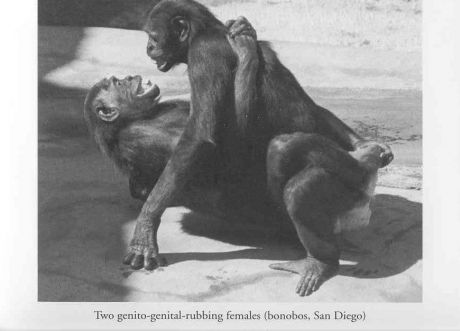
Okay, I exaggerated when I say they fuck all the time, but the truth is even more interesting. They use sex – and I don’t mean fucking as in full penetrative hetero-sex – as a way of bonding and curbing aggression. And because the closest bonding occurs between females, female-female sexual activity, especially in the form of ‘genito-genital rubbing’, is the most common type.

Here’s the social set-up. As with chimps, young bonobo females move away from ‘home’ to another mating group, whereas the males stay forever within the home group. But unlike their cousins, the adolescent females gradually develop close bonds, facilitated by sexual activity, with senior females of their new group. This allows them to band together to keep any larger, would-be aggressive males in check. In fact, it has essentially allowed them to become the dominant sex, spite of sexual dimorphism. Sisterhood is powerful. One reason for this sort of alliance, which male bonobos don’t seem to engage in, may be to prevent infanticide, a common practice among other species, including chimps.

It’s not just a matter of ganging up though. They also use sex to soothe the savage beast [male or female] – and for many other reasons. In fact, I’ve just found a fabulous blog, written by an Oz researcher in the Congo, who’s discovering almost more than she can handle about bonobo [and young chimp] sexual behaviour as we speak. It’s so full of useful and up to date info as to more or less render this post redundant. So I’m going to quit this post and start reading her blog – and so should you, dear reader.

I’ll just finish though by returning to my first line. It would be nice to think we’re becoming more like bonobos, make love not war and all, but my sense of the possibility comes from the increasing power of women in western society. Young women are more sexually confident, and even sexually exploitative than they’ve ever been before, and they’re also engaging in female-female sex play like never before. They’ve taken to hunting in packs, which have provided them with the security to go further than they would normally go. So-called ‘raunch culture’, female-driven, has provided women with a new sexual empowerment, and I’m not sure that I agree with feminist critics who claim that it’s just another form of enslavement [surely raunch culture is emphatically not about stripping for your man]. Sexual empowerment is only one form of empowerment certainly, but it’s far from an insignificant one, for sexuality is always going to be central, and if you can gain control of the sexual agenda, it’s likely everything else can fall to your hands as well. Could this be the real sexual revolution? All I can do is echo an earlier enthusiast. Vive le bonobo! I’d like to be one.

Labels: , ,

Friday, December 21, 2007

our ancestors


the earliest discovered human portait

Okay, it's time to get cracking on homo sapiens, our nearest and dearest, and our ancestors, as I recently promised myself.

First, we're primates. There are over 230 living primate species divided among 13 families. Most primates are arboreal, but a few species such as our own are described as terrestrial. I'm going to be using all sorts of nomenclature here to try to make connections between families, suborders and the like [for example, I’ve only just heard of cladistics], and much of this stuff is contested, so I should say at the outset that this is all provisional. Humans belong to the family Hominidae in the suborder Haplorrhini. At one time, humans were described as the only hominids, but more recent genetic and molecular research has placed chimps, gorillas and orang-utangs in the same family [though there's still some dispute re the latter. As to the rare and endangered bonobo [Pan paniscus], my favourite, it's our closest living relative along with the chimpanzee [Pan troglodytes], sharing some 98.4% of our DNA [though that figure, long quoted, belies the complexity of the differences between our genetic material and that of the Pan species, as revealed through the chimpanzee genome project]. The common chimpanzee and the bonobo, also known as the pygmy chimpanzee, are the only two species of the genus Pan, though there are a number of subspecies of chimps. I'm very much tempted to dwell on the bonobo, but I'll save it for another post. Anyway, in spite of differences, some authorities claim that bonobos, chimps and humans should all be classified within the genus Homo. Others suggest that humans should be reclassified as Pan sapiens, but none of this seems likely to happen in the foreseeable.

To quote from Wikipedia [which I’m pretty confident is reliable in this instance]:

Recent DNA evidence suggests the Bonobo and Common Chimpanzee species effectively separated from each other less than one million years ago. The chimpanzee line split from the last common ancestor with the Human approximately four to six million years ago. Because no species other than Homo sapiens has survived from the human line of that branching, both Pan species are the closest living relatives of humans, and cladistically exactly equally close to humans.

Now to the Homo genus. This is complicated. The Homo genus belongs to the sub-tribe Hominina, and is the only extant genus in that subtribe, one of two subtribes under the tribe Hominini. The other subtribe is Panina, which includes the chimps, but this classification is recent and not entirely accepted. In any case, other members of the Homo genus, such as Homo habilis, Homo ergaster [and/or Homo erectus] and Homo neanderthalensis, are all extinct. Interestingly, no remains have yet been identified of any extinct species of the closely related Pan genus.

It’s obviously difficult to tease out the relations between species and subgroups here, and to date them and determine patterns of movement and development. The fossil record, as everyone knows, is scant and heavily contested, as the ongoing debate about ‘Homo floresiensis’ has shown. The current orthodoxy, in any case, seems to be that Homo habilis is the earliest known member of our genus, and that the species flourished in Africa some two million years ago. Homo habilis seems to have been contemporaneous with the Australopithicines [such as A robusta and A boisei], an extinct genus, possibly the first bi-pedal genus, but not directly related to ourselves, though part of the Hominid family.

Homo erectus seems to have first emerged about 2 million years ago [thus making it contemporaneous with H habilis], and survived till about 400,000 years ago. Its brain size was some 55% larger than H Habilis, and it's believed to have been the first human species to have migrated out of Africa into colder regions. Sexual dimorphism [the size difference between the sexes within a species] became less pronounced over time, and some pundits have argued that these changes represent significant social and behavioural changes. All conjectural, however. The date of the migration out of Africa is also a subject of much dispute. Homo erectus was also contemporaneous with the later 'robust' Australopithicines.

The transition from H erectus to Homo sapiens is as highly contested as all the other transitions. Individual fossils have proved difficult to classify between late H erectus, H sapiens and Homo neanderthalensis. Neanderthals cloud the picture even further, and some classify them as Homo sapiens neanderthalensis [which explains why we are sometimes classified as Homo sapiens sapiens].

The so-called Cro-Magnon man, discovered in France and dating to 28,000 years ago, was an early representative of Homo sapiens sapiens outside of Africa. The earliest known example of H sapiens sapiens is 130,000 years old, and was found in East Africa.

The sites of discovery of H s sapiens show an increasingly accelerated development in tool-making and cultural artefacts. The Lascaux caves date from 15000 to 17000 years ago, and provide evidence of complex ritual and hunting practices, as well as artistic skills. The image accompanying this post is 26,000 years old, and is the oldest 'naturalistic' human portrait yet discovered. More stylised depictions date back to at least 32,000 years ago.

It's an almost impossibly complex story. and one worth updating continually in the light of new research, new dating techniques and new hypotheses. At least I have slightly more of a handle on it than I did before starting this post, which is all I could've hoped for.


Labels:

Wednesday, December 19, 2007

Taylor's critique of secularism

Charles Taylor, winner of this year's Templeton Prize

I read here yesterday that Charles Taylor is a Roman Catholic.
I read some of Taylor's essays at uni. He wrote critiques of social theory, and I was particularly taken with his analysis of Foucault. His style had all the best of Anglo-American clarity, infused with a sort of gentleness and patience which was very becalming. I wasn't myself inclined to be so generous with Foucault. I read other essays of his, and was generally impressed. I know that he's something of a Hegel scholar, which in itself would require almost supernatural patience, as well as a certain kind of mind, one far removed from my own.
So, on hearing that he's RC, I'm frankly gobsmacked. I've always been tempted to claim that the term Roman Catholic thinker is oxymoronic, pace the Jesuits and their ilk. I would amend that, though, to RC thinkers about religion. Taylor didn't mention religion in the essays I read, but now he has written a lengthy book called A Secular Age, in which he apparently writes approvingly of the religious mindset while stringently avoiding the issue of God as broached by Dawkins and others. This is hardly surprising, given that as a catholic he must not only believe in a god but in that God, the mass murderer and moral monstrosity later reshaped by Aquinas et al as the sum of all perfections, etc. Presumably he also believes in the trinity, the virgin birth, the resurrection and transubstantiation. He may also believe in the infallibility of the pope. Then again, he might be an unorthodox catholic with dissenting views on any or all of these doctrines. I suspect that A Secular Age, in spite of its 874 pages, will answer none of these questions.

The NYT review of the book says this:

[Taylor] argues for “the ‘deconstruction’ of the death of God view” proclaimed by Nietzsche. To see secularization as simply the separation of church and state, the alienation of truth from power, and the rise of skepticism and worldliness, he writes, is to miss the deeper and more enduring residues of religion and the spiritual life, the true “bulwarks of belief” that in his view have hardly eroded. Taylor argues against the “subtraction stories” of modernity, in which religious belief and other “confining horizons” are “sloughed off,” leaving the mind without faith or piety. Instead, he argues, “Western modernity, including its secularity, is the fruit of new inventions, newly constructed self-understandings and related practices, and can’t be explained in terms of perennial features of human life.” Even the old distinction between the sacred and the profane has taken on new meaning. Instead of disappearing, God is now “sanctifying us everywhere,” including “in ordinary life, our work, in marriage, and so on.”

Now, what does all this actually mean? It's not quite as murky as theology, but it's getting there.
Firstly, the Nietzschean proclamation of the death of God is problematic. He presumably meant the death of God as concept, but his rhetoric lays itself open to a type of concrete thinking - and of course Nietzsche played on this. Not only does it paradoxically invoke the death of an immortal, but it plays into the concepts of death and immortality that are part and parcel of all religions - ancestor spirits, transfiguration, reincarnation etc. The 'deconstruction' of the idea makes me shudder, so I think I'll just ignore it.

The key sentence in the above para is, to me, the second one. To see secularization as simply the separation of church and state, the alienation of truth from power, and the rise of skepticism and worldliness, he writes, is to miss the deeper and more enduring residues of religion and the spiritual life, the true “bulwarks of belief” that in his view have hardly eroded.

It's possibly true that 'the bulwarks of belief' haven't faded that much, though those places where they have been most eclipsed have been those most affected by Enlightenment thought. The separation of church and state in those countries, and its spread around the globe, is a very positive phenomenon, as is the 'alienation of truth from power', most particularly the waning power of the Catholic church. Skepticism, too, is a healthy thing [I would say that, but note: nothing in excess], and worldliness has always been a pretty useful survival strategy. Just what the deeper residues of religion are, exactly, is unknown to me, as I'm one of the growing number of people in the West who has no need for religion or spirituality as commonly defined [or, more often, not defined]. That a great many people do profess some kind of 'faith' or adherence to a spiritual life is an interesting and important phenomenon, and one which requires investigation. A number of people are investigating the phenomenon, though these investigations are still in their infancy and a great deal more work needs to be done.

From the point of view of science, religious belief is indeed a confining horizon. Early scientists had to do battle with the confining belief that the Earth must be the centre of the universe, then there was the confining belief that humans were 'special', made in God's image, with 'dominion over the Earth'. Even liberal believers are still contending that the universe must be purposeful, and that the ultimate purpose must be the complexity of consciousness [as exhibited, of course, in homo sapiens]. It seems that this is what faith and piety is reduced to among some liberal theologians, a self-serving view about humanity's centrality in the scheme of things, for which we must thank our supernatural 'father'.

Taylor seems to have been rather more evasive about these terms, which is hardly more satisfactory. In any case, I would challenge his assertion that Western modernity [a too-vague term] is about new constructions of self-understanding, unrelated to 'perennial features of human life'. What are these perennial features? Presumably he's again referring to religious belief and its related rituals. We cannot as yet know how perennial these are [or indeed how perennial are any features in the constant flow of evolving human life and behaviour], but by constructions of self-understanding I suspect he means modern science, an impressive construction indeed. Science has been so phenomenally successful in such a short time-span, that to see it as atypical of or somehow contrary to the abiding concerns of humanity is perhaps forgivable, especially as it has so revolutionised our understanding of ourselves as a species in a mere 150 years. The question is, are these understandings mere ephemeral constructions? I doubt it, and I think the methods by which we arrived at those understandings will bring us many more surprises and revolutions in the years to come.

That'll do for now. I might look further into this review later. I think Taylor will have many interesting things to say in his book, but evading the particularities of religious belief looks like a bit of a problem for him.

Labels: , ,

Thursday, December 06, 2007

weighty fantasies


Beijing Man, I believe


The dreaded lurgie has struck me again - something absorbed from the environment has set off my compromised immune system and again I'm sniffling and coughing and going through two or three hankies a day and it won't go away until I visit the doc and get antibiotics to clear things before it turns to pleurisy or pneumonia. Apart from that I feel generally hale, but the constant sniffling and throat-clearing affects my stamina a bit, as well as my sociability.

Just wondering about the word lurgie. Its etymology seems pretty uncertain but the phrase the dreaded lurgie was popularised by an episode of the Goon Show. Well done lads.

I'm still not free of commitments, but I'm catching sight of the light, and I have a few challenges ahead, re making a living. I'm also trying to get fitter - I bought some quite snappy trousers today, not uncomfortably tight, just enough to draw attention to the wrong kind of bulge above the waistline. Could've gone for wider, but I needed to bring my target into better focus. I'd say I'm about 7 or 8 kilos above perfect trim. My diet's fine, it's mostly the exercise that's the problem [bad word - I've been told not to think of it as exercise, just activity]. Trouble is, guys always put their weight on around the tum, and find it well-nigh impossible to remove it from same.

Avoiding the internet a little lately too, getting my stimulation from more traditional sources. Everything stimulates, and an article in Cosmos about important and puzzling archaeological finds in Dmanisi, Georgia, as well as more reading about the ongoing Homo floresiensis controversy have made me want to summarise, for my own benefit, the current thinking, insofar as it can be summarised, on hominid ancestry. This has led to further fantasies, of giving talks on various mainly philosophical issues, before a select audience...

1. Human self-knowledge and self-deception: a scientific approach.
We've known for millenia that we can't be trusted to be judge in our own case, and experimental evidence suggests that even people who have known us for no more than five minutes are better predictors of our behaviour than we are. At the same time, immediate, internal access tells us that in some essential way we know our minds better than anyone else possibly can. How can these two findings be reconciled?

2. Human origins: the current state of knowledge
Does anyone remember Java Man? Peking Man? How about Cro-Magnon Man? Why were they all men? What place do those old guys have in the current picture of human and pre-human ancestry? What exactly is a hominid? How does Australopithecus relate to Homo erectus? Is John Howard really the last Neanderthal?

3. Morality: a triumph of reason over impulse, or a rationalisation of survival instincts?
David Hume notoriously wrote that reason is the slave of the emotions, but until recently this view has found few champions among philosophers. Professional prejudice? What role does reason really play in our sense of right and wrong? And what exactly is reason anyway? Important new work in cognitive anthropology and evolutionary psychology throws some fascinating light on these questions.

4. Philosophy and science: friends, enemies or strangers?
What's the difference between a philosophical question and a scientific question? Does the philosophy of science have any relevance to scientific practice? What exactly is a scientific theory, and what makes the term so controversial? Is it true that science can only answer how questions and not why questions? How so - or why so?

5.
Evolution and religion: what's at stake?
Various thinkers, religious and non-religious, have been at pains to argue that the theory of evolution and religious belief are entirely compatible. Others have been at pains to point out precisely the opposite. Certainly the vehemence of religious, and particularly Christian, attacks on evolution suggests a certain discontent amongst those lucky enough to be made in God's image. Surely the Primate can't really be a primate?

And so forth. Don't hold your breath.

Labels: , , ,

Saturday, October 20, 2007

Hitchens Rising

Hitchens causes another big stink


Christopher Hitchins performs well in this 'debate' with a devastatingly woeful Alister McGrath. I may even read his book now, though it will repeat so much that I've already read, heard and developed in my own mind. Especially in the early stages he maintains his self-discipline and puts forward arguments that are essentially unanswerable. His principal tactic is to attack the religious on primarily moral grounds, and with a degree of moral dudgeon. This is indeed the best tack, to emphasise the self-serving nature of religious faith, as well as its evasion of all reasonable questioning and analysis. He points out, as I have, that, with homo sapiens traversing and eking out a living, and making moral decisions, for over 100,000 years, it's a bit rich to think that the revelation of Christianity less than 2000 years ago contains eternal truths by which we should live. Jesus Saves, is the message. Believe in him and you'll have life everlasting. Too bad, apparently, if you lived out your nasty brutish and short life before Jesus's appearance. Maybe you won't go to hell, but you won't go to heaven either [probably a blessing]. McGrath responds to this by saying that his god will deal justly with those who make the best of the limited amount that they do know, and that this view of things is part of Christian theological tradition. Naturally they would come up with some such vague solution, which seems just another example of making things up as they go along.

I particularly liked Hitchens's example of the scapegoat, an idea common to early religious cults, and its similarity to the Jesus sacrifice. It was a new idea to me, and its moral vacuity was rightly underscored. McGrath didn't really adequately respond to this point.

Its interesting that Hitchens seems to have found a new lease of life with this subject. Many had noted that he was looking tired and faded and a bit "under the weather" after these years of the Iraqi debacle. He seems to be more comfortable with ideas than with the messy realities of that situation, in which his combative style is largely counter-productive.

Labels: , ,

Tuesday, January 30, 2007

the hobbit

she's a mystery girl

Wee Homo floresiensisif the name isn't premature - is an enigma, apparently, and there's a debate raging over whether the only skull so far found is that of a microcephalic variant of Homo sapiens, or that of a wholly new species, first postulated by J R R Tolkien many decades ago in his speculative scientific tract, The Hobbit. The debate has been unresolved for some time now, but it's getting newspaper space currently, and I'm trying to discover why.

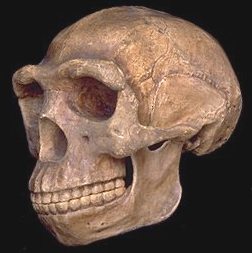
Arguments for microcephaly are outlined here and here. The female skull, from a skeleton known as LB1, was found on the island of Flores in Indonesia in 2003, together with the partial remains from seven other skeletons, all of them indicating a remarkable smallness of stature. LB1 is dated as 18,000 years old, with the other skeletons ranging from 38,000 to 13,000 years old. To compare, and to provide more pabulum, the Neanderthals died out 29,000 years ago [apart from the one living at Sarah's place]. An arm bone, 74,000 years old, has also been found.

There's clearly a difficulty with there being only one cranium. There's also no DNA, which degrades very quickly in tropical climates. Apparently there are political difficulties inhibiting further exploration of the site.

The trouble with the microcephaly argument is that microcephaly comes in all shapes and sizes, so to speak, so that just about any skull could be rationalized to fit into that category. As one critic pointed out, many new hominid finds have been described as pathological on first discovery. More investigation is clearly needed.

Labels:

pavlov's cat